What types of parts or industries benefit most from using semi-permanent mold casting for aluminum?
August 28, 2026
For manufacturers needing complex internal geometries, pressure containment, and precise dimensional control, semi-permanent mold casting offers a cost-effective alternative when high-pressure die casting is impractical. By combining precision metal molds with custom sand cores, this process produces medium- to large-sized aluminum components with superior mechanical integrity and surface finish. It is one of several reusable-mold configurations, each suited to different fill dynamics and geometry requirements. For more information, see What are the variations of permanent mold casting?
Procast’s end-to-end capabilities, from engineering and simulation through tooling, casting, machining, and quality assurance, ensure a seamless workflow and consistently high-quality results tailored to demanding industrial requirements.
Author: Wes Parker, President and CEO, ProCast Technologies Inc.
Key Takeaways
- Semi-permanent mold casting uniquely combines the repeatability and surface finish of permanent molds with the design flexibility of sand cores, making it ideal for medium-volume, complex aluminum components where internal geometry, pressure tightness, and dimensional precision are critical.
- Industries such as automotive, industrial machinery, fluid power, and power generation benefit most, leveraging semi-permanent mold casting for parts like manifolds, housings, valve bodies, and other components that demand both structural integrity and intricate internal features.
- Procast’s integrated, end-to-end capabilities, including in-house engineering, Solidification Analysis, tooling, sand core production, CNC machining, and comprehensive quality controls, ensure consistent, high-quality results for demanding industrial applications, with lower tooling costs and shorter lead times compared to high-pressure die casting.
Process overview: Aluminum semi-permanent molding vs. alternative foundry methods
Semi-permanent mold casting is a precision aluminum casting method that combines a reusable metal mold (typically steel) with expendable sand cores to produce complex, high-integrity aluminum components. Unlike high-pressure die casting, which uses fully reusable dies and suits high-volume runs, or traditional sand casting, which relies entirely on expendable molds and cores for each cycle, semi-permanent molding balances repeatability, cost, and geometric flexibility.
The metal cavity ensures excellent as-cast surface finish and dimensional tolerances, while sand cores enable intricate internal features and passages that permanent metal tooling alone cannot achieve. This process is especially effective for medium-volume production runs, where tooling costs must be controlled but part quality and consistency cannot be compromised.
By leveraging the strengths of both permanent and expendable mold technologies, semi-permanent molding delivers a unique value proposition for aluminum components that require both precise external surfaces and complex internal geometries. The process is particularly advantageous when pressure tightness, repeatability, and cost efficiency are essential, and when production volumes fall between the low quantities suited to sand casting and the high volumes required for die casting to be economical.
Comparing aluminum casting methods
Semi-permanent molding cannot match the ultra-high-volume efficiency of die casting. It also sits apart from shell mold casting products, which use a resin-bonded shell to achieve fine detail on smaller parts but cannot deliver the internal complexity a sand core provides inside a steel cavity. Semi-permanent molding enables a unique combination of repeatability, engineering flexibility, and cost efficiency for aluminum components with demanding internal geometries.
Industry adoption: Ideal part profiles and high-benefit sectors
What types of parts or industries benefit most from using semi-permanent mold casting for aluminum? Semi-permanent mold casting is ideally suited for aluminum components that require complex internal geometry formed by sand cores, medium- to large-part footprints, and production volumes of 500 to 50,000 pieces. This process is specified where pressure tightness, structural soundness, and repeatable dimensional accuracy are critical, making it the method of choice for parts such as intake manifolds, pump housings, valve bodies, gearbox housings, and enclosures with cored passages or pressure containment requirements.
What industries commonly use semi-permanent mold cast aluminum components? Semi-permanent mold casting is widely adopted across sectors where precision, repeatability, and design complexity are essential. Industries that commonly specify this process include automotive (for intake manifolds, cylinder heads, brackets, and housings), commercial vehicles, hydraulic and fluid power (for valve bodies and pump housings), industrial machinery (for structural mounts, gearbox housings, and enclosures), aerospace, defense, electrical and lighting, medical and laboratory equipment, and power generation.
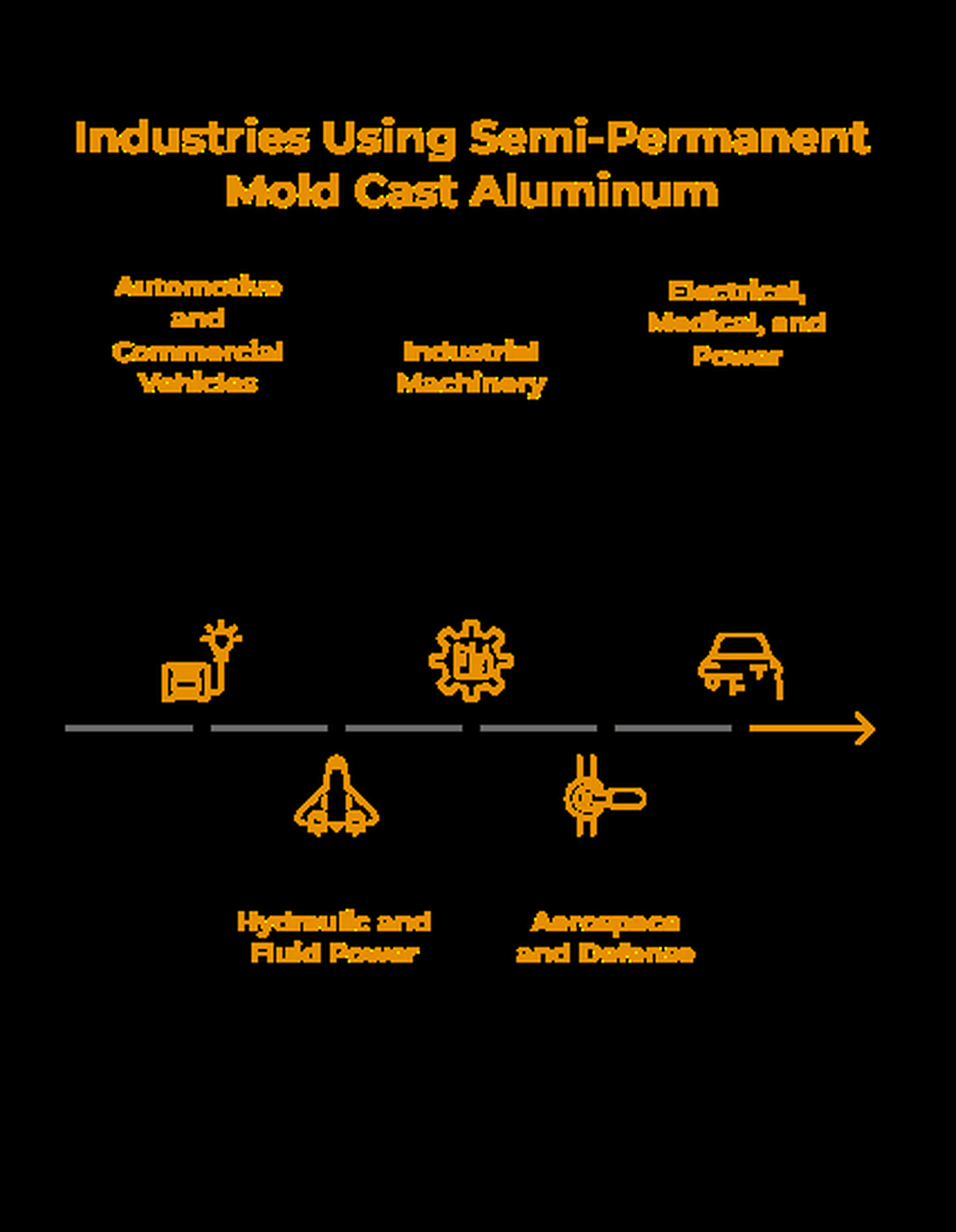
These industries often require industrial machine components and industrial machinery castings with intricate cored passages, tight dimensional tolerances, and enhanced mechanical properties, achieved through rapid, controlled solidification. Using sand cores within a permanent mold framework enables complex internal geometries otherwise unattainable in standard permanent mold or high-pressure die casting processes.
To further clarify, industries such as automotive, fluid power, industrial equipment, energy, and aerospace benefit most from semi-permanent mold casting for aluminum. Each of these sectors relies on the process to produce components where both internal complexity and external precision are non-negotiable. For example, automotive manufacturers use this process for intake manifolds and transmission housings that require pressure tightness and dimensional repeatability. Hydraulic system OEMs specify it for valve bodies and pump housings with intricate cored passages. Power generation equipment manufacturers depend on it for enclosures and heat exchangers that demand both structural integrity and engineered internal features.
Importantly, the lower tooling costs of semi-permanent mold casting compared to die casting make custom, complexity-driven designs feasible at medium volumes. This supports innovation and cost efficiency in sectors where industrial machine components must meet stringent engineering requirements. It also makes semi-permanent mold casting a preferred choice for OEMs and suppliers seeking to optimize performance and total project cost without compromising quality or lead time.
For further discussion on how tooling decisions shape project timelines and cost, see What factors most influence the overall cost of semi-permanent mold casting for aluminum parts?
Partner selection: evaluating an aluminum casting supplier
Selecting the right aluminum casting manufacturer for custom industrial machine components requires a structured evaluation of technical capabilities and quality controls. Procurement and engineering teams should use the following checklist:
- Quality system certification: confirm ISO 9001:2015 certification and documented quality control procedures.
- In-house engineering and simulation: look for providers offering Solidification Analysis, CAD support, and casting process simulation to optimize part design and minimize defects.
- Tooling and core production capability: assess whether the supplier has an integrated Tool & Die department and in-house sand core production for full control over custom molds and tooling.
- Machining and inspection scope: ensure the ability to provide CNC machining, CMM inspection, and comprehensive dimensional verification.
- Pressure testing: for leak-tight or pressure-containing components, verify the availability of air decay and underwater pressure testing to at least 150 psi.
- Single-source accountability: prioritize suppliers who offer turnkey aluminum castings from engineering through assembly, reducing handoffs and maintaining tolerance and responsibility throughout the process.
Procast delivers single-source, end-to-end solutions for aluminum components and industrial machine components, including in-house engineering and Solidification Analysis, integrated Tool & Die, sand core production, CNC machining, ISO 9001:2015-certified quality, CMM inspection, and air decay and underwater pressure testing up to 150 psi, supporting production runs from 500 to 50,000 pieces.
How can I evaluate the quality and reliability of an aluminum casting manufacturer for custom projects? A reliable partner demonstrates traceable quality certifications, in-house simulation and tooling expertise, comprehensive inspection and testing capabilities, and the ability to manage the entire process under one roof to ensure consistent outcomes for demanding industrial applications. At Procast, we offer linear tolerances of 0.005” (and 0.010”-0.015” across parting lines), a preferred minimum wall thickness of 0.188”, and a 3-degree draft angle (sometimes 2°, depending on the part) for optimal part release.
Supply chain: regional sourcing versus overseas suppliers
When choosing between domestic/regional and overseas aluminum casting suppliers for industrial machinery castings, several supply chain factors must be considered:
- Tooling and sampling lead time: regional suppliers typically offer shorter lead times for tooling development, sampling, and design iteration, reducing the risk of project delays.
- Engineering collaboration: proximity enables real-time collaboration during design, simulation, and prototyping, streamlining issue resolution and accelerating product launch.
- Freight and inventory costs: sourcing locally reduces freight costs, streamlines logistics, and supports agile inventory management, crucial for medium-volume production.
- Supply chain resilience: domestic suppliers are less exposed to international shipping disruptions, tariffs, and regulatory changes, supporting more predictable delivery schedules and risk mitigation.
- Quality accountability: partnering with a regional supplier who operates within established standards and documentation frameworks streamlines quality audits and contractual oversight, an essential advantage for complex industrial machinery castings where traceability and regulatory compliance are paramount.
Are there any regional advantages to working with local aluminum casting companies versus global suppliers? Yes. Regional partnerships provide more agile communication, faster engineering feedback loops, reduced shipping and inventory costs, and greater transparency in quality management. While overseas suppliers may offer lower unit prices, these savings are often offset by longer lead times, higher minimum order quantities, and increased supply-chain risk — factors that can significantly impact the total cost and reliability of sourcing industrial machinery castings for demanding applications.
Conclusion
Semi-permanent mold casting stands out as the optimal solution for industries and applications where complex internal geometries, pressure tightness, and dimensional precision are non-negotiable, delivering repeatable, high-quality aluminum components at medium volumes with significant cost efficiency. By integrating advanced engineering, simulation, tooling, and quality control under one roof, Procast ensures that our manufacturing partners benefit from a seamless, turnkey process that meets the most demanding specifications.
If your next project requires intricate internal features, robust mechanical properties, and a partner committed to on-time, high-quality delivery, connect with Procast’s engineering team today. Expect a vertically integrated experience from design simulation to CNC machining, with typical lead times to the sample stage of just 10-12 weeks and ongoing production at 4-6 weeks. Contact us now to start your project consultation.