What are the variations of permanent mold casting?
August 28, 2026
Permanent mold casting splits into different configurations: gravity, low-pressure, tilt pour, and semi-permanent. Each is defined by how molten metal enters the cavity and how the part’s internal geometry is created. That choice then governs fill dynamics, metallurgical soundness, tooling expenditure, and lead time well before a single casting is poured.
The topics below classify these variations by process physics and metallurgy; for the foundational treatment of the parent process, see our guide to Semi-Permanent Mold Casting.
Author: Wes Parker, President and CEO, ProCast Technologies Inc.
Key takeaways
- Permanent mold casting resolves into different working configurations: gravity, low-pressure, tilt pour, and semi-permanent, separated chiefly by fill velocity and by whether internal geometry is formed in reusable steel or in an expendable sand core.
- Compared with sand, die, and investment casting, reusable metal molds occupy their own niche: rapid heat extraction yields finer microstructure and pressure-tight density at medium volumes, with tooling costing roughly one-tenth of die-casting dies.
- Aluminum alloys and zinc alloys dominate the process because their fluidity, hot-tear resistance, and controlled shrinkage match the thermal behavior of a metal mold.
Process classifications: Variations of reusable mold metallurgy
What are the variations of permanent mold casting? Permanent mold casting encompasses four principal configurations: gravity, low-pressure, tilt pour, and semi-permanent. They are best distinguished along two axes: the velocity and motive force with which liquid metal fills the die, and whether the internal geometry is defined by reusable steel or by a consumable sand core. Every downstream difference in surface condition, density, and unit economics is a consequence of those two variables.
Classifying the different types of permanent mold casting
The defining physics is thermal. A steel or ductile-iron die extracts heat from the solidifying melt an order of magnitude faster than sand molds, imposing a steep thermal gradient that refines secondary dendrite arm spacing and, with it, tensile strength and fatigue resistance (Totten & MacKenzie, Handbook of Aluminum, Vol. 1). That rapid, directional freezing is the reason reusable molds routinely deliver higher mechanical properties than sand equivalents cast from the same alloy. The honest answer sorts them by fill mechanism:
Gravity permanent mold casting relies on the metallostatic head alone; the melt descends through a runner and gating system that regulates flow into the cavity, making it the most direct and widely deployed variant. This method is ideal for medium-volume production that requires cost-effective tooling and high repeatability.
Low-pressure permanent mold casting inverts that logic: the die is sealed over a pressurized furnace, and a modest differential of about 5 psi drives metal upward into the cavity from below, filling slowly and with minimal turbulence. It is a comparatively complex, capital-intensive arrangement historically associated with high-volume automotive work such as road wheels, but is increasingly leveraged in industrial applications requiring superior metallurgical integrity and minimal oxide inclusions.
Tilt pour begins with the die and pour cup nearly horizontal and rotates the assembly during filling. Thus, the metal advances as a coherent front rather than a plunging stream, a low-velocity regime that suppresses oxide entrainment and supports directional solidification. This configuration is especially effective for castings with complex geometries and thin walls, where controlled fill and minimized turbulence are critical.
Semi-permanent mold casting is the hybrid case: the external form is cast in a permanent steel mold, while a bonded sand core produces internal passages, undercuts, and negative-draft features that a reusable core could never withdraw from. After which, the core is simply vibrated out, a hybrid of sand and permanent mold casting. This approach is essential for parts that require intricate internal features that conventional steel cores cannot form.
While vacuum permanent mold casting is a specialized variant, gravity, tilt, low-pressure, and semi-permanent remain the dominant configurations for industrial aluminum and zinc castings.
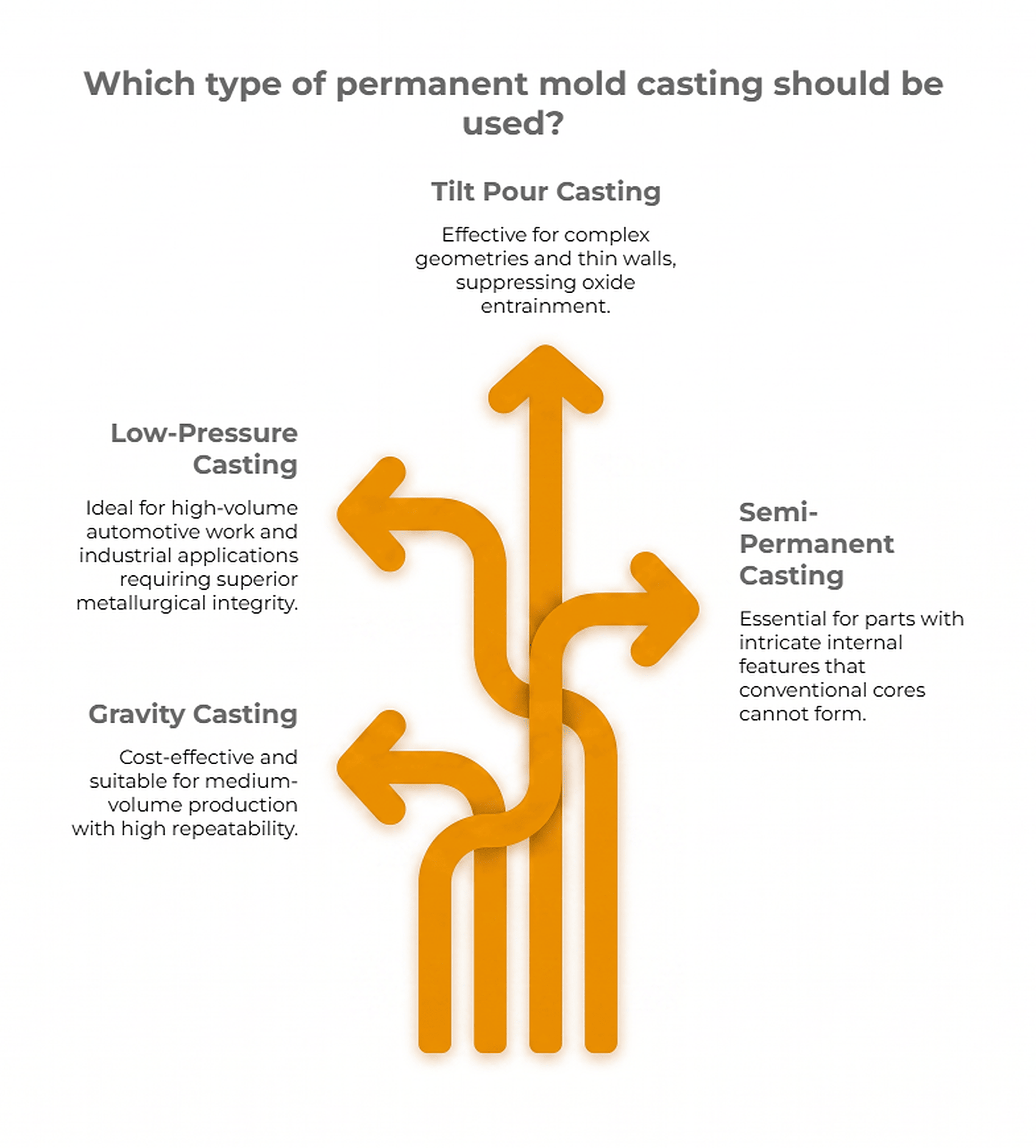
Read against the two axes, gravity and tilt differ mainly in fill velocity and control; both use runner-and-gate systems, but tilt substitutes a programmed rotational fill for the free-fall of a static pour, while the semi-permanent layout is distinguished by core construction rather than pour dynamics.
Because pour configuration drives much of the metallurgical control, see Tilt pour casting process for a detailed treatment. For a deeper look at sand-core challenges specific to semi-permanent work, see What are the main challenges or limitations associated with using sand cores in semi-permanent mold casting?
Mechanics of the permanent mold casting process
When evaluating aluminum and zinc casting solutions, engineers and procurement leaders often ask what the different types of permanent mold casting are. These questions are not only foundational; they directly inform process selection, part quality, and cost structure. Understanding the mechanics of permanent mold casting clarifies why these process variations exist and how each impacts the final product.
Reduced to its mechanical cycle, the permanent mold casting process is a tightly sequenced loop engineered for repeatability:
- Mold preheating brings the die to a working temperature, often several hundred degrees Celsius, so the first castings solidify under the same thermal conditions as the thousandth, ensuring consistency in microstructure and mechanical properties.
- Coating application deposits refractory and insulating washes that control local heat transfer, protect the tool face, and aid release; boron-nitride coats are typical in low-draft regions and pour cups, directly impacting surface roughness and dimensional tolerances.
- Core insertion sets the sand core into the open die in semi-permanent mold casting, locating the internal geometry before the cavity closes. This step is critical for achieving complex internal passages and undercuts that would otherwise be impossible with reusable steel cores.
- Pouring introduces the melt under the configuration’s chosen regime — static gravity, tilt, or low-pressure rise — each influencing fill velocity, turbulence, and the likelihood of defects such as oxide inclusions or porosity.
- Solidification proceeds directionally as the steel draws heat outward, the interval during which grain structure and soundness are effectively fixed. Rapid, controlled solidification gives permanent mold castings enhanced mechanical properties over sand castings.
- Part ejection opens the die and removes the casting; then semi-permanent mold casting parts move to shakeout, where controlled vibration reverts the bonded core to loose sand that falls free of the internal passages.
On a modern semi-permanent mold casting machine, the cycle runs under closed-loop control: a computer-directed pour repeats the same fill trajectory, tilt rate, and timing on every shot, so grain structure and surface condition converge rather than drift across a run. Castings are then degated, inspected, heat treated, and routed to finish machining.
That handoff is where dimensional strategy is decided. As-cast linear tolerances generally fall within roughly 5/1000” on parting lines and 10-15/1000” for cross parting lines. Features formed entirely within the reusable steel hold the tightest bands; features across the parting line or defined by a sand core hold looser ones, since core placement and thermal movement add variability. Stein and Sanders documented this pattern for the American Foundry Society.
When a print demands tighter tolerances, CNC machining closes the gap. The mold sets the near-net form economically, machining reserves precision for features like bearing bores and sealing faces, and CMM inspection verifies the result.
Comparative matrix: Global foundry methodologies
This section classifies the four casting families at a definitional level: what each process is and where its operating envelope sits. Detailed Ra values, tolerance tables, and mechanical-property comparisons belong to the comparison articles elsewhere in this network. Here, we remain at classification depth to clarify the macro-differences that drive process selection.
What are the four types of casting? In the context of industrial aluminum and zinc components, the four principal casting families are:
- Sand casting: the most established and flexible process, forming each mold from bonded silica or synthetic sand packed around a pattern. It supports virtually unlimited geometry and part size, including large, complex components and low-volume runs. However, the thermal properties of sand result in slower solidification, coarser grain structure, and broader as-cast tolerances (typically ±0.030 in. or wider for the first inch). Tooling is inexpensive and rapidly produced, but dimensional repeatability and surface finish are the least precise among the four families.
- Die casting: this high-pressure process injects molten metal into hardened steel dies at velocities and pressures orders of magnitude above gravity or low-pressure methods. It delivers the tightest as-cast tolerances (often ±0.002–0.005 in.), the finest surface finishes, and the fastest cycle times at ultra-high volumes. The trade-off is extreme tooling cost (often 10x that of permanent mold tooling), limited alloy selection, and higher porosity due to entrained gases.
- Investment casting: also known as lost-wax casting, it forms a ceramic shell around a wax pattern, which is then melted out before pouring. This method supports exceptionally intricate geometries, thin walls, and fine surface detail, with as-cast tolerances between those of sand and die casting (typically ±0.005–0.010 in.). Tooling cost is moderate, but cycle times are longer and part size is limited.
- Permanent mold casting: uses reusable steel or iron dies to rapidly extract heat, yielding finer microstructure, improved mechanical strength, and pressure-tight density. Tooling cost sits between sand and die casting (roughly one-tenth of die-cast dies), with as-cast tolerances tighter than sand but not as fine as die casting (±0.010–0.015 in. typical). The process is ideal for medium-volume runs (500–50,000 pieces).
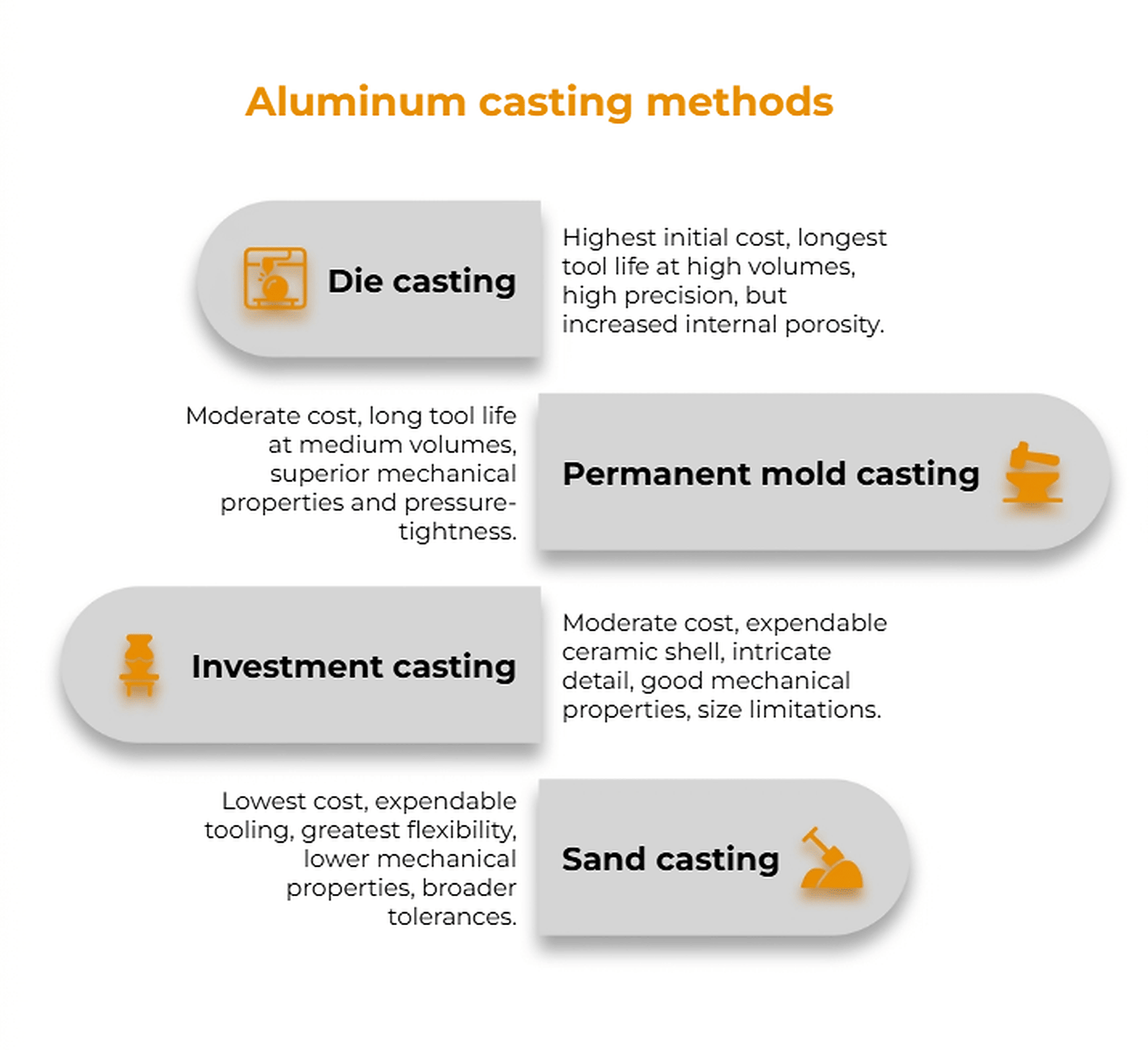
What are the main differences between the various aluminum casting methods, like die casting and sand casting? The core distinctions are:
- Dimensional precision: die casting > permanent mold casting > investment casting > sand casting.
- Tooling wear and cost: die casting (highest initial cost, longest tool life at high volumes), permanent mold casting (moderate cost, long tool life at medium volumes), investment casting (moderate cost, expendable ceramic shell), sand casting (lowest cost, expendable tooling).
- Metallurgical integrity: permanent mold casting delivers superior mechanical properties and pressure-tightness compared to sand and die casting due to rapid, directional solidification and reduced porosity. Die casting achieves high precision but often at the cost of increased internal porosity. Sand casting offers the greatest flexibility but with lower mechanical properties and broader tolerances. Investment casting provides intricate detail and good mechanical properties but at a higher per-part cost and with size limitations.
When evaluating sand casting vs die casting vs investment casting, and the permanent mold casting process, buyers must weigh the operational boundaries of each: sand casting for flexibility and size, die casting for precision and volume, investment casting for complexity, and permanent mold casting for a blend of mechanical performance, repeatability, and medium-volume economics.
Market analysis: Commercial and financial viability
Industry deployment and eligible high-spec applications
The adoption of reusable mold technologies, including gravity permanent mold casting and semi-permanent mold casting, is driven by sectors where pressure tightness, structural density, and repeatable dimensional accuracy are non-negotiable. These process-driven advantages make semi-permanent mold casting the preferred solution for parts subjected to internal pressure, cyclical mechanical loading, or demanding leak-path requirements.
Typical applications include housings, hydraulic components, pump bodies, valve bodies, transmission cases, compressor pistons, and manifold blocks, where the combination of pressure-tight density and fine microstructure is essential for both performance and longevity. The semi-permanent mold casting process is also favored where medium-volume production (500 to 50,000 pieces) aligns with the economics of reusable tooling.
Which industries or applications are best suited for permanent mold casting compared to die casting? The answer is rooted in process physics: permanent mold casting outperforms alternatives for components requiring superior mechanical properties, pressure integrity, and medium-volume economics, particularly where part geometry benefits from hybridizing permanent and sand-core techniques. While die casting excels at ultra-high volumes, its higher porosity and tooling cost profile make it less suitable for applications demanding leak-tightness and frequent engineering changes.
Capital expenditures: Tooling amortization and lead times
Permanent mold casting has a clear advantage in medium-volume production. Permanent mold tooling typically costs roughly one-tenth as much as die casting dies, with mold development cycles measured in weeks rather than months. This cost differential is amplified by permanent molds’ lower maintenance needs and longer service life at moderate production volumes.
For procurement leaders, the break-even point between permanent mold and die casting depends on unit volume, part complexity, and the frequency of engineering revisions. Permanent mold casting delivers optimal ROI where annual production volumes justify the capital outlay for reusable tooling, but do not warrant the extreme investment in high-pressure die-cast dies.
Are there significant differences in tooling costs or lead times for permanent mold casting and die casting? Yes. The permanent mold casting process offers a much lower barrier to entry for tooling investment, with lead times and amortization schedules that support agile product launches and iterative engineering. Tooling for gravity permanent mold casting, in particular, is less expensive than for die casting and offers greater flexibility for design changes and shorter lead times.
Material constraints and technical specifications
Tolerance standards and geometric capabilities
Core type, resin content, and position relative to the parting line each independently affect the shrink factors used to size tooling, which explains why tolerance and core decisions are made concurrently (Stein & Sanders, International Journal of Metalcasting, 2022). In semi-permanent mold casting, the sand core that enables complex internal geometry is the same feature that widens the band, and a semi-permanent mold casting machine sets and extracts that core on every cycle.
What materials are most commonly used with semi-permanent mold casting? The most commonly used materials are cast aluminum alloys, particularly the 3xx.x series (notably A356 and 319) and 4xx.x series (such as B413), as well as zinc alloys like ZA-12. These alloys are chosen for their high fluidity, resistance to hot tearing, and predictable shrinkage during solidification, critical for achieving pressure-tight, structurally dense castings in both reusable and sand-cored configurations.
Critical features, such as bearing bores, sealing faces, and mounting datums, are routinely finished by downstream CNC machining, achieving tolerances in the single-thousandth range and surface finishes suitable for pressure-tight or mating surfaces. This hybrid approach leverages the efficiency of near-net shaping from the permanent mold casting process while reserving high-precision finishing for features that demand it, all verified by CMM inspection before shipment.
What are the tolerances for permanent mold casting? As-cast tolerances are 5/1000” on parting line and 10-15/1000” for cross parting lines, widening with size and with sand-cored features. Machining closes the gap on print-critical dimensions.
Metallurgy and material suitability in semi-permanent configurations
The semi-permanent mold casting process is optimized for alloys exhibiting high fluidity, resistance to hot tearing, and predictable shrinkage during solidification. Due to these properties, their physical behavior during the permanent mold casting process aligns with the rapid, directional cooling imposed by the steel die.
Alloy development for these processes has focused on castability and heat-treatment response rather than melt cost alone (Major & Hartlieb, 2009). Sand cores in semi-permanent mold casting machines further expand design flexibility, supporting intricate internal geometries while maintaining the mechanical advantages of permanent molding. Permanent mold casting can also accommodate magnesium and copper alloys.
Risk assessment: Disadvantages and mitigation protocols
Every casting process carries inherent disadvantages, and permanent mold casting is no exception. Upfront tooling costs, minimum draft-angle requirements, geometry limitations (particularly for undercuts and negative draft), and restrictions on high-melting-point alloys present real constraints. The necessity for parting lines and the challenge of extracting complex cores can limit design freedom compared to sand or investment casting. Additionally, the process is not suitable for very large castings or those requiring extreme section thickness variation.
What are the disadvantages of the casting process? The primary disadvantages are:
- Higher initial tooling cost compared to sand casting
- Draft angle and geometry limitations due to mold release requirements
- Incompatibility with high-melting-point alloys (e.g., steels, bronzes)
- Constraints on part size and wall thickness variation
These challenges are particularly relevant when evaluating both semi-permanent mold casting and the permanent mold casting process. In semi-permanent mold casting, the use of expendable sand cores introduces additional variables in dimensional tolerance and core extraction, while the permanent mold casting process as a whole is limited by the thermal and mechanical properties of the reusable mold material. Understanding these limitations is essential for effective process selection and risk management in industrial applications.
Mitigation protocols are rooted in advanced engineering: predictive solidification simulation and early design optimization compress development cycles, reduce the risk of internal defects, and ensure that parts meet both performance and cost objectives. In-house simulation tools such as Solidification Analysis, coupled with integrated engineering and tooling design, allow for rapid iteration and defect prevention before physical tooling is commissioned.
This approach supports a deterministic, data-driven path from concept to finished part, minimizing risk and maximizing yield throughout the permanent mold casting process, and specifically when applying semi-permanent mold casting techniques for complex internal geometries.
Final Thoughts
Permanent mold casting, in its gravity, low-pressure, tilt pour, and semi-permanent configurations, offers unmatched precision, repeatability, and value for medium-volume industrial applications demanding high mechanical integrity and pressure-tightness. Procast’s integrated engineering, simulation, and in-house tooling capabilities ensure your casting projects achieve optimal results, on time and on spec.
Contact our engineering team today to discuss how our turnkey aluminum and zinc casting solutions can accelerate your next product launch and solve your most demanding manufacturing challenges.