What factors most influence the overall cost of semi-permanent mold casting for aluminum parts?
August 28, 2026
Semi-permanent mold casting for aluminum sits at the intersection of expendable sand casting and fully permanent metal mold processes, offering a unique value proposition for medium-volume industrial production. The process uses a reusable metal mold to form the casting’s external shape, while sand cores are inserted as needed to create internal features or undercuts. This hybrid approach delivers superior aluminum casting tolerances and repeatability compared to sand casting, while avoiding the prohibitive tooling cost associated with high-volume die casting.
Understanding the drivers behind total cost, return on investment, how per-part price accumulates, and which technical decisions move the final quote is essential for business decision-makers evaluating casting solutions. For the parent process and how its configurations differ, see What are the variations of permanent mold casting?
Author: Wes Parker, President and CEO, ProCast Technologies Inc.
Key Takeaways
- Tooling investment and amortization: the up-front cost of permanent mold tooling is a primary driver, but its impact per part decreases significantly as production volume increases. Semi-permanent mold casting offers roughly one-tenth the tooling cost of die casting, making it ideal for medium-volume applications (500–50,000 pcs).
- Part complexity and engineering requirements: features such as intricate geometries, multiple or complex sand cores, and tight dimensional tolerances increase both tooling and recurring costs. Early engineering intervention, including Solidification Analysis and simulation, can optimize designs, reduce defects, and control costs.
- Downstream processing and quality demands: additional requirements such as CNC machining, pressure testing (air decay/underwater up to 150 psi), and advanced inspection (CMM, ISO 9001:2015) add to the total cost of ownership but are essential for applications demanding precision and reliability.
Production mechanics and engineering foundations
Semi-permanent mold casting uses a durable metal mold for the primary part geometry, supplemented by expendable sand cores to form internal cavities or complex features. This process bridges the gap between sand casting (fully expendable, low tooling cost, lower dimensional precision) and die casting (fully permanent, high tooling cost, high precision), making it optimal for production runs where neither alternative is cost-effective. The aluminum casting process flow is as follows:
- Mold preparation: the permanent mold is preheated, coated with a refractory wash for surface control, and inspected. This step ensures consistent heat transfer and surface quality, directly impacting aluminum casting tolerances.
- Core setting: in-house produced sand cores are inserted for features not producible with the mold alone.
- Pour: molten aluminum or zinc is introduced using tilt-pour or static-pour techniques, depending on part geometry and feeding requirements. The method choice affects yield, gating complexity, and subsequent trimming requirements.
- Controlled solidification: the metal cools rapidly and directionally within the mold, refining grain structure for enhanced mechanical properties. This is a key differentiator from sand casting and drives both cycle time and final part quality.
- Ejection: once solidified, the casting is ejected from the mold, requiring careful handling to maintain dimensional accuracy.
- Core knockout: sand cores are broken out and removed, with labor scaling according to part complexity.
- Trim: gates, runners, and flash are removed, and excess metal is recycled. Finishing labor is added at this stage.
Employing the best aluminum casting molds throughout the process not only improves surface finish and dimensional tolerances but also reduces the risk of casting defects, contributing to lower scrap rates and more predictable production outcomes.
For a comprehensive look at each process step, see Semi permanent mold casting process.
Where the tooling investment pays back
The economic logic of semi-permanent mold casting hinges on amortizing a one-time tooling cost — the permanent mold itself — over the production volume. Unlike sand casting, where each mold is destroyed after use, or die casting, where tooling costs are much higher, permanent mold tooling typically costs about one-tenth as much as a comparable die casting tool. This makes the process ideal for medium-volume runs, typically in the 500 to 50,000 piece range, where tooling investment can be recovered within the program’s life.
How tooling amortization works: divide the total tooling cost by the number of parts expected to be produced. For example, a $30,000 mold amortized over 500 pieces adds $60 per part; over 30,000 pieces, only $1 per part. Annual volume is the primary lever for payback: the more parts you produce, the faster you absorb the fixed tooling cost, lowering the effective cost per casting.
What types of products or industries are best suited for permanent mold casting despite its higher upfront cost?
Product types that justify the investment in semi-permanent mold tooling require precise, repeatable geometry, enhanced mechanical properties, or complex internal features that sand casting cannot reliably deliver. This includes structural housings, manifolds, mounting brackets, valve blocks, and enclosures — components where dimensional precision and mechanical soundness are critical, particularly when parts must mate with machined assemblies or function under pressure.
Common sectors include industrial automation, fluid handling, electrical equipment, and commercial machinery. The key decision points are that the application demands medium volume and higher quality than sand casting can provide, but does not justify the high cost of die-casting tooling.
What are the common uses of cast aluminum?
Cast aluminum is widely used for structural and commercial components such as:
- Housings: protecting sensitive electronics or mechanical assemblies, where precise fit and surface quality matter.
- Manifolds: distributing fluids or gases within industrial systems, requiring consistent aluminum casting tolerances to maintain leak-tight performance and dimensional integrity.
- Mounting brackets: supporting assemblies in machinery or equipment, where repeatable geometry and robust mechanical properties are critical for long-term reliability.
- Valve blocks: integrating fluid control in hydraulic or pneumatic systems, demanding high-quality cast surfaces and tight tolerances to ensure proper sealing and function.
- Structural enclosures: providing rigid, lightweight protection for critical assemblies, with uniform wall thickness and excellent dimensional repeatability.
Dimensional precision is essential in these applications, especially where cast parts interface with machined components or require leak-tight seals. Advanced mold technology and process control deliver high-quality, repeatable parts that support a wide range of industrial and commercial applications.
Cost drivers and financial optimization
The variables that move the final quote
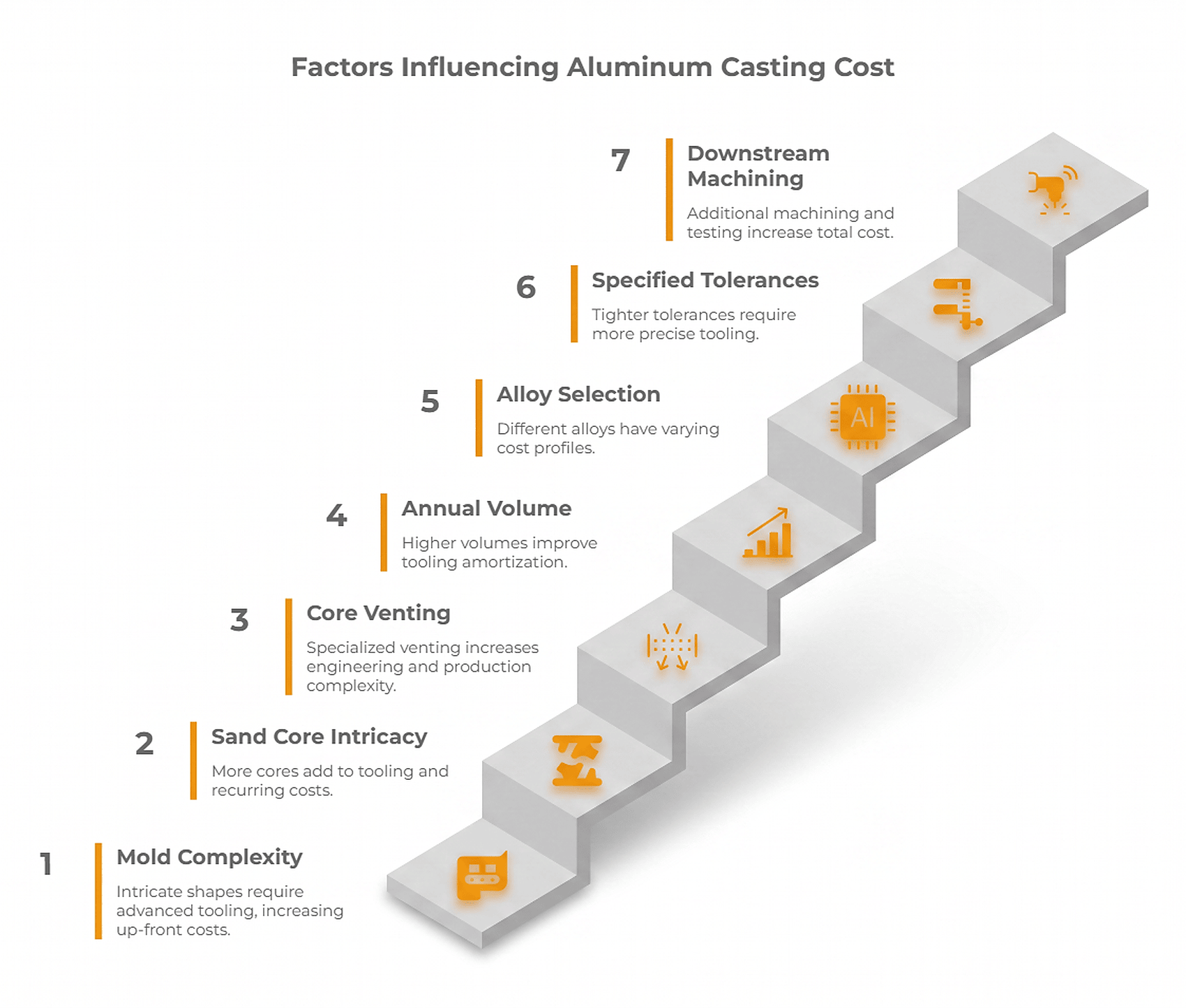
When evaluating semi-permanent mold casting for aluminum components, business decision-makers often ask how much mold casting costs and what factors most influence the overall cost. A range of technical and commercial variables shape the answers and directly affect both initial investment and ongoing per-part expenses:
- Mold geometric complexity: more intricate shapes require more advanced tooling design and fabrication, increasing up-front costs.
- Number and intricacy of sand cores: each additional core adds to both tooling and recurring per-part costs, especially if complex venting or handling is required.
- Core venting requirements: critical for avoiding casting defects, specialized venting increases engineering and production complexity.
- Annual and per-release volume: higher volumes improve tooling amortization, while lower volumes increase per-part burden.
- Alloy selection: different aluminum and zinc alloys have varying melt temperatures, handling requirements, and cost profiles.
- Specified tolerances: tighter aluminum casting tolerances require more precise tooling, process control, and inspection.
- Downstream machining and testing scope: additional CNC machining, pressure testing (air decay or underwater up to 150 psi), and CMM inspection increase the total cost of ownership but may be required for critical applications.
The core-related items on that list are not independent line items. Core type, resin content, and knock-out timing each independently influence the shrink factors used to size tooling, alongside section thickness and position relative to the parting line. For this reason, tolerance and core decisions appear on the quote together. (Stein et al., International Journal of Metalcasting, 2022. Source)
Early engineering intervention is a key cost-control lever. Solidification Analysis and casting simulation allow design flaws to be identified and corrected digitally, before tooling is cut or production begins. This eliminates costly rework cycles and scrap, improving yield and reducing both schedule risk and per-part cost.
Procast’s integrated capabilities, comprising in-house engineering and simulation, Tool & Die department, sand core production, CNC machining, ISO 9001:2015-certified quality, CMM inspection, and pressure testing, provide a single-source solution from 500 to 50,000 pieces, enabling predictable cost and quality outcomes.
How much does mold casting cost?
The cost structure for semi-permanent mold casting is composed of two main categories:
- One-time tooling cost: this includes engineering and design (CAD, simulation, re-engineering), permanent mold fabrication, and core tooling. Permanent mold tooling is a fixed investment, typically about one-tenth the cost of die casting tooling, and is amortized over the production run.
- Recurring per-part cost: this includes alloy material, melt energy, cycle time, sand core consumption, labor for core setting and knockout, and finishing operations such as trimming, CNC machining, and inspection. Part complexity, volume, and quality requirements drive each of these elements.
Unlike sand casting, the mold’s reusability offsets the upfront investment with lower per-part costs as volume increases. Conversely, compared to die casting, the lower tooling cost makes semi-permanent mold casting financially viable at medium volumes, where die casting would not amortize and sand casting cannot deliver the required quality.
Conclusion
The total cost of semi-permanent mold casting for aluminum parts depends on the balance between initial tooling investment and ongoing per-part expenses. This process is ideally aligned with medium-volume production where the value of precision, enhanced mechanical properties, and repeatability outweighs the limitations of sand casting.
By thoroughly understanding the aluminum casting process flow, pinpointing cost drivers, and utilizing early-stage engineering simulation, business decision-makers can achieve predictable cost structures, mitigate risk, and ensure superior quality. Ultimately, optimal results come from strategically matching annual volume, part complexity, and quality requirements to the distinct economic advantages of semi-permanent mold casting.
If you are ready to explore how integrated engineering, advanced simulation, and a medium-volume focus can deliver superior castings and measurable ROI for your next project, connect with Procast’s technical team today for a confidential consultation and process review.