How does the quality of parts produced by semi-permanent mold casting compare to those made with traditional sand casting?
August 28, 2026
A sand-cast aluminum component rejected for low density or marginal tensile numbers reveals a fundamental truth: the culprit is rarely the alloy specification; rather, it is the boundary that shaped the metal as it froze. In short, the mold medium governs how quickly heat exits the melt, and that single variable cascades into grain structure, soundness, and mechanical performance.
For foundational context, consult our pillar guide to Semi-Permanent Mold Casting, then use the sections below to weigh structural integrity against tooling economics.
Author: Wes Parker, President and CEO, ProCast Technologies Inc.
Key takeaways
- Sand’s insulating, moisture-bearing aggregate produces a coarser grain structure and a much higher tendency toward shrinkage porosity, while a reusable steel cavity extracts heat fast enough to refine dendrite arm spacing and starve shrinkage voids of the isolated liquid pockets they need to form.
- The semi-permanent configuration takes both: a steel outer cavity holds tighter external dimensions and a smoother as-cast skin, while expendable sand cores form the undercuts, negative draft, and internal passages a rigid core could never withdraw from.
- Semi-permanent tooling costs more than sand and a fraction of die casting, a premium repaid through part-to-part consistency and reduced machining stock as run quantities climb into medium volumes.
Process Mechanics: Reusable Molds vs. Expandable Sand Boundaries
A reusable metal cavity conducts heat away from the solidifying melt far faster than bonded sand, driving rapid directional solidification, finer secondary dendrite arm spacing, and a denser grain structure; whereas an expendable sand aggregate insulates the melt, slowing the freeze and coarsening the microstructure. That thermal contrast is the mechanistic core of the entire comparison.
Across the full spectrum of aluminum casting types and applications, from low-stress brackets to pressure-containing housings, the boundary that shapes the melt is the most consequential process variable of all. In the semi-permanent variant of the aluminum casting process, a reusable steel cavity forms the exterior while a bonded, shakeable sand core forms internal features, capturing the higher freezing rate of permanent mold on the outside and the geometric freedom of sand on the inside.
Traditional sand casting surrenders that chill entirely: the aggregate behaves as a thermal blanket, extending local solidification time and permitting grain coarsening throughout the section.
Metallurgical Integrity: Structural Soundness and Defect Proclivity
Parts poured in a semi-permanent mold consistently exhibit higher tensile and yield strength, greater density, and lower shrinkage porosity than their sand-cast counterparts, because the steel cavity’s higher freezing rate produces a finer, more uniform microstructure. The same rapid, directional solidification that refines the grain also starves shrinkage voids of the isolated, last-to-freeze liquid pockets they require to nucleate.
This is the crux of how semi-permanent mold quality compares to traditional sand casting: the outcome is metallurgical, set the moment heat begins to leave the metal. For a broader discussion of defect prevention and quality control, see our insights on defect prevention and quality.
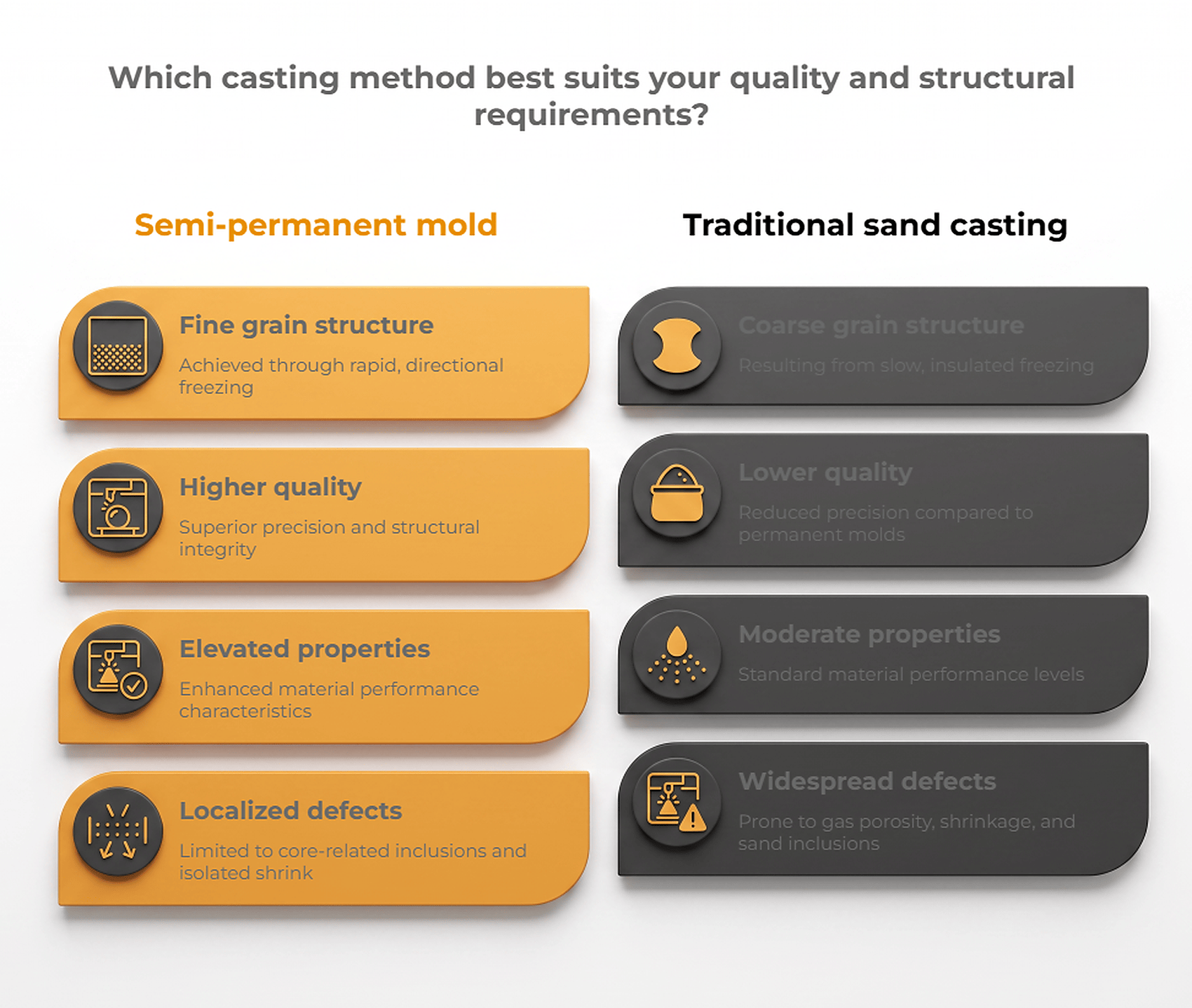
To discuss the types and causes of casting defects with precision, group them by mechanism: gas porosity from dissolved hydrogen, shrinkage porosity from inadequate feeding of the last-to-freeze region, non-metallic inclusions, and hot tears from restrained contraction. The mold medium directly governs the thermally driven subset, shrinkage and grain-coarsening, while leaving hydrogen management to melt practice. In the semi-permanent process, the residual risk is not bulk porosity but the sand core itself, where a fractured core or dislodged particles can become an embedded inclusion.
Why does sand casting not give a very high quality finish? Because the as-cast skin is a negative impression of a granular medium: the mold wall transfers its own texture to the surface, and residual moisture in a green-sand aggregate reacts with molten aluminum to roughen and pit that skin further. The quantitative Ra values and tolerance bands behind that difference are treated in How does the surface finish and dimensional accuracy of semi-permanent mold castings compare to those made with sand casting or die casting?.
Among the broader catalog of aluminum casting defects, only the thermally governed modes shift decisively with the mold; porosity acceptance criteria and in-service fatigue behavior are covered in How does the quality or durability of aluminum parts from semi-permanent mold casting compare to other methods like sand or die casting?
Design Constraints and Tooling Economics
Can complex internal geometries and thin walls be produced with semi-permanent mold casting? Yes. Expendable sand cores form undercuts, negative-draft passages, and internal cavities that a rigid steel core could never withdraw from, while the steel outer cavity simultaneously holds tighter external dimensions. Sand cores allow negative draft and complex internal geometries that can be shaken out after casting, while the steel mold delivers a smoother, tighter exterior.
How do the tooling costs for semi-permanent mold casting compare with those for sand casting and die casting? Sand tooling is cheapest per set but is consumed and rebuilt each cycle. Hardened die-casting dies are by far the most expensive. A semi-permanent metal mold sits between them, at roughly one-tenth the tooling outlay of pressure die casting.
The premium over sand tooling pays for itself as quantities climb. Each part arrives closer to final dimension and closer to the previous one, which cuts machining stock and scrap. That is why the semi-permanent aluminum casting process is economically strongest between roughly 500 and 50,000 pieces.
A single-source operation such as Procast concentrates this advantage by folding in-house the engineering and Solidification Analysis, an integrated Tool & Die department, and sand core production upstream of CNC machining, then validating soundness under an ISO 9001:2015 quality system with CMM inspection, air decay, and underwater pressure testing to 150 psi. See What are the main steps involved in the semi-permanent mold casting process, and how long does it typically take?
If a sand-cast part fails on density or strength rather than finish, the remedy is usually the mold medium, not the alloy. The difference in part quality between semi-permanent and sand casting depends on how the metal freezes.
We can review an existing sand-cast component and model what changes when the identical geometry is run in a semi-permanent mold. Send us your drawing and defect data to see the projected gain.