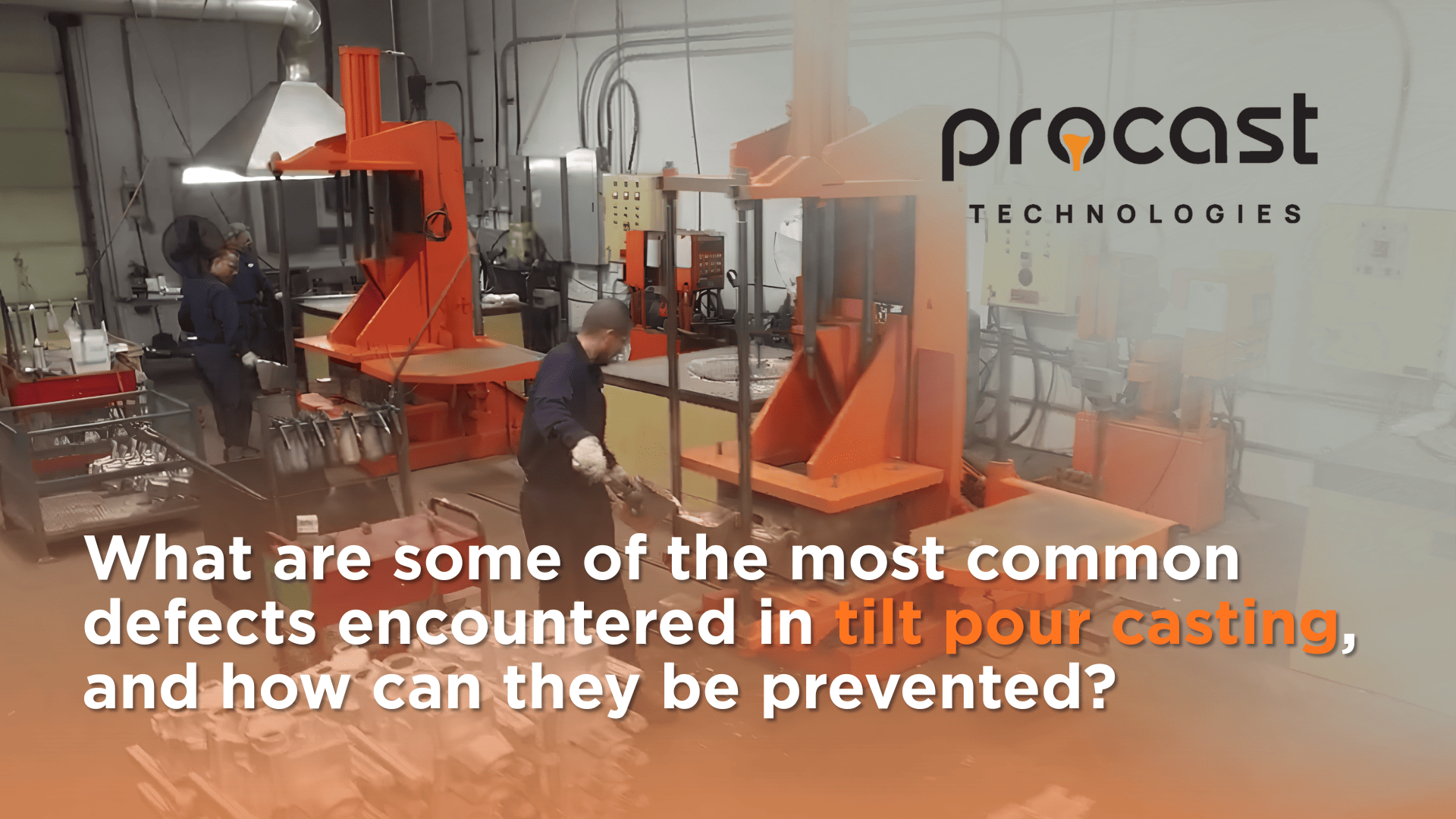
What are some of the most common defects encountered in tilt pour casting, and how can they be prevented?
August 28, 2026
The aluminum tilt pour casting process delivers precision and repeatability for medium-volume industrial work. But its advantages over static gravity pouring come with technical challenges that, unaddressed, become defects. This article covers the most common tilt pour defects, why they form, and how Procast prevents them. For the foundational treatment of the parent process, see our pillar guide to Semi-Permanent Mold Casting.
Author: Wes Parker, President and CEO, ProCast Technologies Inc.
Key Takeaways
- Controlled fill is the mechanism: tilt pour reduces common aluminum casting defects by maintaining laminar metal flow and uniform fill velocity, limiting the turbulence that entrains oxides and traps gas.
- Five defect families dominate: gas porosity, shrinkage porosity, cold shuts, misruns, and oxide film inclusions, each with a distinct root cause and a targeted prevention strategy that belongs in tooling design rather than inspection.
- Prevention is engineered upstream: Procast validates gating, tilt profile, and thermal management through in-house engineering and Solidification Analysis, with CMM inspection, air decay, and underwater pressure testing to 150 psi under an ISO 9001:2015-certified quality system.
Process performance: How controlled fill improves metallurgical density
Best tilt pour aluminum casting methods rely on precisely controlling how molten aluminum enters and fills the mold cavity. Where static gravity pouring drops metal rapidly and unpredictably, tilt-pour starts with the mold near-horizontal and rotates it upright as the pour progresses. That mechanized motion keeps the aluminum flowing smoothly along the mold wall at uniform velocity, minimizing turbulence, splashing, and air entrainment.
Why does this matter? Turbulent flow and uncontrolled fill rates are primary contributors to defect formation, raising the risk of oxide film entrainment and gas entrapment that compromise the microstructural integrity of the finished part. Keeping the fill front calm and laminar produces a cleaner, denser microstructure with fewer inclusions and voids, which translates directly into improved mechanical properties, tighter dimensional tolerances, and more consistent part-to-part quality.
How does tilt pour casting improve casting quality and consistency? By enabling repeatable fill profiles validated through Finite Solutions Casting Simulation and Solidification Analysis, each cycle matches the part’s geometry and engineering requirements. This is what delivers the best tilt-pour aluminum casting outcomes: higher metallurgical density and lower defect rates.
For a detailed breakdown of operational steps and timing, see What are the main steps involved in the semi-permanent mold casting process, and how long does it typically take?
Defect formation and prevention strategies
What are some of the defects encountered in casting processes?
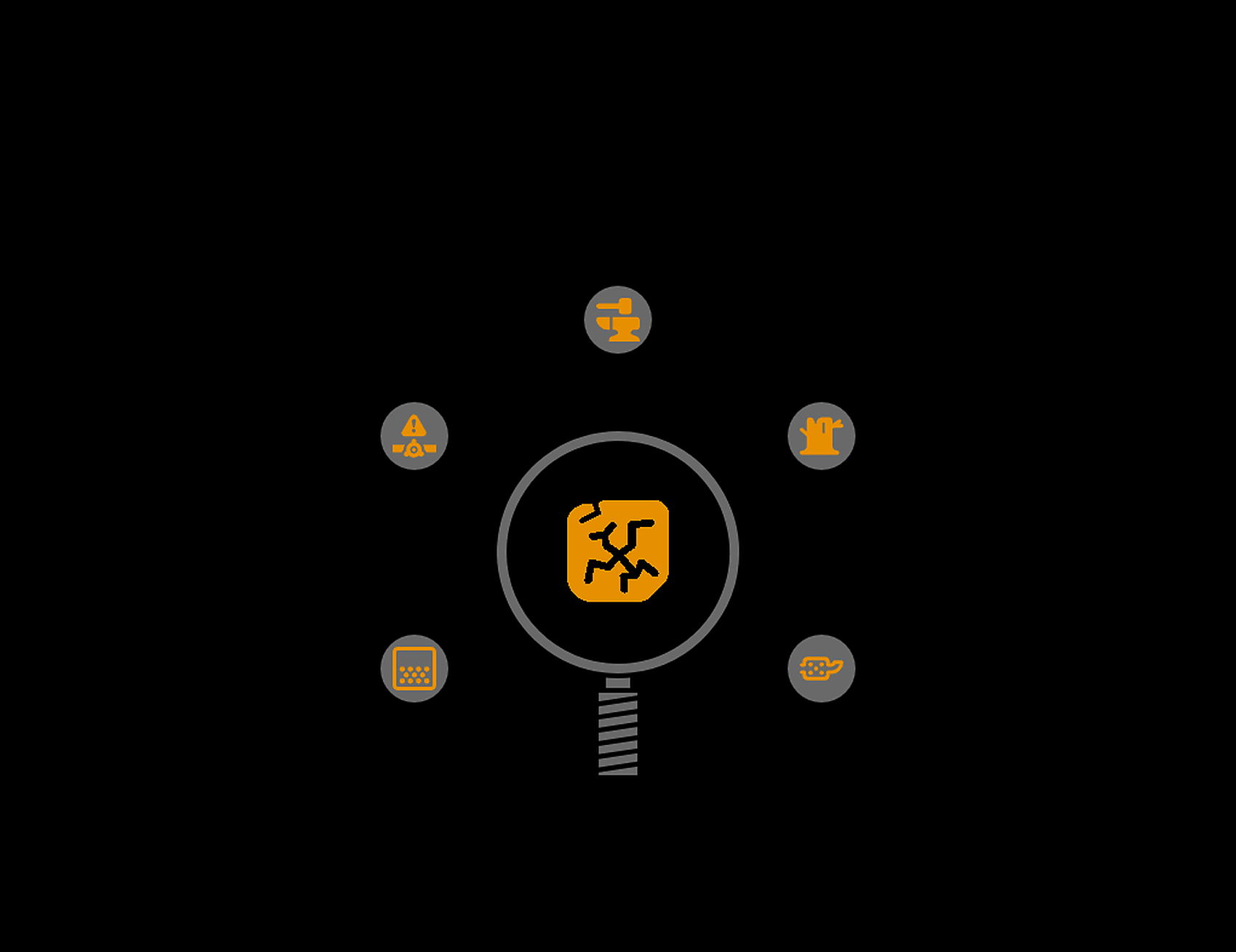
In aluminum casting, several non-conformities can arise, each with distinct causes and solutions. The most common are:
- Gas porosity: small, rounded voids within the casting caused by dissolved hydrogen or air that becomes trapped as the metal solidifies. The root cause is excessive gas content in the melt or turbulent filling that entraps air.
- Shrinkage porosity: irregular voids or cavities formed as the metal contracts during solidification, especially where inadequate feeding prevents the last-to-freeze regions from being supplied with liquid metal. Unlike gas porosity, shrinkage porosity depends on thermal gradients and mold design.
- Cold shuts: surface or internal discontinuities where two advancing streams of metal fail to fuse properly, often due to low pouring temperature or slow fill rates.
- Misruns: incomplete filling of the mold cavity, leading to missing features or thin sections. This typically results from insufficient metal temperature, poor gating, or an overly rapid solidification profile.
- Inclusions and oxide films: non-metallic particles or thin oxide layers trapped within the casting, originating from dross, slag, or surface oxidation entrained during turbulent filling.
Gas porosity originates in dissolved hydrogen rather than in feeding. Hydrogen solubility in aluminum drops sharply at the liquid-to-solid transition, so gas that was in solution comes out as the metal freezes. This is why the fix is degassing and fill control rather than riser design. (Totten & MacKenzie, Handbook of Aluminum, Vol. 1, Marcel Dekker, 2003. Source)
Identifying and mitigating tilt-pour anomalies
In tilt-pour casting, these defects can manifest in process-specific ways that require tailored prevention strategies. Understanding what the five casting defects are and how they relate to tilt-pour’s unique process dynamics is essential for effective defect mitigation.
Oxide film entrainment: if the tilt rate is too fast or the fill profile is not optimized, a turbulent metal front can sweep oxide films into the casting, leading to internal weaknesses. Prevention: optimize gating ratios, precisely control tilt rate and fill curve, and validate the process with casting simulation before committing to tooling. This aligns with Procast’s use of Solidification Analysis and proprietary simulation to ensure laminar flow and minimize oxide inclusion risk.
Gas entrapment at the fill front: poorly controlled tilt or gating can trap air or gas ahead of the advancing metal, resulting in porosity. Prevention: design gating systems to vent effectively and match the tilt profile to the part geometry, using simulation to predict and eliminate risk zones. Procast’s integrated engineering and in-house tooling design support these preventive measures, directly addressing gas porosity.
Incomplete fill in thin sections: if the tilt profile does not match the part’s thermal behavior, thin-wall areas may solidify before the metal arrives, causing misruns or cold shuts. Prevention: employ predictive solidification analysis, adjust mold heating, and fine-tune the tilt profile to ensure complete fill before local freezing. Because custom castings each carry their own thermal signature, the profile is derived from that part’s geometry rather than from a standard recipe. Procast’s engineering process leverages simulation and real-time monitoring to prevent these anomalies.
Dimensional drift belongs in the same prevention logic. Core type, resin content, and knock-out timing each independently influence the shrink factors used to size tooling, alongside section thickness and position relative to the parting line. This is why these variables are fixed at the design stage rather than tuned in production. (Stein et al., International Journal of Metalcasting, 2022. Source)
In summary, aluminum casting defects in tilt-pour processes are best addressed through an integrated approach comprising advanced simulation, disciplined process control, and continuous monitoring. At every stage, actionable prevention strategies, such as gating optimization, tilt-rate control, and mold thermal management, are validated in the engineering phase to minimize risk and ensure repeatable, high-quality results.
For further information on process selection and design considerations, refer to Are there specific design limitations or considerations when choosing semi-permanent mold casting for complex aluminum components?.
Porosity benchmarks and acceptance standards
Porosity in aluminum casting is categorized as either macro-porosity (visible voids or cavities) or micro-porosity (sub-millimeter-scale pores distributed throughout the microstructure). Macro-porosity primarily reduces tensile strength and can cause catastrophic failure under load, while micro-porosity, even at low volume fractions, can significantly lower fatigue resistance and sealing performance.
How much porosity is acceptable in casting?
No universal figure defines acceptable porosity; acceptance levels are set by the customer’s specification and, more critically, by the part’s engineering requirements. For example, a pressure-containing housing may require near-zero porosity in sealing surfaces, while a non-structural cover may tolerate higher levels.
Without a customer specification, engineering analysis sets acceptance thresholds, taking into account the part’s loading, machining allowance, sealing requirements, and service environment. This acceptance conversation is integral to the design and simulation phase, ensuring that porosity targets are agreed upon before tooling is manufactured.
We maintain production within these standards through disciplined process control and inspection, not by chance. We control porosity at the source by validating gating, tilt-pour parameters, and thermal management through in-house engineering and Solidification Analysis before production. During the manufacturing run, real-time monitoring via an integrated ERP/MES platform ensures process variables remain within specification. Dimensional conformance is verified through CMM inspection, and sampling plans confirm internal soundness across the lot, not just on first articles.
Internal quality verification relies on non-destructive testing. For castings that must be leak-tight, air decay and underwater pressure testing up to 150 psi directly validate that any porosity present does not create a leak path through pressure-containing walls or sealing surfaces. Combined with dimensional and visual inspection, these tests confirm that each casting meets its defined acceptance level and performs as engineered.
That verification rests on in-house capabilities: engineering and Solidification Analysis, an integrated Tool & Die department, CNC machining, CMM inspection, and air decay and underwater pressure testing to 150 psi under an ISO 9001:2015-certified quality system.
Conclusion
Consistent aluminum castings start with a process that eliminates defects before they reach the part. Executed with simulation, integrated engineering, and disciplined process control, tilt pour casting delivers the metallurgical density and dimensional accuracy demanding applications require. Procast targets gas porosity, shrinkage, cold shuts, misruns, and oxide inclusions at the source, so every casting meets acceptance standards for integrity, leak-tightness, and mechanical properties.
Related reading
Tilt pour casting is one way of running a permanent mold, so most of these defect mechanisms and controls carry over to the wider process. If you need more information on that process and on where its strengths and limits lie, see Permanent Mold Aluminum Casting and Permanent Mold Casting Advantages and Disadvantages.
Contact Procast’s engineering team today to discuss your requirements and experience the difference of a true turnkey aluminum casting partner.