What are the main steps involved in the semi-permanent mold casting process, and how long does it typically take?
August 28, 2026
The semi-permanent mold casting process combines the precision of metal molds with the flexibility of sand cores to produce engineered aluminum components at medium volumes. The process follows a structured sequence: hybrid mold engineering, tooling fabrication, core production, casting, and post-casting operations.
Typical lead times, from kickoff to qualified production parts, range from 6 to 12 weeks depending on part complexity and program requirements.
Author: Wes Parker, President and CEO, ProCast Technologies Inc.
Key Takeaways
- Semi-permanent mold casting combines a reusable metal cavity with expendable sand cores, producing engineered aluminum components with internal features and tolerances neither sand casting nor die casting can deliver economically at medium volumes.
- The sequence runs in seven stages, from engineering and simulation through tooling, core production, casting, shakeout, and post-cast operations, with each stage controlling a specific metallurgical outcome.
- Process-typical aluminum casting lead times run 6 to 12 weeks from kickoff to qualified production parts, with tooling fabrication the dominant variable at 6 to 10 weeks. Procast pairs Solidification Analysis with CMM inspection and pressure testing to 150 psi under an ISO 9001:2015 certified quality system.
Process fundamentals: Hybrid mold engineering
Semi-permanent mold casting uses a hybrid toolset. A reusable metal mold forms the external geometry while sand cores create internal features, delivering tighter dimensional tolerances and smoother surface finishes than sand casting with greater design freedom than fully permanent processes such as pressure die casting.
The method suits engineered aluminum components requiring complex internal passages or undercuts, balancing mechanical performance, cost, and manufacturability.
Key characteristics of the process:
- Hybrid tooling: steel or iron mold for external surfaces, sand cores for internal geometry
- Medium-volume focus: economical from 500 to 50,000 pieces
- Alloys: aluminum and zinc
- Integrated engineering: Solidification Analysis and casting simulation to optimize gating, feeding, and cooling
See semi-permanent mold casting process.
Step-by-step mechanics of the semi-permanent mold process
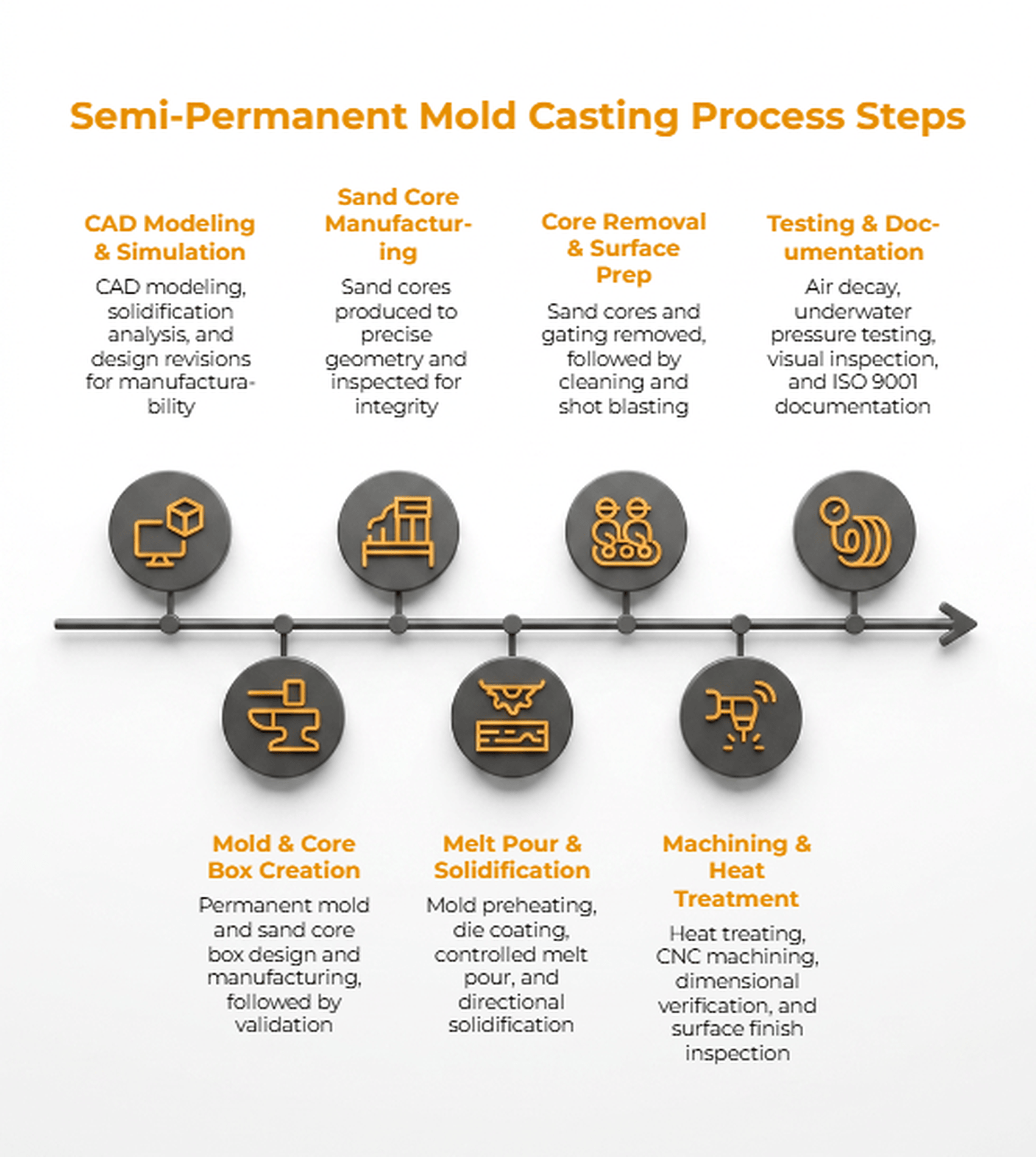
What are the main steps involved in the semi-permanent mold casting process, and how long does it typically take? A successful program follows a disciplined, iterative path. Each stage is engineered to minimize aluminum casting defects at the point they originate rather than at inspection.
- Engineering and design review. The first stage comprises CAD modeling of the part and gating system, Solidification Analysis to predict shrinkage, porosity, and fill behavior, then simulation-driven design revisions to optimize manufacturability.
- Tooling fabrication. This stage includes permanent mold tooling and sand core box design and manufacturing, followed by tooling validation and fit-up.
- Core production. Sand cores are produced to precise geometry and dimensional tolerances, then inspected for core integrity. Core variables carry directly into finished part dimensions: core type, resin content, and knock-out timing each independently influence the shrink factors used to size tooling, alongside section thickness and position relative to the parting line. (Stein et al., International Journal of Metalcasting, 2022. Source)
- Casting operations. Mold preheating governs thermal shock and fill behavior. Die coating governs heat transfer and part release. Controlled gravity pour, tilt, or static introduces the melt, and directional solidification is engineered to minimize porosity and internal stress.
- Shakeout and cleaning. This stage involves removal of sand cores and gating, then cleaning, shot blasting, and initial inspection.
- Post-casting processes. This is followed by heat treating for specified mechanical properties, CNC machining of critical dimensions, dimensional verification by CMM, and surface finish inspection.
- Quality assurance. The final stage comprises air decay and underwater pressure testing up to 150 psi for pressure-critical parts, visual inspection, and ISO 9001:2015 process documentation and traceability.
How long does it typically take? The complete process generally spans 10 to 12 weeks: engineering and simulation at 2 to 4 weeks, tooling and core box fabrication at 6 to 10 weeks, initial sampling and validation at 2 to 3 weeks, and production ramp-up at 1 to 3 weeks.
Each phase feeds the next: simulation output drives tooling geometry, tooling fit-up drives core tolerances, and core tolerances drive the dimensional envelope of the finished engineered aluminum components. Compressing any single phase without revisiting the ones downstream is where most scheduled recovery attempts fail.
Timeframe analysis: Cycle rates, tooling development, and production schedules
Realistic scheduling depends on part complexity, tooling requirements, and quality benchmarks. Each stage carries its own variables. How long does the casting process take? The actual casting cycle for each part, including core placement, pour, solidification, and shakeout, typically runs several minutes depending on size and geometry. Mold re-preparation and core replacement form the main bottlenecks.
Factors that move cycle time:
- Mold complexity and number of cavities
- Core setup and removal time
- Alloy and wall thickness, which govern solidification rate
- Required post-casting treatments
How long does tooling and production typically take for aluminum castings? Process-typical aluminum casting lead times break into four phases. Tool design and simulation run 2 to 4 weeks. Mold fabrication and core box build run 6 to 10 weeks; longer for highly complex or multi-cavity tools.
Initial sampling and validation run 2 to 3 weeks, covering first-article castings, CMM verification, and pressure testing. Production ramp-up runs 1 to 3 weeks after approval.
Permanent mold tooling develops faster and costs substantially less than a die casting tool, at roughly one-tenth the investment. For a program schedule, that means design iterations remain affordable well into development rather than being locked at tool release.
Keeping engineering and Solidification Analysis, the Tool & Die department, sand core production, casting, heat treating, CNC machining, and inspection under one roof removes the vendor handoffs that typically extend engineered aluminum components schedules. When those functions sit with separate suppliers, each transfer adds queue time that no amount of tooling speed can recover.
For more on design-stage impacts, see: Are there specific design limitations or considerations when choosing semi-permanent mold casting for complex aluminum components?
Production advantages and quality benchmarks
Semi-permanent mold casting offers a combination of dimensional precision, mechanical performance, and cost efficiency for medium-volume aluminum and zinc parts. Compared to sand casting and die casting, the process delivers:
- Lower tooling investment: permanent mold tooling costs approximately one-tenth that of die casting, making it economical for 500 to 50,000 piece runs.
- Faster tooling development: simpler mold fabrication and fewer mechanical complexities reduce lead times and enable faster design iterations.
- Superior quality control: integrated simulation and ISO 9001:2015 systems ensure consistent quality and traceability.
- Enhanced properties: directional solidification and rapid cooling improve grain structure and minimize common aluminum casting defects, including porosity, hot tears, and shrinkage.
- Predictable lead times: an integrated, in-house approach streamlines every stage from engineering to final inspection, reducing the schedule risk that vendor handoffs introduce for complex engineered aluminum components.
What are the advantages of semi-permanent mold casting compared to sand casting or die casting? Semi-permanent mold casting bridges the gap between traditional sand casting and high-pressure die casting.
Compared to sand casting, it delivers improved dimensional tolerances, superior surface finishes at 160 to 400 RMS, and enhanced mechanical properties from controlled solidification rates. Alloy development for permanent and semi-permanent mold processes has focused on that intersection of castability, high-temperature performance, and heat-treatment economics. (Major & Hartlieb, International Journal of Metalcasting, 2009. Source)
Permanent metal molds reduce variability and enable repeatable quality across medium-volume runs, while sand cores allow complex internal geometries that would be challenging or cost-prohibitive in die casting. That said, core variables feed directly into finished dimensions: core type, resin content, and knock-out timing each independently influence the shrink factors used to size tooling, alongside section thickness and position relative to the parting line. (Stein et al., International Journal of Metalcasting, 2022. Source)
Unlike die casting, which requires high tooling investment and suits very large volumes, semi-permanent mold casting offers much lower tooling costs (approximately one-tenth of die casting), and greater flexibility for design changes or engineering iterations. That makes it well suited to production runs of 500 to 50,000 pieces where cost-effectiveness and engineering precision are both required.
The process is designed to systematically address aluminum casting defects at every stage. Through simulation-driven gating, controlled pour dynamics, and rigorous post-casting inspection, Procast holds both dimensional tolerance and mechanical performance targets across the run.
Quality assurance benchmarks include:
- CMM dimensional inspection
- Air decay and underwater pressure testing up to 150 psi
- Documented acceptance criteria per ISO 9001:2015
Common aluminum casting defects and solutions:
- Porosity: controlled via simulation-driven gating and feeding, pressure testing, and solidification management; hydrogen solubility in aluminum drops sharply at the liquid-to-solid transition, so the rate and direction of heat extraction govern whether dissolved gas nucleates into pores (Totten & MacKenzie, Handbook of Aluminum, Marcel Dekker)
- Oxide inclusions: minimized through controlled pour dynamics, tilt-pour or static pour
- Cold shuts and misruns: prevented by validating fill temperature and flow paths
- Hot tearing: addressed through alloy selection, mold design, and post-casting heat treatment
Conclusion
Efficient, high-quality aluminum and zinc castings require more than technical know-how. They demand an integrated, end-to-end approach that eliminates handoff risks and accelerates time to market.
With Procast, the critical stages from engineering and Solidification Analysis through tool and die, sand core production, casting, CNC machining, and quality control are managed under one roof. That continuity is what keeps each engineered aluminum component inside its dimensional, mechanical, and performance envelope.
Related reading
If you need more information on the finished components this production sequence is typically used for, see Permanent Mold Casting Applications.
If you are planning a new program or working through delays with a current supplier, share your part requirements and target dates to receive a clear project roadmap, from initial design to qualified production parts. Contact us today to discuss your next engineered aluminum or zinc casting project.