Are there any limitations or challenges associated with the tilt pour casting process?
August 28, 2026
Tilt pour buys a calmer fill than static gravity pouring, and that advantage is real. But it is bought with a narrower process window, a more complex machine, and a shorter list of workable alloys. Specifying the process well means knowing where those limits fall before you commit a part geometry to tooling. The sections below cover the three that most often decide whether a part is a good candidate: pouring temperature, equipment constraints, and alloy compatibility. For how the pour works, see Tilt pour casting process; for the parent process this configuration belongs to, see Semi-Permanent Mold Casting.
Author: Wes Parker, President and CEO, ProCast Technologies Inc.
Key Takeaways
- Pouring temperature governs the trade-off: holding close to the melting point refines grain structure and limits hydrogen pickup, but narrows the process window and raises the risk of incomplete fill in thin or intricate sections.
- Equipment complexity is the structural limitation: the rotating mold assembly adds maintenance burden, capital cost, and hard limits on part envelope and mold mass that static pour cells do not face.
- Alloy choices depend on temperature limits: the process works best with non-ferrous 3xx.x, 4xx.x aluminum groups and zinc. Metals that require high heat to melt accelerate thermal fatigue in the metal mold.
Process fundamentals: Mechanics of tilt pour casting
Tilt pour casting is a controlled gravity casting process in which the mold and pour basin rotate together, allowing molten metal to enter the cavity under managed, low-turbulence flow rather than free-falling under head pressure. By governing fill velocity through the tilt rate, the process minimizes surface turbulence and suppresses oxide entrainment, resulting in a cleaner as-cast surface finish and reduced risk of air entrapment.
This method delivers significant advantages over static gravity casting: it produces a finer aluminum casting surface finish, enhances dimensional consistency, and supports tighter aluminum casting tolerances for complex geometries. The controlled flow inherent to tilt pour directly improves aluminum casting surface finish by reducing inclusions, minimizing surface defects, and promoting uniform solidification across intricate features.
However, these benefits are balanced against process-specific limitations, which are best understood as trade-offs inherent to the mechanics of tilt pour casting.
Process challenges and metallurgical boundaries
Equipment constraints and operational cycle boundaries
The tilt pour casting process introduces several genuine constraints that must be managed for reliable, repeatable production. The most prominent challenges include:
- Mechanical complexity and maintenance: the rotating mold assembly requires robust, precise actuation and regular maintenance, adding operational overhead not inherent to static pour cells.
- Capital investment: tilt pour systems typically entail higher up-front capital costs due to the complexity of the tilt mechanism and integrated controls.
- Part envelope and mold mass limits: the tilt mechanism imposes practical limits on maximum size and mass of the mold, which restricts the largest part envelope castable with this method.
- Cycle times: while the process produces high-quality castings, cycle times are generally longer than high-pressure die casting, which can affect aluminum casting lead times for high-volume applications.
- Narrow process window: controlled fill velocity and solidification demand precise tuning of parameters; small deviations can result in aluminum casting defects, and solutions must be engineered into both the tooling and the process controls.
Dimensional repeatability has limits. Tool size relies on core type, resin content, knock-out timing, wall thickness, and parting line position. Because these factors act independently, casting tolerances are fixed during tool design and cannot be changed later. (Stein et al., International Journal of Metalcasting, 2022. Source)
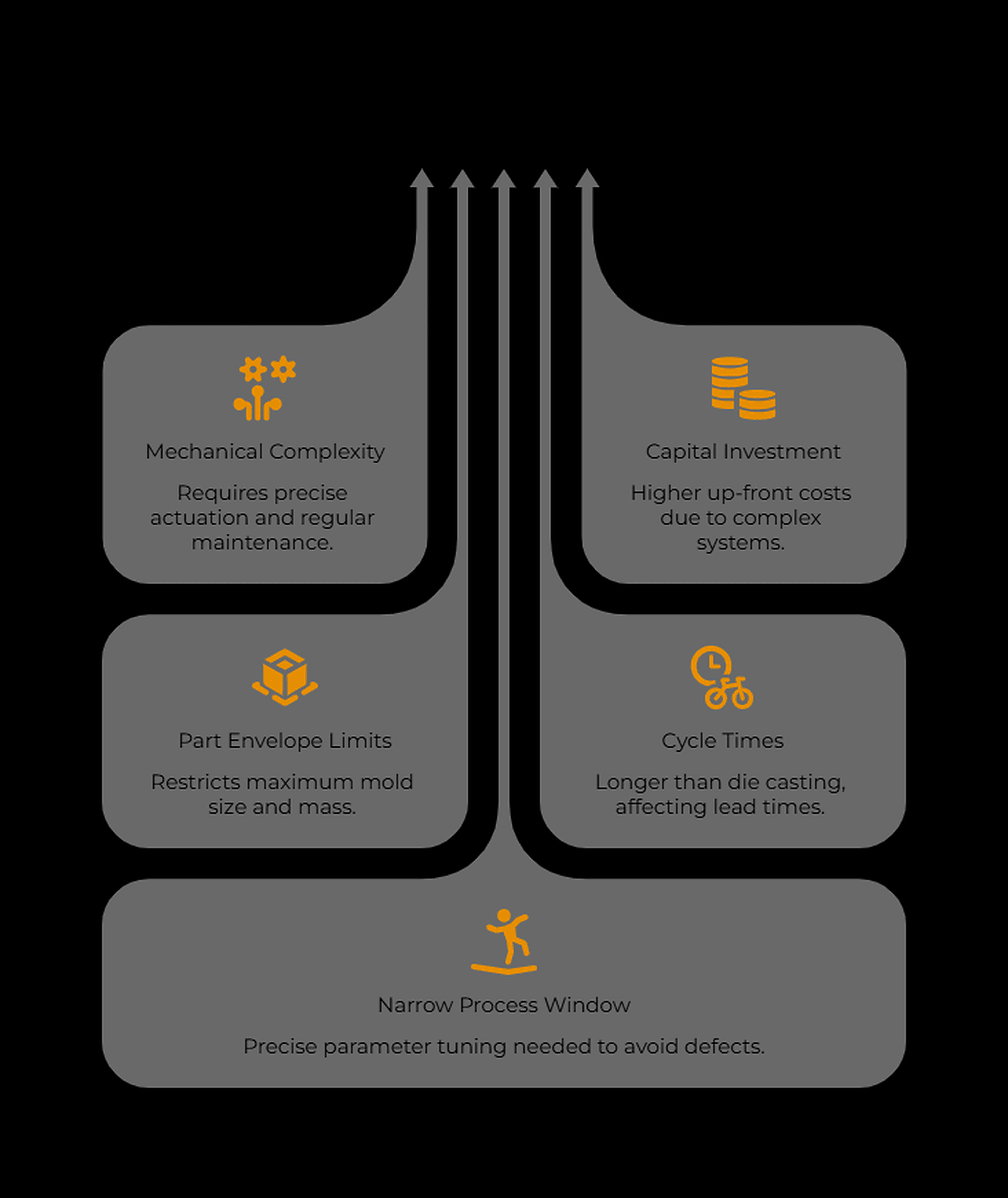
In summary, while tilt pour casting achieves superior surface finish and dimensional accuracy, these advantages come with increased equipment complexity, longer cycle times, and a narrower operational window — trade-offs that must be weighed against project requirements and production volumes.
What are the advantages and disadvantages in having the pouring temperature remain close to the melting temperature?
Pouring temperature is a central variable in the tilt pour process, directly impacting fluidity, solidification behavior, and final part quality. Holding it close to the alloy’s melting point promotes rapid, controlled solidification. This tightens grain structure and refines dendrite arm spacing, improving mechanical properties and reducing porosity. It also extends tool and die life by mitigating thermal shock to the mold.
Low superheat carries a second benefit, a recurring theme in aluminum casting defects and solutions. Hydrogen solubility in aluminum drops sharply at the liquid-to-solid transition, so reducing the amount dissolved before the pour directly narrows the window in which gas porosity can nucleate. (Totten & MacKenzie, Handbook of Aluminum, Vol. 1, Marcel Dekker, 2003. Source)
Are there any limitations or challenges associated with the tilt pour casting process? Yes, the first challenge involves the pouring temperature. Metal poured at a level too close to the melting point loses fluidity quickly, increasing the risk of misruns, cold shuts, and incomplete fill, especially in thin-walled or highly intricate castings. These issues directly impact aluminum casting tolerances and may require design modifications or gating adjustments to ensure full cavity fill.
The practical superheat window depends on the specific alloy, casting geometry, and gating design, and is typically validated before tooling is finalized through casting process simulation and Solidification Analysis. This ensures the selected parameters balance rapid solidification against sufficient fluidity for full cavity fill and optimal aluminum casting surface finish. Aluminum casting tolerances and mechanical properties are confirmed via CMM inspection and pressure testing up to 150 psi.
Operating near the melting temperature improves mechanical properties and extends tool life. However, it narrows the margin for error, increases the risk of aluminum casting defects, and can extend lead times if process adjustments or rework are required. That trade-off is why precise process control and simulation-driven validation matter most in medium-volume production, where both quality and schedule are critical.
Material science: Alloy selection and composition comparisons
What types of materials are best suited for semi-permanent mold casting, and are there any limitations?
The tilt pour and semi-permanent mold processes are optimized for non-ferrous alloys, primarily the 3xx.x (e.g., A356, 319) and 4xx.x (e.g., B413) cast aluminum families, as well as selected zinc alloys such as ZA-12. These alloys are specifically engineered for foundry use, offering the fluidity, controlled solidification range, and shrinkage behavior required for high-integrity castings.
Alloys with high silicon content (such as A356) are favored for their superior casting characteristics, including excellent aluminum casting surface finish and tight aluminum casting tolerances. Zinc alloys provide additional options for parts requiring exceptional detail or lower melting temperatures.
The primary limitation is thermal: alloys with high melting points (such as ferrous metals) accelerate mold degradation and are not suitable for the permanent mold process. While the general permanent mold process can theoretically accommodate other non-ferrous metals, alloys outside these families are not recommended due to increased risk of rapid tool wear, inconsistent fill, and compromised part quality.
For a deeper dive into design and material choices for complex projects, explore Are there specific design limitations or considerations when choosing semi-permanent mold casting for complex aluminum components? and the semi-permanent mold casting process.
Which is better, aluminum or cast aluminum?
This is a common question among industrial buyers seeking optimal performance, cost-effectiveness, and manufacturability in their components. The answer depends on the specific application, desired aluminum casting surface finish, aluminum casting tolerances, production volume, and the need to address aluminum casting defects as part of the manufacturing strategy.
“Aluminum” typically refers to the pure element or to wrought aluminum alloys, which are processed through rolling, extrusion, or forging. These methods yield high ductility and directional strength, making them suitable for simple, uniform profiles where tight aluminum casting tolerances are less critical and complex internal features are not required. However, wrought processes are less effective for producing parts with complex geometries, variable wall thicknesses, or intricate internal passages.
“Cast aluminum,” by contrast, refers to specialized alloy families, engineered specifically for casting processes like the permanent mold process. These alloys incorporate silicon and other elements to enhance fluidity, allowing precise replication of intricate mold features and superior aluminum casting surface finish. Cast aluminum excels in medium-volume production, where repeatable, tight casting tolerances and effective defect management are paramount.
The process also supports integrated features, reducing secondary machining and assembly costs. Alloy development for permanent and semi-permanent mold processes has focused on the intersection of castability, high-temperature performance, and heat-treatment response. (Major & Hartlieb, International Journal of Metalcasting, 2009. Source)
Returning to the material question: non-ferrous alloys, especially the 3xx.x and 4xx.x cast aluminum series and select zinc alloys, are ideally suited due to their foundry-optimized properties. These materials offer the right balance of fluidity, solidification range, and shrinkage behavior for high-integrity, complex castings.
However, limitations exist. Alloys with higher melting points are not recommended, as they accelerate mold wear and compromise quality. Procast’s process, with integrated Tool & Die, in-house engineering, and advanced simulation, is designed specifically for these alloy families, ensuring consistent results and long tool life for medium-volume production.
When evaluating “which is better, aluminum or cast aluminum?” consider the full project lifecycle, including aluminum casting lead times, part geometry, and performance requirements. For applications demanding complex shapes, integrated engineering and tooling design, and validated mechanical performance, cast aluminum, especially when produced through Procast’s tilt-pour and semi-permanent-mold processes, offers distinct advantages.
Our in-house engineering support, casting process simulation, Solidification Analysis, and comprehensive quality controls (including CMM inspection and pressure testing up to 150 psi) ensure that aluminum casting defects are proactively addressed, tolerances are met, and surface finish is optimized for demanding industrial applications. Additionally, our focus on medium-volume production (500 to 50,000 pcs) with cost-effective tooling delivers faster aluminum casting lead times compared to high-pressure die casting for similar volumes.
For industrial clients requiring turnkey aluminum castings with complex geometries, stringent tolerances, and controlled surface finish, cast aluminum is the superior choice. The decision should always be driven by functional requirements, production volume, and the need for integrated quality controls. Procast’s process and engineering expertise ensure the right alloy and forming method to match your application, maximizing yield, minimizing defects, and delivering reliable lead times for your medium-volume projects.
Conclusion
The tilt pour casting process delivers exceptional control over aluminum casting surface finish, dimensional tolerances, and mechanical properties, but is bounded by equipment complexity, material selection, and the need for precise thermal management. Understanding these limitations and leveraging advanced engineering and simulation to navigate them is essential to achieving consistent, high-quality results in medium-volume industrial casting projects.
For a comparative analysis of casting quality and durability versus other methods, see How does the quality or durability of aluminum parts from semi-permanent mold casting compare to other methods like sand or die casting?.
Ready to solve your casting challenges with precision-engineered, turnkey aluminum or zinc castings? Connect with Procast’s engineering team today to discuss your project requirements, leverage our in-house simulation and quality controls, and experience the difference of an integrated, medium-volume casting partner committed to your success from design through assembly.