What types of metals are most commonly used in semi-permanent mold casting?
August 28, 2026
Selecting the optimal alloy is the most critical engineering choice in any semi-permanent mold casting project, as it directly influences tooling design, feeding methodology, and the attainable heat-treat condition. This process, which combines a durable metal mold with a removable sand core, naturally limits viable alloys to those that can fill consistently and solidify controllably within chilled steel boundaries. Fill dynamics differ across the reusable-mold family, and those differences shape which alloys suit each one; for more information, see What are the variations of permanent mold casting?
The metallurgical considerations outlined below clarify which alloy families meet these requirements, enabling more robust specifications and minimizing unexpected issues at first article inspection. For a detailed explanation of why this alloy range is narrower than in sand casting, see Semi-Permanent Mold Casting.
Author: Wes Parker, President and CEO, ProCast Technologies Inc.
Key takeaways
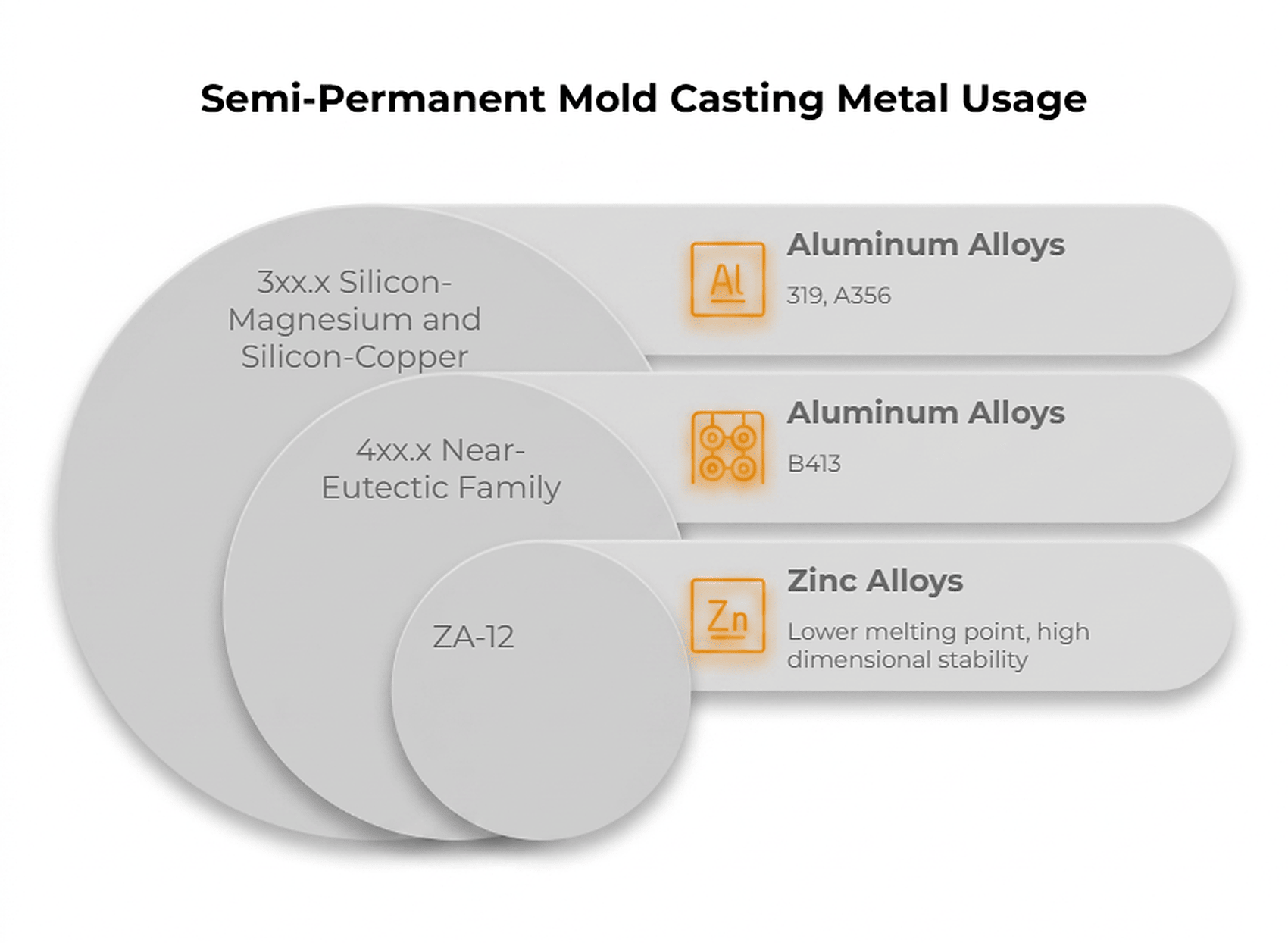
- Semi-permanent mold casting is dominated by cast aluminum alloys, specifically the 3xx.x silicon-magnesium and silicon-copper families (A356, 319) and the 4xx.x near-eutectic group (B413). Zinc alloys such as ZA-12 also regularly run in reusable tooling.
- Alloy selection depends on fluidity, solidification shrinkage rate, and hot-tear resistance rather than strength alone. These properties ensure predictable filling and freezing against both the rigid steel cavity and the expendable sand core.
- The fine, dense microstructure produced by rapid directional solidification allows these castings to accept heat treatment, CNC machining, and pressure testing without the gas blistering that constrains high-pressure die castings.
Metallurgical profiles and material selection criteria
What types of metals are most commonly used in semi-permanent mold casting? Semi-permanent mold casting is predominantly an aluminum process, dominated by the cast 3xx.x silicon-magnesium and silicon-copper alloys, principally A356 and 319, followed by the 4xx.x near-eutectic family such as B413. Zinc alloys, including ZA-12, are also poured into permanent and semi-permanent tooling when a lower melting point and high dimensional stability are advantageous.
Three metallurgical properties dictate which alloys perform in a reusable metal cavity: fluidity (which governs whether thin sections fill before the melt loses superheat against chilled steel), solidification shrinkage rate (which determines how aggressively risers must feed last-to-freeze regions), and hot-tear resistance (which decides whether the casting cracks as it contracts around a rigid core). Excelling in all three properties explains why silicon-bearing 3xx.x alloys make up the bulk of metals most commonly poured into semi-permanent tooling.
Advantages and disadvantages of aluminium as a cast material flow directly from these traits. On the positive side, aluminum offers an exceptional strength-to-weight ratio and inherent corrosion resistance from its self-passivating oxide film. On the negative side, it exhibits meaningful solidification shrinkage that must be engineered out through gating, and lower absolute strength than ferrous alternatives such as ductile iron.
The fine, dense microstructure produced by rapid, directional solidification in a metal mold enables these castings to be fully heat treated, CNC machined, and pressure tested — capabilities not reliably available in high-pressure die castings due to gas entrapment.
Structural engineering and industrial deployment
Tooling materials and core-to-cavity matching
How do I choose the right type of mold material for my casting projects? Once the pour alloy is fixed, the next engineering decision is the tooling material that forms the reusable cavity. This choice depends on a direct trade-off between tool life and heat-transfer rate, both of which must be balanced against projected production volume, pouring temperature, and geometric complexity. The permanent portion of a semi-permanent mold is typically machined from heat-resistant tool steels for maximum cycle life, while cast iron molds are selected when lower cost and easier machining take priority.
Core-to-cavity matching is a deliberate engineering step. The rigid metal cavity chills the outer skin rapidly, refining the surface microstructure, while the expendable bonded sand core freezes the internal geometry more slowly. Achieving dimensional stability across a run requires balancing these two rates in Solidification Analysis, ensuring the casting feeds directionally and avoids tearing or distortion around the core.
Heat-transfer rate is the second axis: a steel cavity extracts heat aggressively, refining grain and enhancing mechanical properties. However, this same thermal severity can accelerate die stress and wear. Managed coatings and controlled preheat moderate the thermal gradient so the tool survives the required number of cycles.
As production volumes rise, the economic trade-off shifts. For medium-volume runs (approximately 500 to 50,000 pieces per year), hardened tool-steel cavities amortize cleanly, as their tooling cost is typically about one-tenth that of high-pressure die casting dies while still delivering the required cycle life. For lower-volume programs, prototypes, or re-engineering trials, a cast-iron or lower-hardness cavity may be more economical, since the tool need not survive as many cycles.
Integrated tool and die design, combined with simulation-driven engineering, ensures that the tooling material decision is directly informed by the same data that drove the alloy choice, supporting precision aluminum casting and the production of engineered aluminum components with consistent quality.
Industry adoption and high-integrity applications
What industries or applications most commonly use semi-permanent mold casting, and why is it preferred in those cases? Semi-permanent mold casting is selected for parts that require internal undercuts, low gas porosity, and high strength-to-weight ratios, requirements that neither sand casting nor high-pressure die casting can fully address. Typical examples include housings, manifolds, mounting brackets, and valve blocks — components defined by cored cavities, sealed pressure boundaries, and load paths that must endure service conditions.
The process is preferred for a series of engineering reasons:
- Rapid chilling of the outer walls by the rigid metal cavity produces a fine, dense microstructure, resulting in castings with low porosity and high mechanical integrity, ideal for pressure-containing parts that must pass stringent air-decay and underwater pressure testing.
- The expendable sand core reproduces complex internal galleries, undercuts, and passages that a fully metallic permanent mold cannot eject, allowing a single casting to incorporate intricate internal features.
- The porosity-free skin achieved by controlled solidification means these parts can be fully heat treated (T5 or T6) without blistering, providing the mechanical strength demanded by structural and pressure-critical applications.
- The lower tooling cost relative to die casting makes the process economically viable for medium-volume runs, where die-cast tooling would be cost-prohibitive to amortize.
These process-level advantages make semi-permanent mold casting the solution of choice in industries that require engineered aluminum components with high integrity, complex geometries, and moderate production volumes. For a detailed breakdown of how this process compares to other methods, see How does the quality or durability of aluminum parts from semi-permanent mold casting compare to other methods like sand or die casting?
Metallurgical post-processing: Heat treatment and machining capabilities
Can cast aluminum parts be heat treated, machined, or pressure tested?
Yes. The ability to reliably heat treat, machine, and pressure test aluminum castings is a core advantage of the semi-permanent mold process. The dense, fine-grained structure produced by rapid directional solidification in a metal mold is free of the gas porosity that limits high-pressure die castings, allowing full T5 and T6 heat treatment without the risk of surface blistering.
In the context of semi-permanent mold casting, heat-treatable and non-heat-treatable aluminium alloys both play important roles. Heat-treatable aluminum alloys like A356 and 319 (3xx.x series) gain strength through precipitation hardening during controlled aging. Non-heat-treatable alloys, such as B413 (4xx.x family), are chosen for their as-cast stability and fluidity, not for post-cast strengthening. Distinguishing between these alloy types is essential for defining mechanical targets and processing strategies.
For buyers, this distinction is critical when specifying a T5 or T6 condition. T5 is a direct artificial aging process applied after casting to relieve stress and increase yield strength, while T6 involves solution treatment, quenching, and artificial aging to achieve maximum strength and hardness. Because the microstructure is free of entrapped gas, even aggressive T6 solution cycles do not cause blistering, unlike in high-pressure die castings.
Downstream, precision aluminum casting supports a full suite of post-processing operations: CNC machining to final tolerances and surface roughness, dimensional verification via CMM, and comprehensive pressure testing (air decay and underwater) up to 150 psi. At Procast, we perform these operations in-house under an ISO 9001:2015-certified quality system, ensuring consistent quality and traceability from casting through final inspection.
Mechanical properties and post-processing readiness
Values reflect well-fed, chill-solidified castings and may vary with section thickness. The fine microstructure ensures pressure-tightness, full heat-treatability, and machining stability. For engineering and procurement teams, understanding the differences between heat-treatable and non-heat-treatable aluminum alloys is essential for optimal casting and post-processing outcomes.
Conclusion
Choosing the right alloy for semi-permanent mold casting is foundational to achieving precision, durability, and cost efficiency in engineered aluminum and zinc components. At Procast, our integrated approach, combining in-house engineering, simulation-driven solidification analysis, and end-to-end quality controls, ensures your castings meet the highest standards from concept through final inspection.
Related reading
If you need more information on the wider permanent mold process and the parts it is used for, see Permanent Mold Aluminum Casting and Permanent Mold Casting Applications.
Ready to specify your next casting project or need expert guidance on material selection? Connect with Procast’s engineering team today to ensure your components are built on a foundation of technical excellence and manufacturing reliability.