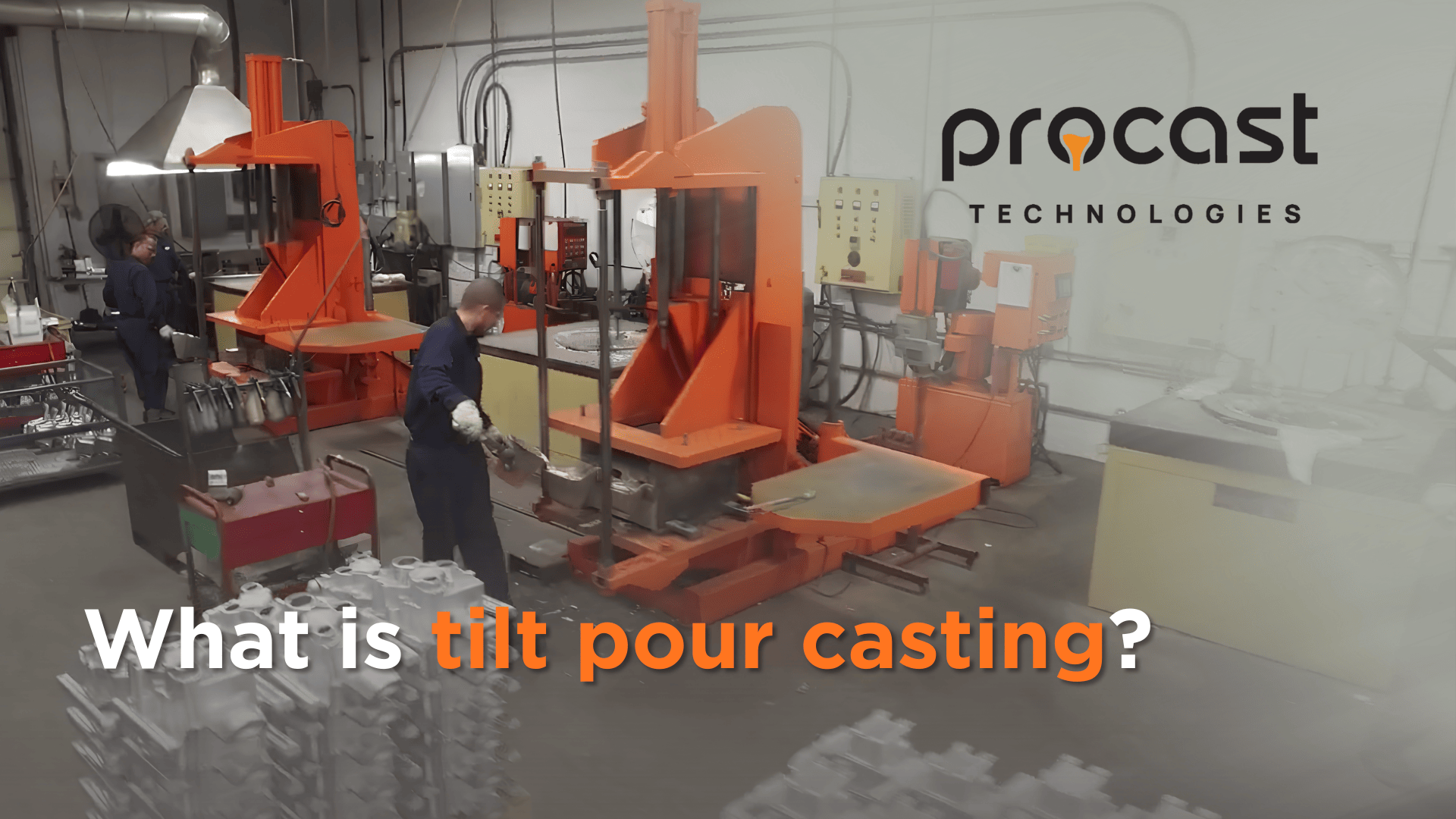
Tilt pour casting is a permanent mold process where the mold and pour basin rotate on an axis, allowing molten metal to fill the cavity by computer-controlled tilting rather than free-fall. This precise, laminar flow minimizes turbulence and oxide formation, enabling gases to escape and producing low-porosity, high-integrity castings. Tilt casting is ideal for custom aluminum castings and molds demanding superior surface finish and dimensional accuracy. For the full mechanics of how the pour is controlled, see Tilt pour casting process; for the parent process this configuration belongs to, see Semi-Permanent Mold Casting.
Author: Wes Parker, President and CEO, ProCast Technologies Inc.
Key Takeaways
- Computer-controlled, laminar metal flow: tilt casting employs rotational mold filling to achieve precise, turbulence-free metal flow, resulting in superior surface finish, reduced porosity, and enhanced structural integrity compared to traditional gravity die casting.
- Optimized for custom aluminum and zinc alloys: the process is especially effective for 3xx.x and 4xx.x aluminum alloys and select zinc alloys, delivering high-quality, dimensionally accurate castings ideally suited for small- to medium-volume industrial applications.
- Integrated engineering and quality assurance: Procast’s in-house engineering, simulation, sand core production, and ISO 9001:2015-certified quality system ensure turnkey, end-to-end control over every phase, from design and tooling through casting and post-casting inspection.
Process mechanics: Fluid dynamics and rotational filling
Operational principles of tilt molds
In tilt casting, the entire mold assembly, including the pour basin and gating system, rotates from horizontal to vertical in a controlled motion. The sequence begins with the mold closed and in the horizontal position. Molten metal is then poured into the basin, and as the system tilts, gravity causes the metal to flow smoothly into the mold cavity. The tilt rate is carefully set to keep the metal’s surface intact, preventing oxides and air pockets.
By controlling the fill velocity below the threshold where the metal surface breaks up, tilt pour casting achieves a progressive, laminar fill that is virtually free of turbulence. This core mechanism differentiates tilt casting from static pour methods and is fundamental to achieving the best aluminum casting surface finish and structural soundness.
The gas that matters most is already in solution. Hydrogen solubility in aluminum drops sharply at the liquid-to-solid transition, so a fill that avoids adding more and gives what is present a path to escape is doing two jobs at once. (Totten & MacKenzie, Handbook of Aluminum, Vol. 1, Marcel Dekker, 2003. Source)
What types of metals are best suited for tilt casting?
At its core, tilt pour casting delivers computer-controlled, laminar flow and precise solidification through rotational mold filling. This unique approach makes it exceptionally effective for specific alloy families. Tilt casting consistently delivers optimal results with cast aluminum alloys in the 3xx.x and 4xx.x series, as well as select zinc alloys.
The 3xx.x aluminum-silicon-magnesium alloys, such as A356 and 357, are the primary workhorses for custom aluminum castings. Their higher silicon content improves fluidity and reduces shrinkage, allowing the melt to fill thin sections and complex geometries as the mold rotates. This computer-controlled fill is essential to minimize defects and achieve high-quality as-cast surface finishes. These alloys also respond well to heat treatment (e.g., T6 temper) for applications requiring high mechanical strength.
In addition to the 3xx.x series, 4xx.x aluminum-silicon alloys such as B413 offer even greater castability and wear resistance, making them ideal for intricate parts where complete mold fill is the top priority. On the zinc side, ZA-12 and related ZA alloys are excellent candidates for tilt casting. Their low melting points reduce thermal stress on tooling, while their fluidity and mechanical properties support tight dimensional tolerances and fine detail in custom casting molds.
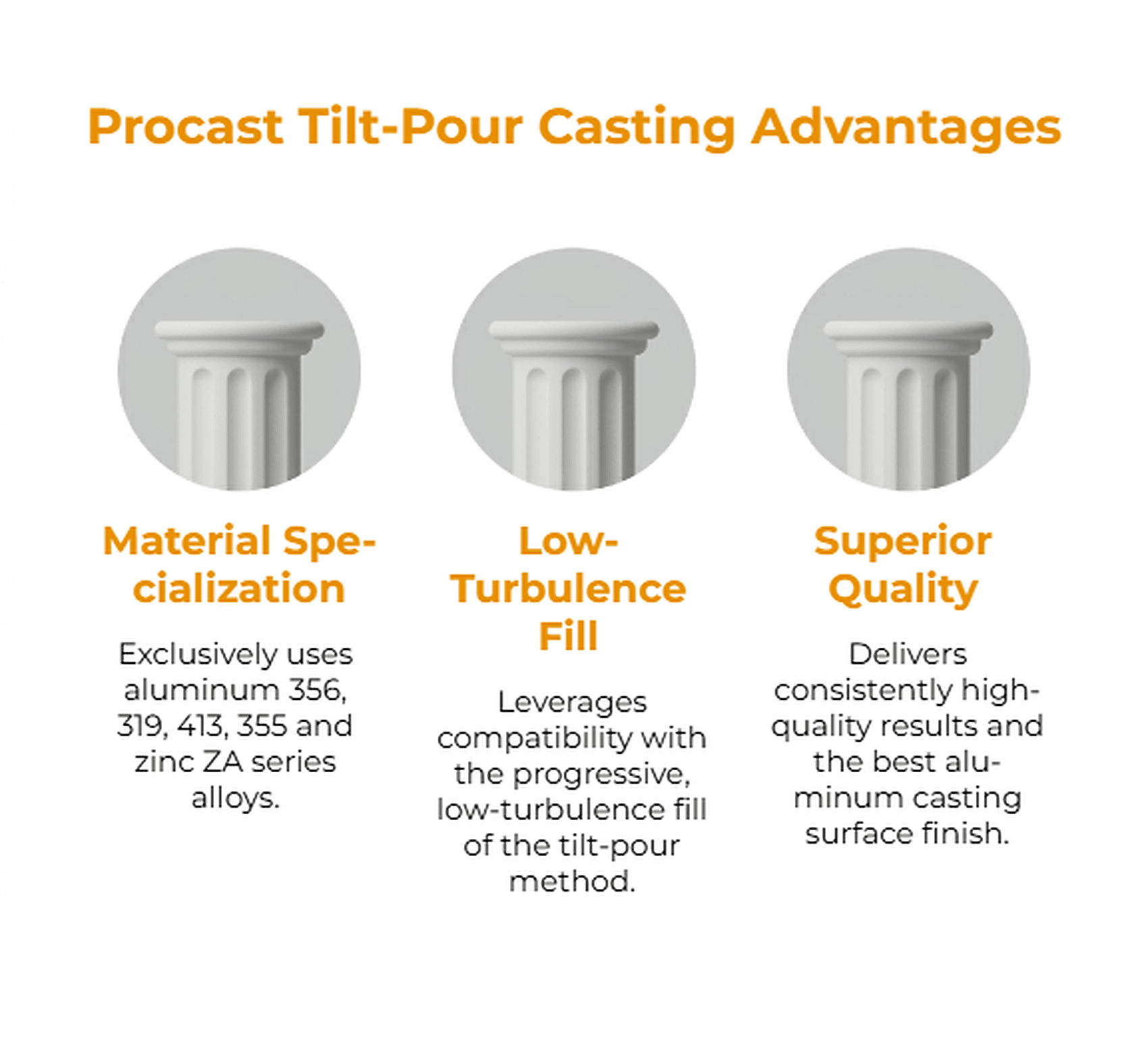
While the tilt pour casting process can, in principle, be applied to other metal families, Procast specializes exclusively in aluminum (356, 319, 413, and 355 when requested) and zinc (ZA series) alloys, leveraging their compatibility with the progressive, low-turbulence fill of the tilt-pour method to deliver consistently high-quality results. This focus ensures clients receive the best aluminum casting surface finish and precision required for demanding industrial applications.
Comparative analysis: Process capabilities and constraints
Can you explain the main differences between tilt pour casting and traditional gravity die casting?
Understanding the distinction between tilt casting and traditional gravity die casting is essential for selecting the right process for your application. The following comparison highlights the operational and quality differences:
- Fill turbulence: tilt casting uses computer-controlled rotation to fill the mold, producing laminar flow and minimizing turbulence. Gravity die casting relies on vertical pouring, which often causes more turbulence and a higher risk of oxide formation.
- Achievable tolerance and surface finish: the gentle fill of tilt casting supports tighter dimensional tolerances and a better aluminum casting surface finish, while gravity die casting may show more variation due to turbulent flow.
- Microstructural density: the progressive fill in tilt pour casting promotes directional solidification and reduces porosity, yielding higher density and improved mechanical properties compared to gravity die casting.
- Cycle behavior: tilt pour casting typically involves slightly longer cycle times due to the controlled rotation, but delivers higher first-pass yield and reduced post-casting rework.
Are there any limitations or challenges associated with using tilt pour casting for manufacturing?
While tilt pour casting offers clear advantages in quality and precision, especially for custom aluminum castings and custom casting molds, it has constraints. The mechanical complexity of the rotating mold assembly brings higher capital and setup costs than static-pour gravity casting. Practical limits on part size and mass also exist, dictated by the tilt mechanism’s capacity.
In addition, engineering and fabricating custom casting molds for tilt casting requires specialized expertise and precision to ensure the process delivers its full benefits. The process also demands careful design of gating and venting systems to fully realize the advantages of laminar fill and directional solidification. For some part geometries — especially those with deep or intricate internal features — integrating sand cores within tilt pour molds can introduce additional complexity, requiring advanced simulation and validation to avoid internal defects or porosity.
Finally, tilt pour casting cycle times are typically longer than for traditional gravity die casting because of the controlled rotation and solidification profile. However, these longer cycles are often offset by higher first-pass yield and a reduced need for secondary finishing, particularly when the best aluminum casting surface finish is required. See also Are there any limitations or challenges associated with the tilt pour casting process?
Hybrid tooling: Sand core integration in tilt pour molds
Integrating expendable sand cores into a tilt-poured semi-permanent mold enables internal passages, undercuts, and complex geometries that rigid metal cavities cannot form. Sand cores act as thermal insulators, slowing heat extraction from the surrounding metal. This changes the local solidification pattern: metal adjacent to the steel mold chills and solidifies quickly, while metal against the sand core remains molten longer. Managed correctly, this promotes directional solidification towards risers, reducing shrinkage defects in critical sections. However, if not properly engineered, the insulating effect can create hot spots and localized porosity near core surfaces.
Another trade-off is interior surface finish. Because sand cores are granular, the internal walls they form have a coarser texture and higher surface roughness than exterior surfaces cast against polished steel. Where higher precision is required, secondary machining may be specified.
Core variables govern not just thermal behavior, but also dimensional outcome. Core type, resin content, and knock-out timing each independently influence the shrink factors used to size tooling, alongside section thickness and position relative to the parting line. (Stein et al., International Journal of Metalcasting, 2022. Source)
Core removal must also be considered; cores must be designed for complete breakdown and extraction after casting, and complex geometries can complicate this step.
Can you explain how the use of sand cores impacts the final properties or quality of cast parts?
Sand cores in tilt pour casting fundamentally influence both the microstructural and surface characteristics of custom aluminum castings. Their insulating properties alter the solidification profile, which can reduce shrinkage in key areas and promote directional solidification. However, this same effect can introduce localized porosity if not carefully managed through simulation and engineering controls.
The granular nature of sand cores also means that the internal surfaces of castings will not achieve the best aluminum casting surface finish possible with metal-on-metal molds; instead, these surfaces may require additional machining if a finer finish is specified. Core design and removal are critical to avoid residual sand and to ensure precise internal geometries, both of which are essential for maintaining the integrity and performance of the final part.
Procast addresses these challenges through in-house sand core production, an integrated Tool & Die department, and advanced engineering and Solidification Analysis. We model and validate all sand core and tooling designs before production to ensure dimensional accuracy and casting quality. After casting, our ISO 9001:2015-certified quality system, supported by CMM inspection, CNC machining, and air decay and underwater pressure testing up to 150 psi, ensures each casting meets stringent requirements. For an in-depth look at sand core failure modes and mitigation strategies, see What are the main challenges or limitations associated with using sand cores in semi-permanent mold casting?
Conclusion
Tilt pour casting delivers superior surface finish, tight tolerances, and structural integrity for custom aluminum castings. Leveraging controlled laminar flow and advanced solidification analysis, Procast reduces turbulence and porosity to achieve optimal mechanical properties. Our integrated process, engineering, simulation, tooling, sand core production, and ISO 9001:2015-certified quality control ensure seamless coordination and reliable, on-time delivery.
Related reading
Tilt casting is a specialized form of permanent mold casting: the metal still solidifies against a reusable metal die, but the die is rotated during filling so the melt arrives without the turbulence of a direct pour. If you need more information on the parent process, see Permanent Mold Aluminum Casting.
If your next project requires the best aluminum casting surface finish, tight tolerances, or complex internal geometries, contact us today to discuss how our tilt pour casting expertise can deliver a turnkey solution tailored to your requirements.