Are there specific design limitations or considerations when choosing semi-permanent mold casting for complex aluminum components?
August 28, 2026
Complex aluminum components frequently arrive at the foundry carrying internal geometry that a rigid steel cavity alone cannot draw — precisely the condition where the hybrid tooling of semi-permanent mold casting earns its place. Yet the same sand-core flexibility that unlocks cored passages also imposes a distinct set of engineering constraints that must be resolved before tooling is committed.
Are there specific design limitations or considerations when choosing the semi-permanent mold casting process for complex aluminum components? The short answer is yes, and they are largely predictable, quantifiable, and resolvable at the CAD stage.
Author: Wes Parker, President and CEO, ProCast Technologies Inc.
Key takeaways
- Semi-permanent mold casting occupies a hybrid niche between sand and die casting, delivering smoother surfaces and tighter dimensional repeatability than sand casting while accommodating internal geometry a fully rigid mold could never release.
- The dominant design constraints are draft angle, fillet radius, minimum practical wall thickness, and uniform section transition, each mapped to a specific macro-defect it prevents. Tolerance and surface-finish expectations feed back into the same decisions, shaping mold configuration, cooling behavior, and the need for secondary CNC machining.
- Solidification simulation resolves fill, feeding, and shrinkage questions before any mold steel is cut, and while the model is still inexpensive to change. That front-loading is what makes the process viable at medium production volumes, where tooling amortizes at roughly one-tenth the cost of comparable pressure die cast tooling.
Process overview: How semi-permanent casting stacks up
Semi-permanent mold casting is a hybrid process that unites a durable steel (permanent) mold with expendable sand cores, positioning it between sand casting and die casting in terms of cost, precision, and geometric freedom. The steel cavity imparts the smoother as-cast surface and tighter dimensional repeatability characteristic of permanent mold, while the sand core allows internal complexity, undercuts, negative draft, and intricate passages that a fully rigid tool could never eject. Dimensionally, the process occupies a middle band: superior to the liberal tolerances typical of sand casting, yet looser than high-pressure die casting, with external walls formed by steel trending smoother than internal surfaces formed by sand.
Tooling and first-article timelines are correspondingly moderate; contingent on shop workload, often on the order of 6 to 12 weeks from model to first samples. Accounting for those aluminum casting lead times early prevents late-stage redesign.
For a step-by-step breakdown of how the process unfolds from design to finished part, see our overview on What are the main steps involved in the semi-permanent mold casting process, and how long does it typically take?
Where the process fits: applications and volume
Semi-permanent mold casting suits components defined by complex internal geometry, medium production volumes, and a requirement for pressure tightness or high structural density. Parts that must contain fluid, resist leakage, or carry load without internal voids benefit from the rapid, directional solidification the steel mold enforces, while the sand core delivers the cored passages those functions demand.
What types of industries or specific products benefit most from using semi-permanent mold casting for aluminum parts?
As a property of the process rather than any single supplier’s customer base, semi-permanent mold castings are commonly specified for product families such as cylinder heads, engine blocks, suspension components, pump and valve bodies, sealed housings, and structural brackets — geometries that share cored internal passages with demanding soundness requirements. On volume, the economics are decisive: the process is strongest at medium quantities — roughly the 500-to-50,000-piece band — where tooling amortizes sensibly without the capital burden of a hardened die.
At very high annual volumes, the calculus shifts toward high pressure die casting, whose expensive tooling is justified only by enormous throughput; below that threshold, semi-permanent mold tooling typically runs on the order of one-tenth the cost of a comparable die-casting tool.
Market analysis: Eligible industries and high-spec products
Semi-permanent mold casting’s unique combination of geometric flexibility and robust mechanical properties positions it as a preferred solution for industries and applications demanding both complexity and reliability. The process is especially relevant to sectors where components must meet stringent requirements for leak-tightness, dimensional accuracy, and structural integrity, qualities that are critical for safety, regulatory compliance, and long-term performance.
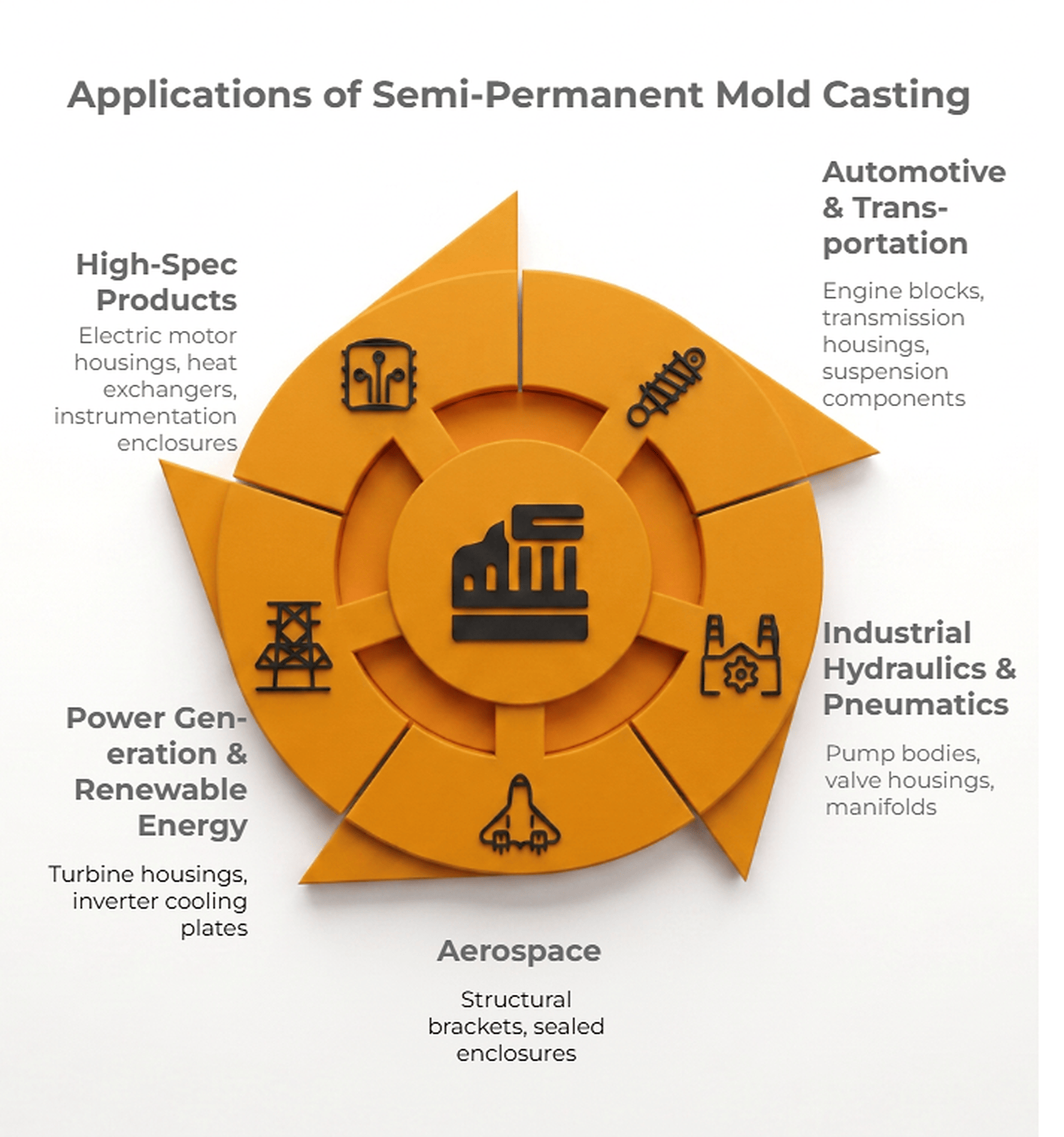
Eligible Industries: The automotive and transportation sectors rely heavily on semi-permanent mold castings for engine blocks, cylinder heads, transmission housings, and suspension components, where internal cooling passages and pressure containment are non-negotiable. Industrial hydraulics and pneumatics manufacturers specify the process for pump bodies, valve housings, and manifolds, leveraging the ability to integrate complex fluid paths with minimal post-processing. Aerospace suppliers turn to semi-permanent mold casting for structural brackets and sealed enclosures, balancing weight reduction with the need for mechanical soundness. Power generation and renewable energy applications, such as turbine housings or inverter cooling plates, benefit from the process’s capacity to deliver intricate internal channels and robust, pressure-tight castings at moderate production volumes.
High-Spec Products: Beyond industry verticals, the process is routinely chosen for products that combine challenging geometry with demanding service environments. Examples include water-cooled electric motor housings, high-pressure pump and compressor bodies, heat exchanger components, and instrumentation enclosures requiring both EMI shielding and environmental sealing. In each case, the ability to produce thin-walled, cored, and pressure-tight castings with consistent dimensional tolerances is central to the product’s function and market competitiveness.
These market realities are reflected in procurement trends: OEMs and Tier 1 suppliers increasingly specify semi-permanent mold castings for medium-run, high-value components where rapid prototyping, flexible engineering changes, and reliable performance are essential. The process’s lower tooling investment relative to die casting enables faster design iteration and cost-effective entry into new product lines, while the integrated engineering and quality controls offered by partners like Procast ensure that even the most complex parts are delivered on time and to specification.
Structural engineering: design rules and hard limits
The core design constraints of semi-permanent mold casting reduce to three foundational parameters: adequate draft angle (minimum 3° and in some cases 2° depending on the part), generous fillet radii at each section junction, and an honest accounting of what geometry a rigid metal cavity can physically release. Because the permanent mold does not collapse, any external feature that cannot be drawn along the die-open direction must be redesigned, relocated to the sand core, or formed by a retracting slide.
What are the design considerations for casting?
They begin with manufacturability; draft, radii, and wall uniformity govern whether a part fills cleanly and ejects undamaged.
What are the manufacturing considerations in the design of castings?
They extend to how the mold is gated and fed, where cores are seated and vented, and how the assembly cools, because solidification sequence, not merely final shape, dictates soundness.
Are there specific design limitations or considerations when choosing semi-permanent mold casting for complex aluminum components?
Yes. Beyond the draw-direction constraint, section thickness, core placement, and gating cannot be engineered in isolation. Each one shifts where the casting solidifies last, and therefore where defects concentrate. For complex parts, early collaboration with engineering and simulation teams is essential to optimize geometry for both function and castability.
For decision-makers, it is critical to understand how aluminum casting tolerances and aluminum casting surface finish expectations shape the engineering process from the outset. Tighter tolerances (below 0.005” on parting line and 0.010-0.015” for cross parting lines) require careful mold configuration and may drive the need for secondary CNC machining, especially on critical dimensions or sealing surfaces.
The permanent mold delivers superior as-cast surfaces compared to sand, but internal features formed against sand cores will have a rougher finish, so post-processing requirements should be identified early. Minimum practical wall thickness is set by fill behavior: aluminum flowing under gravity sheds fluidity as it chills against steel, so sections thinner than roughly 0.187” risk misruns where the metal freezes before the cavity fills.
Conversely, isolated heavy sections that solidify last, unfed by a riser, contract into shrinkage porosity. These are classic aluminum casting defects, and solutions are engineered at the design stage: uniform section thickness, deliberate tapers, and robust solidification analysis all help steer directional solidification toward risers and away from defect-prone regions. By leveraging advanced simulation and in-house engineering expertise, Procast resolves these challenges before tooling is committed, ensuring reliable manufacturability and long-term part performance.
To explore how these engineering choices impact the end result, including mechanical properties and service life, read our discussion on How does the quality or durability of aluminum parts from semi-permanent mold casting compare to other methods like sand or die casting?
Conclusion
Semi-permanent mold casting offers a unique balance of geometric flexibility, mechanical soundness, and cost-efficiency for complex aluminum components, provided that design teams understand and address its specific engineering constraints. Early integration of solidification analysis, precise CAD modeling, and direct collaboration with an experienced casting partner ensures that draft, wall thickness, and core configuration are optimized before any steel is cut. This proactive approach not only prevents costly rework but also guarantees your parts meet demanding structural and performance requirements from first article through full production.
Related reading
If you need more information on how these design constraints compare with those of the fully metallic process, see Permanent Mold Casting Advantages and Disadvantages.
If you are evaluating casting processes for your next project or need expert guidance on manufacturability, connect with Procast’s engineering team. Leverage our end-to-end expertise, from design and simulation through tooling, casting, and assembly, to achieve high-quality, turnkey aluminum castings that perform as engineered and deliver on schedule.