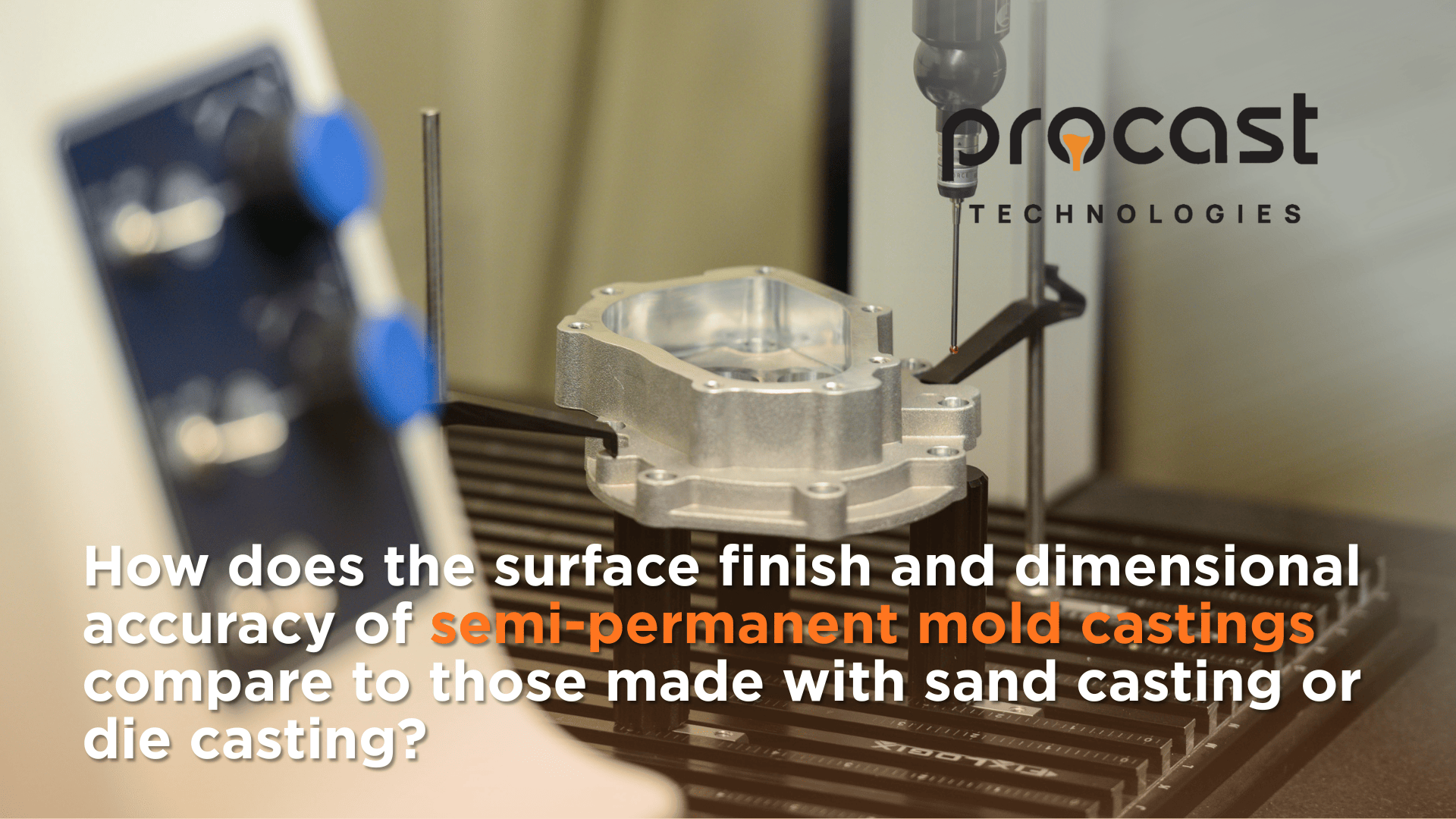
How does the surface finish and dimensional accuracy of semi-permanent mold castings compare to those made with sand casting or die casting?
August 28, 2026
Specifying a casting process begins with two measurable questions: how smooth the as-cast surface will be, and how tightly the geometry can be held across a full production run. Semi-permanent mold casting occupies a deliberate middle ground, markedly finer and more repeatable than sand casting, without the tooling investment or volume commitment that die casting demands.
Author: Wes Parker, President and CEO, ProCast Technologies Inc.
Key takeaways
- Semi-permanent mold casting commonly holds as-cast tolerances near 0.005” on the parting line, and 0.010-0.015” across cross-parting lines.
- The steel mold’s high thermal conductivity and rigidity enable both smoother surfaces and better run-to-run dimensional repeatability, while internal features formed by sand cores follow sand-casting shrink behavior.
- When a print demands tolerances tighter than the as-cast band, targeted CNC machining is the economical route, applied only to the features that genuinely require it.
What is the surface finish of permanent mold casting?
Permanent and semi-permanent mold castings typically have an as-cast surface roughness of roughly 160-400 RMS, yielding a uniform, semi-smooth texture noticeably cleaner than the grainy matte of a sand casting. The mold casting process governs this outcome through three levers: tooling condition, mold coating selection, and thermal management.
A steel mold reproduces its own machined finish onto the part, so the refractory coating that protects the die and controls heat extraction becomes the dominant variable in the final aluminum casting surface finish. A heavier insulating coat slows solidification and softens texture, while a thin release coat preserves detail on low-draft features. Die casting achieves the smoothest surface of the three.
How do engineers choose between sand casting, permanent mold casting, and die casting?
The selection depends on several interacting criteria: part complexity, required dimensional accuracy, surface-finish specification, production volume, and the resulting tooling and per-piece cost structure. Sand casting has the lowest tooling cost, but sacrifices finish and repeatability; die casting delivers the tightest as-cast tolerances and best finish but only amortizes its steel-tool and machine costs at high volumes.
Semi-permanent mold casting resolves the tension by combining a rigid steel outer mold with expendable sand cores, capturing permanent-mold surface quality and dimensional consistency while still forming complex internal passages and negative-draft features that a fixed metal core could never withdraw from.
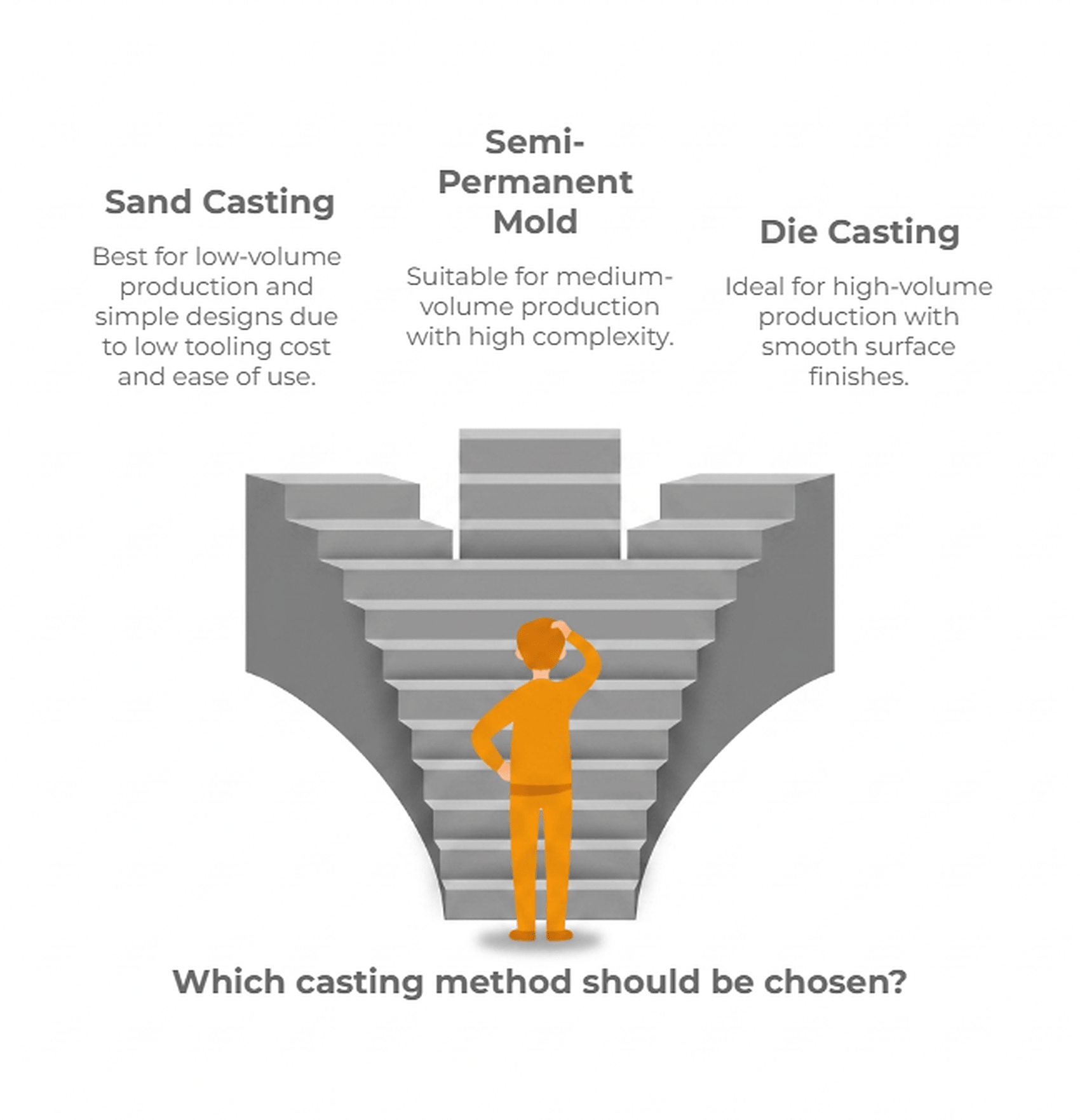
This is where an integrated supplier justifies its place in the decision. Procast pairs in-house engineering and Solidification Analysis with an integrated Tool & Die department and air decay and underwater pressure testing to 150 psi under an ISO 9001:2015-certified quality system. This enables it to work the medium-volume band of roughly 500 to 50,000 pieces at about one-tenth the tooling cost of die casting, where semi-permanent mold economics are strongest.
Deep dive: Surface finish and dimensional accuracy across methods
Achievable tolerance bands track directly with mold material, as does dimensional repeatability over a run. Semi-permanent mold casting commonly holds as-cast tolerances near 0.005” on the parting line, and 0.010-0.015” across cross-parting lines, tolerances that sand casting cannot approach and that die casting achieves only with substantially higher tooling investment.
The mechanism is thermophysical: a high-conductivity, dimensionally stiff steel mold extracts heat rapidly and resists thermal distortion, so it both reproduces a smoother face and returns to the same cavity geometry pour after pour. An expendable sand mold, by contrast, is destroyed and re-rammed for every part, injecting mold-to-mold variation that a permanent tool eliminates. This is the single most consequential variable in any mold casting process: what the metal freezes against determines what the metal becomes.
Repeatability also varies within a single semi-permanent casting. Surfaces formed by the steel mold (typically the OD) hold tighter repeatability than surfaces formed by the sand core (typically the ID), which shrink and vary like a sand casting (Stein & Sanders, International Journal of Metalcasting, 2022). That consistency tends to drift as tooling ages, which is why long programs benefit from periodic tool correction.
Where a callout falls inside the as-cast band, the casting ships as poured; where it is tighter — as with bearing bores, sealing faces, and mating flanges — secondary CNC machining is the practical and economical route, the castings being inherently near-net-shape components finished to their functional tolerances. The same rapid, directional solidification that sharpens dimensional control also refines microstructure. See: How does the quality or durability of aluminum parts from semi-permanent mold casting compare to other methods like sand or die casting?
How does semi-permanent mold casting reduce porosity and defects?
Semi-permanent mold casting suppresses internal defects relative to gravity sand casting through coordinated controls: a faster, steel-driven cooling rate that shrinks the solidification window, engineered mold coatings that tune local heat extraction, and optimized gating, often via tilt pour, that fills the cavity gently to limit the turbulence and air entrainment that seed gas porosity.
The core of any serious discussion of aluminum casting defects and solutions is fill behavior, because entrapped gas and shrinkage voids that intersect a machined surface are precisely what convert a good casting into scrap. In contrast, a controlled, directional fill keeps porosity below the plane where machining will later expose it, protecting both surface integrity and the dimensional acceptance of finished features. In practice, moving a porosity-sensitive part from a turbulent static pour to a tilt pour has been enough to drive persistent scrap on flame-path flanges to near zero.
Whether that level of soundness meets a given casting porosity acceptance level depends on the applicable standard and the part’s duty cycle. For more on how defects are managed and evaluated, see What are some of the most common defects encountered in tilt-pour casting, and how can they be prevented?
When tolerances exceed the inherent precision of the as-cast process, those features become candidates for machining. At Procast, we evaluate your drawings against our as-cast capabilities, ensuring machining is reserved only for features that truly require it.
Related reading
If you need more information on the permanent mold process itself and on the trade-offs that set these tolerance and finish limits, see Permanent Mold Aluminum Casting and Permanent Mold Casting Advantages and Disadvantages.
Contact our team, and we will clearly identify which features we can deliver as-cast and which will need additional machining.