Semi-Permanent Mold Casting: Process, Benefits & Applications
August 28, 2026
Semi-permanent mold casting occupies a position that neither fully expendable nor fully permanent processes can satisfy alone. It combines a reusable metal mold cavity with expendable sand cores, giving a single part the accuracy of permanent tooling and the design freedom of sand casting.
This guide covers the terminology, production sequence, sand- and pressure-die casting feasibility comparisons, financial break-even point, and geometric envelope involved in the process, as well as the components and sectors it best serves.
Author: Wes Parker, President and CEO, ProCast Technologies Inc.
Key Takeaways
- Semi-permanent mold casting pairs a reusable metal mold with expendable sand cores: the mold delivers exterior accuracy; the cores deliver internal undercuts and zero-draft passages no rigid tool can withdraw from.
- The working envelope comprises ±0.005” within one mold half and ±0.010 to ±0.015” across parting lines, 160 to 400 RMS as-cast, 0.1875-inch minimum wall, and three-degree exterior draft.
- The economics remain viable from 500 to 50,000 pieces per year at roughly one-tenth the tooling cost of pressure die casting, with porosity controlled upstream through degassing, riser placement, and directional solidification.
Foundations of Semi-Permanent Mold Casting: Definitions and Terminology
Semi-permanent mold casting is a gravity-fed aluminum casting process that combines a precision-machined, reusable metal mold with chemically bonded sand cores that are destroyed and replaced each cycle. The metal mold governs exterior accuracy and surface quality. The sand cores form internal features no rigid tool could produce or withdraw.
The process bridges an operational gap. Expendable mold casting destroys both the mold and the core with each cycle, trading dimensional repeatability for geometric freedom. Fully permanent tooling delivers repeatability but constrains geometry to positive draft. This process combines the dimensional behavior of the first and the freedom of the second.
What is semi-permanent mold casting?
Semi-permanent mold casting is a gravity-fed aluminum casting process in which a precision-machined metal mold, typically ductile iron or tool steel, is combined with chemically bonded sand cores to form the complete part geometry. The mold halves are reused across production runs. The cores are regenerated each cycle. That division of labor essentially defines the process.
The metal cavity delivers repeatability because its thermal mass and machined precision remain constant over thousands of cycles. The cores create undercuts, recessed channels, branching passages, and negative-draft walls that no rigid mold element could extract from a solidified casting.
The distinction matters most where internal geometry is functional rather than cosmetic: pressure-containing housings with cast-in passages, manifolds, and enclosures where a machined sealing surface must be backed by sound metal.
What does the term semi-permanent mold casting refer to?
The terminology reflects the hybrid tooling system. The reusable iron or steel mold halves are the permanent element. But because the expendable sand cores are replaced each cycle, the “semi” designation applies.
Because the mold is fixed tooling while the core is regenerated every cycle, part consistency depends heavily on core production. Core box precision, resin content, and handling feed directly into final dimensions. This defines core manufacturing as a controlled process step rather than a consumable supply activity.
Process Mechanics: How Semi-Permanent Mold Casting Works
How does semi-permanent mold casting work?
The sequence begins in engineering. Tooling design validated through thermal flow simulation establishes mold geometry, core box configuration, gating, and solidification sequence before any steel is cut.
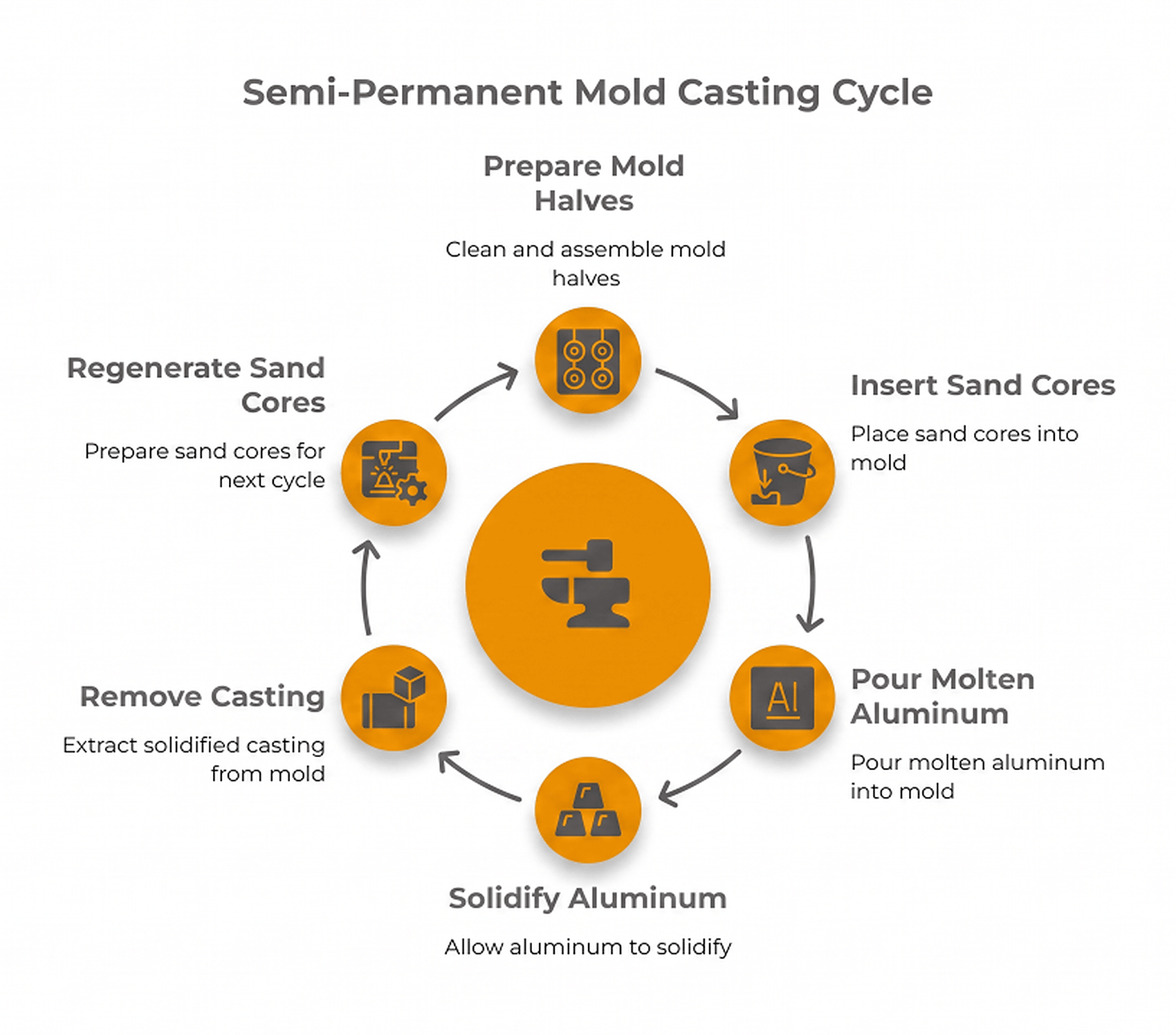
That simulation phase identifies shrinkage-prone regions and optimizes riser placement before defects can manifest in production. The physical cycle then runs in six stages (see semi-permanent mold casting process for additional detail).
- Tool preheating to a stabilized 300°F to 450°F prevents premature solidification at the cavity wall during fill.
- Mold coating, a ceramic die coat applied zone by zone to modulate local heat transfer and support the intended freezing sequence.
- Core setting, with fit-up verified before production. Any gap risks core shift, flash, or metal penetration into the sand.
- Gravity or tilt pouring at 1,225°F to 1,350°F (depending on the alloy), following rotary impeller degassing for reducing dissolved hydrogen to subcritical levels.
- Controlled cooling, applied through water circuits, misting, or air, timed to enforce directional solidification from the section farthest from the riser back toward the feed source.
- Ejection and shakeout, where timing governs both dimensional stability and microstructural response to later heat treatment.
The choice between tilt-pour casting and static pour is a fill-behavior decision, not a preference. Tilt pour suppresses turbulence in tall or thin-walled sections that static pour struggles to fill cleanly. See Tilt pour casting process.
Heat treating eliminates residual sand in enclosed cavities, as elevated temperatures volatilize the binders. Gate removal, CMM inspection, T5 or T6 temper, CNC machining, and pressure testing complete the sequence.
The Role of Automation in Repeatable Metallurgy
In tilt-pour production, an aluminum casting machine executes a programmed rotation sequence with fixed velocity curves, dwell times, and cooling parameters. The machine continuously monitors melt and mold temperatures, and will not initiate a pour outside the established process window. This removes the largest historical source of variability: operator-dependent timing. When one program governs rotation, cooling, and ejection, cycle-to-cycle variation collapses to equipment tolerance.
Core type, resin content, and knock-out timing each independently influence the shrink factors used to size tooling, alongside section thickness and position relative to the parting line. (Stein et al., International Journal of Metalcasting, 2022. Source)
Comparative Analysis: Selecting the Right Casting Methodology
Method selection turns on the combined evaluation of part complexity, tolerance, finish requirements, annual volume, and total cost of ownership. This section frames the decision criteria; the benchmark detail sits in the supporting articles.
How do I choose the right expendable mold casting method for a specific metal or project?
The decision hinges on three points: geometric complexity, required metallurgical integrity, and volume. For complex internal geometry with pressure tightness at medium volumes, semi-permanent mold casting is the rational choice. For one-off or very large parts, fully expendable methods remain more economical. For simple high-cycle geometry, pressure die casting wins on unit cost. Each reusable-mold variant shifts this calculus.
Can you explain how semi-permanent mold casting compares to traditional sand casting in terms of surface finish and dimensional accuracy?
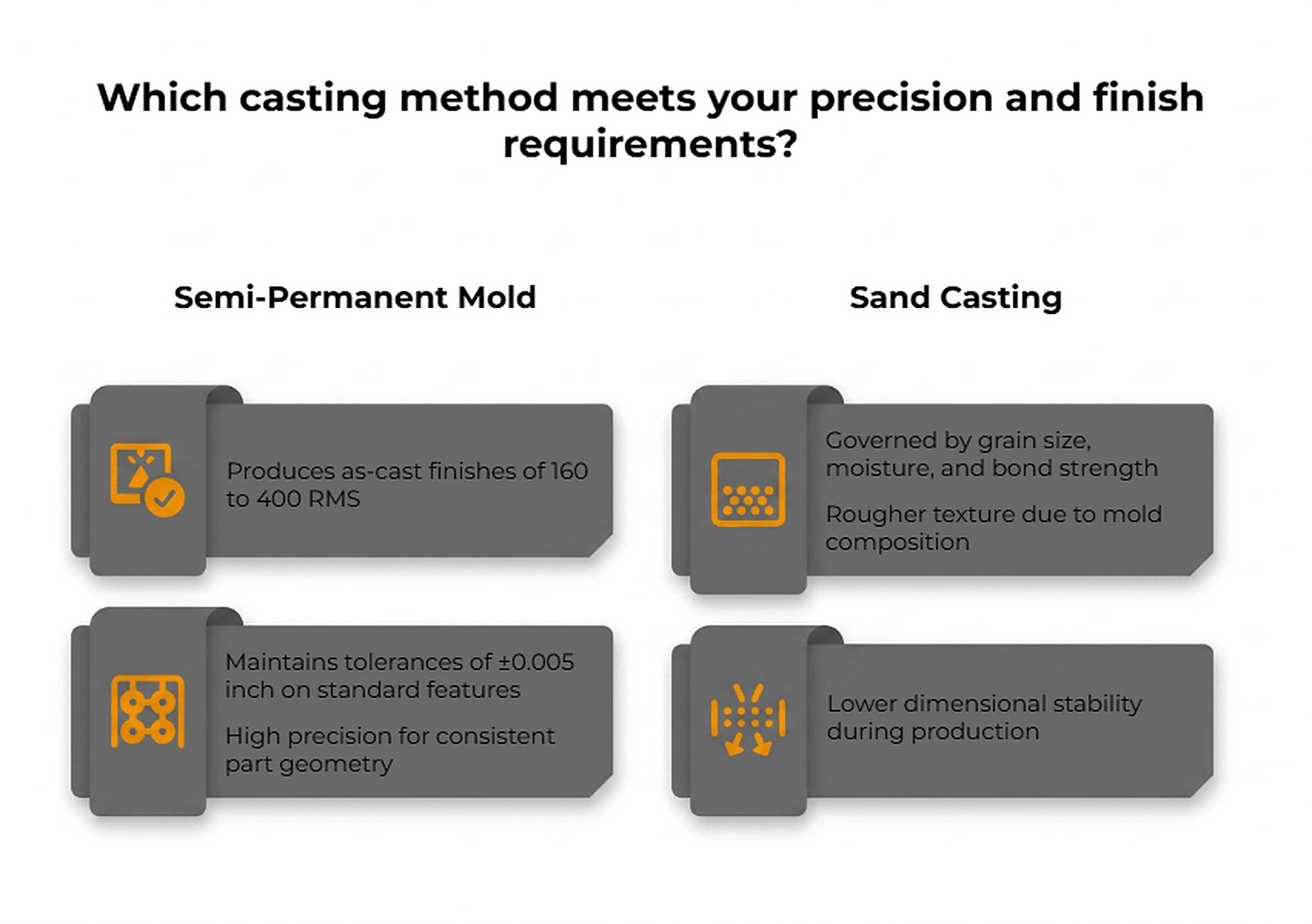
The metal mold produces as-cast finishes of 160 to 400 RMS. At production scale, sand casting cannot reliably match this given that its surface finish is governed by grain size, moisture, and bond strength.
Tolerances of ±0.005 inch on standard features, widening to ±0.010 to ±0.015 inch across parting lines, tighten measurably on sand casting’s envelope. See: How does the surface finish and dimensional accuracy of semi-permanent mold castings compare to those made with sand casting or die casting?
What are the advantages of semi-permanent mold casting compared to sand casting or die casting?
Compared to sand casting, semi-permanent mold casting offers tighter tolerances, a better surface finish, a finer microstructure, and higher repeatability — at a per-part casting cost roughly 30 to 40% lower. The metal mold’s higher thermal conductivity accelerates solidification, resulting in finer dendrite arm spacing and a denser grain structure.
The effect compounds in heat-treatable alloys, where refinement amplifies the T6 response. Alloy development for these processes has focused on that intersection of castability, high-temperature performance, and heat-treatment economics. Major & Hartlieb, International Journal of Metalcasting, 2009.
The differentiation between semi-permanent mold casting and pressure die casting lies in metallurgical integrity and part size. Die casting forces aluminum alloy into a closed die at pressures above 1,000 psi, producing excellent finishes but also elevated dissolved gas and trapped oxide films. That limits pressure-tight and heat-treatable applications. Gravity fill at controlled velocity produces a denser microstructure and accommodates parts from a few ounces to 120 pounds.
Economic Viability and Production Volume Thresholds
What production volume is typically needed for semi-permanent mold casting to become cost-effective?
Roughly 500 pieces per year. Below that, amortized tooling and qualification costs make the process uncompetitive against sand casting. The defensible operating range runs from 500 to 50,000 pieces per year, at roughly one-tenth the tooling cost of an equivalent die-casting program. That is a medium-volume position, and it is deliberate: sand casting delivers insufficient quality, and die casting incurs excessive capital cost.
Break-even against sand casting, where savings from better finish and reduced machining allowances offset the tooling investment, typically falls between 1,500 and 2,500 parts for a mid-complexity component.
Multi-cavity tooling compounds the effect. A four-cavity mold quadruples throughput per cycle while overhead stays nearly constant. Among aluminum casting companies serving technically demanding sectors, simulation-driven multi-cavity capability is one of the most significant differentiators in production economics.
Is casting cheaper than forging?
For complex aluminum geometries at medium volumes, yes. Forging dies for comparable components routinely cost three to five times more than a semi-permanent mold program.
Forging generates scrap proportional to the volume machined away. Casting produces near-net-shape parts with those features already formed, requiring only finish machining.
For items such as suspension knuckles, connecting rods, and highly loaded structural brackets where forging’s superior grain flow is genuinely required, the premium is justified, and casting is the wrong answer.
Advanced Geometry: Capabilities, Design Limitations, and Defect Mitigation
Can complex internal geometries or thin walls be produced with semi-permanent mold casting?
Yes, within parameters set during design. The minimum wall thickness is 3/16 inch; below this, gravity-fill dynamics make consistent wall formation unreliable. Exterior surfaces require a three-degree draft, with two degrees achievable depending on the part.
Core surfaces follow different rules. Because the core is destroyed at shakeout rather than withdrawn, core-formed surfaces permit zero-draft and negative-draft geometry, including internal undercuts and reverse tapers, that no rigid mold process can produce. That asymmetry between exterior and interior design rules is the single most important thing to understand when designing for the process.
Thin-Wall Feasibility and Design for Manufacturability
What are the main design limitations or challenges when using semi-permanent mold casting for complex aluminum components?
Three constraints dominate: parting line placement, core vent path geometry, and part weight. Parting line position determines which features inherit the wider tolerance, so a critical bore straddling the line is a dimensional decision, not just a tooling one. Vent path geometry determines whether binder decomposition gases escape without producing blowholes, with long or fully enclosed cores at the highest risk. Part weight is bounded at 120 pounds by machine capacity.
External undercuts require side cores or hydraulic pulls, adding cost and cycle time. Internal undercuts are achieved through core geometry at no cycle penalty. Sand cores involve trade-offs in stability, venting, and removal. For more information, see What are the main challenges or limitations associated with using sand cores in semi-permanent mold casting?
Identifying and Mitigating Common Defects
What types of defects are most common in semi-permanent mold casting, and how can they be minimized?
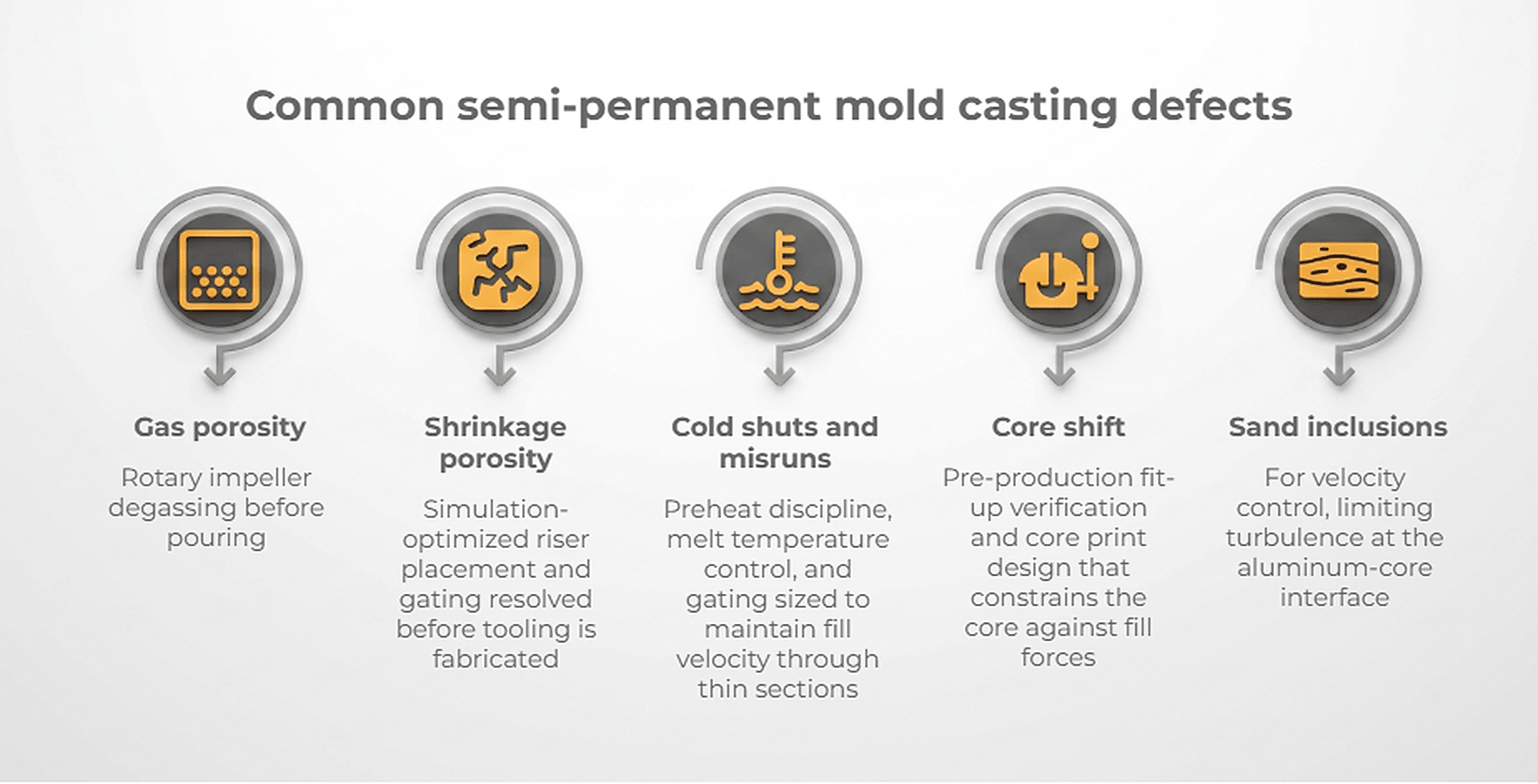
The defects include gas porosity, shrinkage porosity, cold shuts, misruns, core shift, and sand inclusions. Each has a distinct origin and mitigation that belongs in the production workflow, not post-cast inspection.
- Gas porosity: rotary impeller degassing before pouring
- Shrinkage porosity: simulation-optimized riser placement and gating resolved before tooling is fabricated
- Cold shuts and misruns: preheat discipline, melt temperature control, and gating sized to maintain fill velocity through thin sections
- Core shift: pre-production fit-up verification and core print design that constrains the core against fill forces
- Sand inclusions: for velocity control, limiting turbulence at the aluminum-core interface
How does semi-permanent mold casting reduce porosity and defects?
The reduction occurs through three mechanisms operating simultaneously. Accelerated heat extraction compresses the window during which dissolved hydrogen can nucleate into pores, since hydrogen solubility drops sharply at the liquid-to-solid transition. (Totten & MacKenzie, Handbook of Aluminum, Marcel Dekker). Directional solidification lets liquid aluminum continuously feed volumetric contraction. Controlled pour velocity limits oxide film entrainment during fill.
Because these three operate in tandem, no single process variable can explain how semi-permanent mold casting reduces porosity and defects. Porosity control fundamentally results from tooling design rather than pouring technique.
Advanced Simulation and Validation Infrastructure
Procast performs Solidification Analysis simulation during the engineering phase and validates finished castings through CMM inspection, air decay, and underwater pressure testing to 150 psi, under an ISO 9001:2015-certified quality system.
An aluminum casting foundry that builds soundness in from the start and then verifies it has a different quality risk profile than one that relies on inspection to catch what the process let through.
Strategic Industrial Deployment and Market Applications
Are there specific industries or applications where semi-permanent mold casting is especially advantageous?
The components that benefit most share three traits: complex internal geometry, pressure tightness requirements, and volumes that justify permanent tooling. Gearbox housings require zero porosity at machined oil retention surfaces, since a pore intersecting a sealing face scraps the part regardless of how sound the rest of the casting is. Hydraulic manifolds need cast-in passages that eliminate the cross-drilled intersections and plugs a machined-from-solid manifold requires. Compressor bodies face cyclic pressure loading where fatigue life is governed by the largest defect rather than the average one. Explosion-proof enclosures require a machined flame path completely free of porosity — one of the most demanding requirements in industrial casting.
The sectors where these converge include oil and gas equipment, explosion-proof electrical systems, hydraulic and compressor systems, and driveline components. Automotive aftermarket and performance work fits in volumes of 2,000 to 20,000 that die casting cannot serve economically.
Aerospace and defense components demand certified properties and documented process controls that align with a simulation-driven production model. Across all of these, the aluminum casting company model that controls tooling design through inspection and assembly eliminates the attribution disputes that arise when casting, machining, and inspection sit with separate vendors.
Before the Tooling Exists
Alloy, wall section, core strategy, and target volume all move together in semi-permanent mold casting, and all four are cheapest to change before you cut a mold. Procast reviews part geometry against all four at the design stage. Explore casting capabilities, or send a drawing and target volume to get answers.
Related reading
Semi-permanent mold casting is one branch of the broader permanent mold family: it runs in the same reusable metal die as conventional permanent mold casting, but replaces selected metal cores with expendable sand cores so that internal passages a metal core could never withdraw from can still be cast in one piece. For the wider process family and the parts it produces, see Permanent Mold Aluminum Casting and Permanent Mold Casting Applications.
Unlock the full potential of your manufacturing process with the advanced techniques of semi-permanent mold casting. Dive into our comprehensive resources to learn how this method can improve product quality and efficiency. Contact our experts today to discuss your specific needs and start optimizing your casting operations.