What are the Advantages and Disadvantages of the Permanent Mold Process?
December 12, 2025
In the world of manufacturing, choosing the right casting method is crucial for achieving precision and quality, with both its advantages and disadvantages playing key roles in the decision-making process. This article delves into the benefits and drawbacks of permanent mold casting, providing insights to help manufacturers optimize their production processes. It will facilitate more informed choices to align your project requirements with industry standards. (For a comprehensive overview, visit our Permanent Mold Aluminum Casting pillar page)
What is the Basic Permanent Mold Process?
The permanent mold process involves several key steps that differentiate it from other casting methods, using durable, reusable metal molds that ensure high precision and long-term consistency.
Key Steps in the Permanent Mold Process:
- Mold Preparation: The mold is cleaned, preheated, and sprayed with refractory coatings to ensure proper metal flow and minimize defects.
- Metal Pouring: Molten metal is poured into the mold cavity, allowing it to cool and solidify.
- Casting Removal: Once the metal has cooled sufficiently, the mold is opened to remove the cast part.
Unlike expendable mold processes where molds are destroyed after a single use, permanent molds can be used repeatedly, leading to cost savings and consistent quality over time. This makes permanent mold casting applications for metal particularly advantageous in high-volume production scenarios. Additionally, Procast employs advanced simulation techniques such as Solidification Analysis to mitigate defects before production, further enhancing the reliability of the casting process.
What Materials are Used for Permanent Mold?
The materials used in permanent mold casting are critical to the process’s success. Common materials include:
- → Aluminum Alloys: Lightweight and excellent for thermal conductivity.
- → Zinc Alloys: Known for their corrosion resistance and strength.
- → Copper Alloys: Offer superior durability and thermal properties.
These casting metals are chosen for their ability to endure high temperatures and repeated casting cycles, making them ideal for permanent molds.
These materials are chosen for their ability to endure high temperatures and repeated casting cycles, making them ideal for permanent molds. Understanding the advantages and disadvantages of casting with these materials is essential for optimizing production efficiency. Procast’s commitment to ISO 9001:2015-certified quality ensures that all materials meet stringent industry standards, further enhancing the reliability of the final product.
What are the Three Basic Steps in Casting?
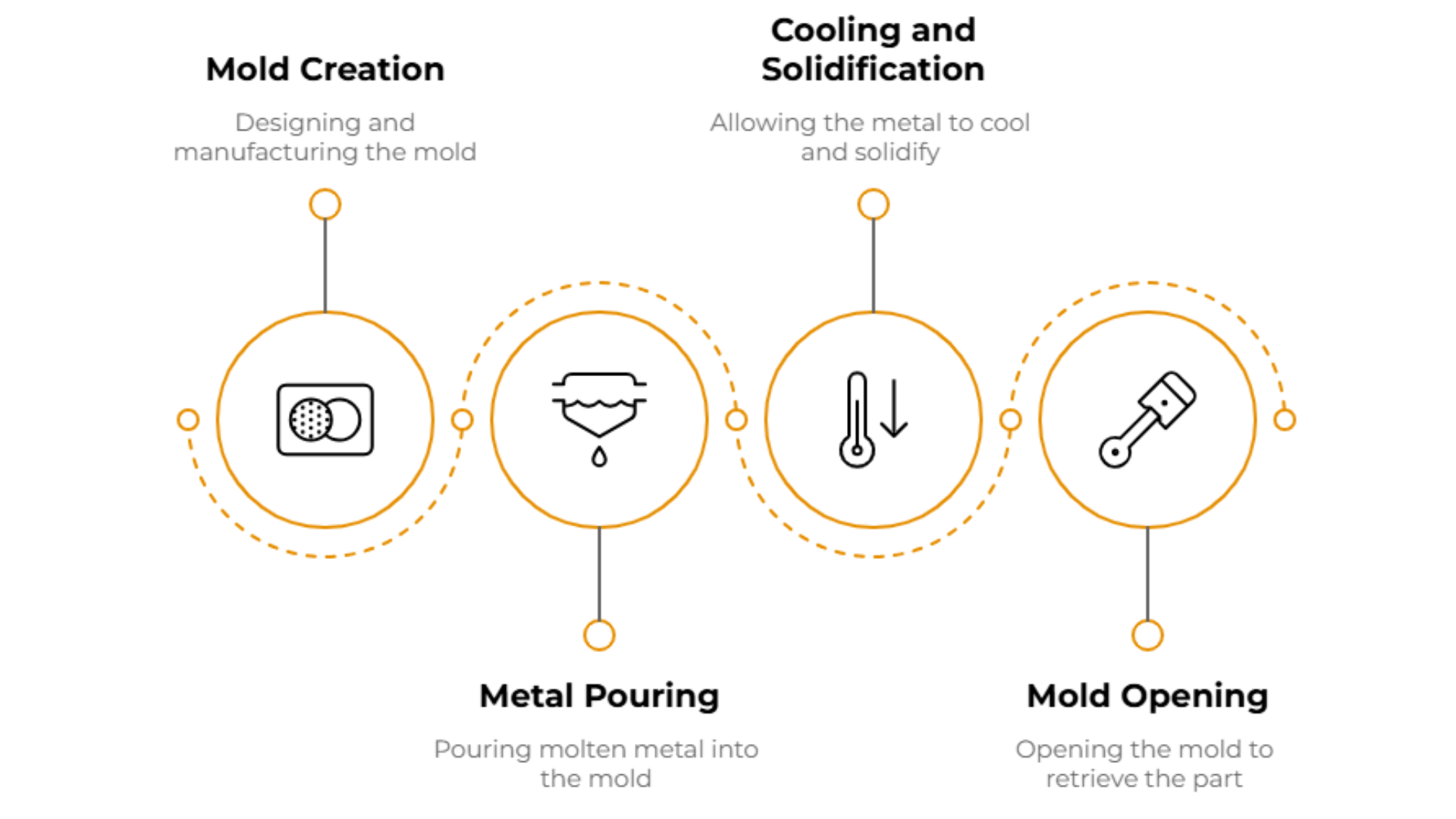
The three fundamental steps involved in the Permanent Mold casting process are:
- Mold Creation: Involves designing and manufacturing the mold, ensuring it meets the specifications for the desired part.
- Metal Pouring: The molten metal is poured into the prepared mold, filling the cavity to form the desired shape.
- Cooling and Solidification: The metal is allowed to cool and solidify, after which the mold is opened to retrieve the finished part.
These steps are crucial for ensuring that the final product meets stringent quality standards. Advanced techniques such as Solidification Analysis further enhance the quality of the cast parts. Procast’s in-house engineering, CNC machining capabilities, and Quality System, provide additional layers of precision and control throughout the entire process.
What is the Difference Between Expendable and Permanent Molds?
Expendable Molds: |
Permanent Molds: |
|---|---|
|
Definition: Molds that are destroyed after a single use. Advantages: ✓Flexibility in design for complex geometries. ✓Lower initial investment. Disadvantages: ✗Higher per-part cost due to the need for new molds. ✗Potential for variability in quality. |
Definition: Reusable molds that can produce multiple parts. Advantages: ✓Cost-effective for high-volume production. ✓Consistent quality and precision across high volume production runs.. Disadvantages: ✗Higher initial setup costs. ✗Limited design flexibility compared to expendable molds. |
A firm understanding of the differences between these two types of molds helps manufacturers decide which process best aligns with their production goals. The choice typically depends on factors such as production volume, part complexity, and budget considerations. Procast’s custom inventory management solutions further alleviate the burden on clients by optimizing their in-house stock levels, making permanent mold casting an even more attractive option for high-volume needs.
Conclusion
If you’re considering the permanent mold casting process for your next project, we invite you to reach out for a consultation. Our team at Procast Technologies is dedicated to providing top-tier custom aluminum casting and machining solutions tailored to your unique project needs.
Frequently Asked Questions
What are the key benefits of using Procast for permanent mold casting?
At Procast, we provide distinct benefits for permanent mold casting:
- Our integrated approach means you receive tailored aluminum castings directly from us, minimizing delays.
- Our skilled team employs innovative design methodologies, such as advanced simulation with Solidification Analysis, to ensure optimal mold performance and efficiency, directly addressing the advantages of the permanent mold process.
- By leveraging our extensive experience in casting materials and in-house CNC machining, we can enhance product longevity and functionality, ensuring superior outcomes.
How does Procast’s technology enhance the permanent mold casting process?
Procast employs advanced technology to enhance the permanent mold casting process:
- Our automated quality control systems, including real-time MES (AMPER), ensure each casting meets stringent specifications, addressing the advantages of consistent quality in permanent mold casting.
- We utilize advanced simulation techniques like Solidification Analysis to eliminate defects before production, significantly improving casting reliability.
Can Procast handle complex designs in permanent mold casting?
Yes, Procast excels at managing complex designs with our permanent mold casting services:
- Our experienced team utilizes advanced CAD software to create precise models, ensuring intricate geometries are accurately produced.
- We implement rigorous testing protocols throughout the design phase, allowing for adjustments that enhance manufacturability.
- Our commitment to quality is reflected in our work with high-tech industries where precision and reliability are paramount, showcasing the advantages of permanent mold casting in producing complex designs efficiently.
What industries benefit the most from Procast’s permanent mold casting?
Procast serves a variety of industries that benefit from our permanent mold casting expertise:
- The Motorcycle sector relies on our precision castings for components that enhance performance, showcasing the advantages of permanent mold casting in producing high-quality parts.
- Explosion Proof applications require lightweight yet durable parts, which we achieve through our innovative casting techniques, illustrating the benefits of this process.
- Our collaboration with the energy sector demonstrates our capability to produce high-strength castings for demanding environments, highlighting the advantages and potential disadvantages of using permanent mold casting in extreme conditions.
What are the limitations of permanent mold casting with Procast?
While permanent mold casting offers many advantages, there are some limitations to consider:
- The initial tooling costs can be higher compared to other methods i.e. sand casting, but at Procast, we offset this with our specialized design capabilities, allowing us to create custom tooling efficiently.
- It is best suited for medium to high-volume production due to the setup costs, which we streamline through our advanced project management techniques and in-house engineering.
- Complex designs may require additional engineering time, which our experienced team, equipped with cutting-edge simulation technology, is well-prepared to manage effectively.
How does Procast ensure quality in permanent mold casting?
Quality is paramount at Procast, and we implement several measures to ensure it:
- Our rigorous testing protocols include non-destructive testing methods to identify potential flaws without damaging the castings, which is crucial for maintaining the advantages of permanent mold casting.
- We utilize advanced alloy compositions tailored to specific applications, enhancing the performance and longevity of our products.
- Our skilled technicians conduct regular training sessions to stay updated on the latest industry standards and best practices.
What is the typical lead time for permanent mold casting at Procast?
Lead times for permanent mold casting at Procast are optimized through our integrated processes:
- Typically, lead times can range from 6 to 18 weeks based on design intricacy and the advantages of permanent mold casting, such as improved surface finish and dimensional accuracy.
- Our dedicated team focuses on efficient project management, ensuring timely communication and updates throughout the process.
- For priority projects, we implement fast-tracking measures to meet tight deadlines without compromising quality.
How does Procast manage changes during the permanent mold casting process?
Procast is well-equipped to manage changes during the permanent mold casting process:
- Our dedicated project managers facilitate swift adjustments to designs based on client input or evolving specifications, ensuring that any advantages or disadvantages of the permanent mold process are addressed promptly.
- We leverage our advanced ERP system and real-time MES systems to track production changes, ensuring efficiency and quality.
- Regular updates and collaborative discussions with clients are integral to our workflow, fostering transparency and satisfaction.
Let’s work together to elevate your manufacturing capabilities. For more information, please visit our contact page.