How does the quality or durability of aluminum parts from semi-permanent mold casting compare to other methods like sand or die casting?
August 28, 2026
When evaluating aluminum casting options, industrial buyers face a complex decision matrix balancing cost, part complexity, durability, and production volume. Understanding the fundamental differences in casting processes is critical to specifying the right solution for robust, high-performance components.
This article examines how the quality and durability of aluminum parts produced via the semi-permanent mold casting process compare to those made with sand casting and die casting. Drawing on Procast’s proprietary methodologies and integrated capabilities, we clarify how process selection impacts mechanical properties, defect rates, and long-term reliability.
Author: Wes Parker, President and CEO, ProCast Technologies Inc.
Key Takeaways
- Compared with sand casting, semi-permanent mold casting delivers superior mechanical durability and dimensional consistency, with lower porosity and enhanced fatigue resistance. Compared to die casting, it produces fewer internal defects and supports post-cast treatments, maintaining robust performance in demanding environments.
- Sand core integration allows complex internal geometries that standard permanent mold or die casting cannot release, while cost-effective tooling keeps the process competitive across medium production volumes of 500 to 50,000 pieces.
- Procast’s integrated engineering, simulation, and quality control, including Solidification Analysis and ISO 9001:2015 certified systems, ensure consistent, high-quality results.
Process fundamentals and reusable mold mechanics
Semi-permanent mold casting is a precision aluminum casting process that utilizes a reusable metal mold paired with expendable sand cores to form complex internal geometries. This approach positions semi-permanent mold casting within the family of reusable-mold processes, but distinguishes it from permanent mold casting by the integration of sand cores, and from high-pressure die casting by its reliance on gravity or low-pressure metal fill rather than injection. The result is a process that offers the rapid, directional solidification and fine-grained structure characteristic of permanent mold methods, while accommodating intricate internal passages or undercuts that would be unachievable with a rigid die alone.
Can you explain the key differences between permanent mold casting and other reusable mold processes like die casting?
Permanent mold casting relies on a metal die, typically without expendable cores, and fills the cavity by gravity or low-pressure, producing dense, high-integrity parts with repeatable tolerances. High-pressure die casting, by contrast, injects molten metal into the die at high velocity, enabling rapid cycle times and tight as-cast tolerances, but often resulting in higher internal gas porosity and limited post-cast heat treatment options. Semi-permanent mold casting bridges these approaches, using sand cores to extend design flexibility while maintaining the metallurgical advantages of a metal mold.
Types of casting materials utilized in these processes include cast aluminum alloys from the 3xx.x (A356, 319) and 4xx.x (B413) series, as well as zinc alloys like ZA-12. The selection criteria focus on required mechanical properties, corrosion resistance, and downstream processing compatibility. The choice of alloy and process is determined by the part’s functional requirements and the performance criteria set by the application.
Semi-permanent mold casting machine manufacturers supply specialized equipment to enable foundries to execute these processes at scale, including tilt-pour and static-pour systems, mold handling, and core-setting automation. While Procast is not a machine manufacturer, it operates using advanced permanent and semi-permanent mold casting equipment sourced from leading suppliers, combined with proprietary process controls and integrated engineering systems.
For a detailed look at tilt-pour versus static-pour methods and their impact on casting quality, consult our in-depth resource on the tilt-pour casting process.
Cost and versatility across the three processes
How does permanent mold casting compare to other casting methods, like sand casting or die casting, in terms of cost and versatility? When evaluating the economics and flexibility of aluminum casting methods, three primary factors drive decision-making: tooling cost, viable production volume, and achievable part complexity.
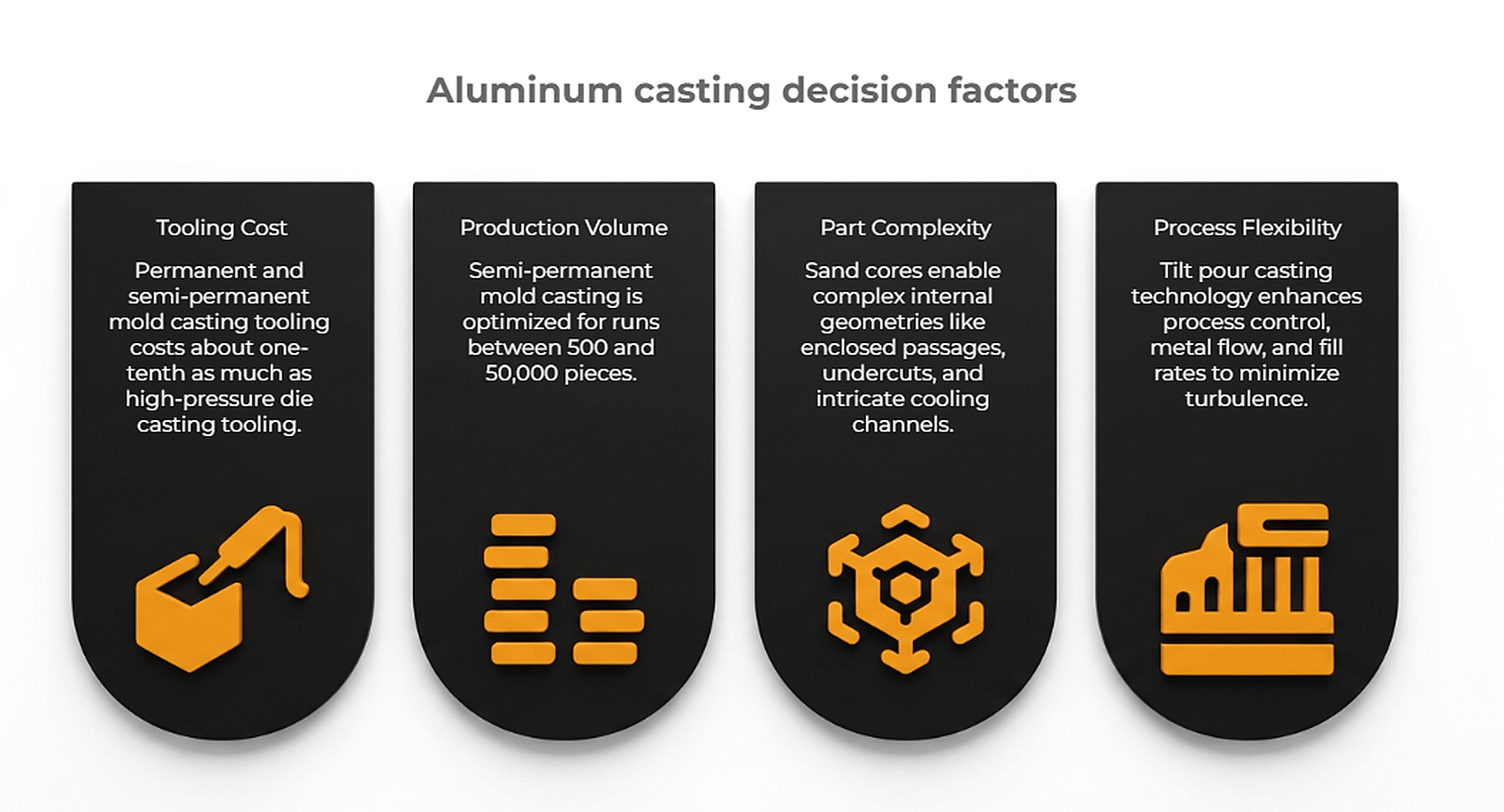
- Tooling cost: Permanent and semi-permanent mold casting tooling typically costs about one-tenth as much as high-pressure die casting tooling. This lower upfront investment makes them the preferred choice for medium-volume production, whereas sand casting’s low initial cost becomes less competitive as volume increases, and die casting’s high tooling investment cannot be amortized effectively.
- Production volume: Semi-permanent mold casting is optimized for runs between 500 and 50,000 pieces — volumes too high for sand casting’s manual processes, but not large enough to justify die casting’s tooling expense.
- Part complexity: The integration of sand cores in semi-permanent mold casting enables complex internal geometries such as enclosed passages, undercuts, and intricate cooling channels, which are difficult or impossible to achieve with standard permanent mold or die casting.
- Process flexibility: Within the semi-permanent mold category, the use of tilt pour casting technology further enhances process control and casting quality. Tilt pour casting delivers precise control over metal flow and fill rates, minimizing turbulence and defects. This method ensures consistent quality and repeatability for medium-volume production, resulting in optimal mold filling, improved surface finish, and superior mechanical properties.
Procast’s verified capabilities in this domain include in-house engineering and Solidification Analysis, an integrated Tool & Die department for custom mold and sand core production, CNC machining, ISO 9001:2015 certified quality systems, CMM inspection, and air decay and underwater pressure testing up to 150 psi. These services are delivered across production runs from 500 to 50,000 pieces annually, ensuring both cost efficiency and technical excellence.
For additional considerations regarding design complexity and potential limitations when specifying semi-permanent mold casting for intricate aluminum components, refer to our resource: Are there specific design limitations or considerations when choosing semi-permanent mold casting for complex aluminum components?
Metallurgical performance: durability, fatigue, and defect mitigation
Mechanical properties and long-term component durability
The core advantage of semi-permanent mold casting lies in the metallurgical structure it produces. Rapid, directional solidification in a metal cavity yields a fine, dense grain structure with minimal internal discontinuities. This microstructure translates directly to superior fatigue resistance, improved dimensional stability under thermal cycling, and increased resistance to crack initiation when compared to sand casting, where slower cooling and variable mold conditions introduce coarser grains and more potential defect sites.
High-pressure die casting achieves tight as-cast tolerances and smooth surfaces, but the process’s high-velocity fill often introduces subsurface gas porosity, limiting both fatigue life and the ability to perform post-cast heat treatment or welding. Semi-permanent mold castings, by contrast, exhibit lower gas content and fewer shrinkage voids, making them more robust under cyclic loading and better suited for demanding service environments.
How does the quality and surface finish of parts produced with semi-permanent mold casting compare to those made with sand or die casting?
Surface roughness is not just an aesthetic consideration; it directly impacts fatigue initiation. Semi-permanent mold casting produces a smoother as-cast finish than sand casting (160-400 RMS), reducing the number of surface sites where cracks can initiate under stress. Die casting offers the finest as-cast finish, but at the cost of increased porosity risk.
Semi-permanent mold castings consistently deliver tighter tolerances and smoother surfaces than sand castings, while maintaining superior internal soundness compared to die castings, making them ideal for applications where both appearance and fatigue performance are critical.
Are there ways to minimize casting defects or improve the overall quality of cast aluminum products?
Yes. For semi-permanent mold casting, the most effective strategies include:
- Optimized gating and riser design using predictive solidification simulation to control metal flow and feeding, minimizing shrinkage and turbulence. Procast leverages Solidification Analysis to validate and refine these parameters before tooling is manufactured.
- Controlled cooling rates through precise mold temperature management, ensuring directional solidification and fine grain development. This enhances dimensional accuracy and mechanical performance.
- Core venting and precise sand core production to evacuate gases and prevent core-related inclusions or voids. Procast’s integrated Tool & Die department manufactures sand cores to exacting standards, further reducing defect risk.
- Proactive process monitoring using ERP/MES systems to track pour temperature, cycle timing, and mold condition. This closed-loop feedback enables immediate adjustments throughout every production run.
- Rigorous quality control: CMM inspection, radiographic evaluation, and pressure testing (including air decay and underwater pressure testing up to 150 psi) verify that castings meet internal soundness and leak-tightness requirements.
Applied together, these semi-permanent mold casting techniques deliver defect-minimized castings matched to medium-volume industrial needs. Porosity criteria and dimensional tolerances are defined by engineering requirements and validated through simulation before tooling begins, so quality is built into the process rather than caught by post-process inspection.
How does the quality or durability of aluminum parts from semi-permanent mold casting compare to other methods like sand or die casting?
The semi-permanent mold process yields castings with lower porosity, finer grain structure, and higher fatigue resistance than sand casting, and avoids the gas-related defects commonly found in high-pressure die castings. This translates to superior mechanical durability and dimensional stability for demanding applications.
Surface finish follows the same pattern. Semi-permanent mold castings achieve a smoother as-cast surface (160-400 RMS) than sand castings, reducing fatigue initiation points and minimizing post-processing. Die castings may offer slightly finer as-cast finishes, but their higher porosity can compromise both appearance and structural integrity in critical applications. Semi-permanent mold casting strikes the balance between surface quality and internal soundness.
Conclusion
Semi-permanent mold casting stands out as the preferred solution for industrial buyers seeking a balance of mechanical durability, dimensional accuracy, and design flexibility. By combining the metallurgical advantages of permanent mold processes with the complexity enabled by sand core integration, this method delivers turnkey aluminum castings that outperform sand castings in fatigue life and surface quality, while avoiding the porosity and post-cast treatment limitations of high-pressure die casting. Procast’s end-to-end capabilities, including in-house engineering, advanced simulation, integrated tool and die, and comprehensive quality control, ensure that every casting meets the rigorous demands of medium-volume industrial applications.
If your project requires robust, precision-engineered aluminum or zinc components, delivered on time and to exacting standards, connect with Procast’s engineering team today. Discover how our integrated permanent and semi-permanent mold casting solutions can elevate your product’s performance and reliability.