What are the main challenges or limitations associated with using sand cores in semi-permanent mold casting?
August 28, 2026
Semi-permanent mold casting solves a problem that fully permanent tooling cannot: it produces enclosed internal passages and negative-draft features inside an otherwise rigid metal die. It does this by inserting an expendable sand core into the steel cavity. For details on this hybrid approach, see Semi-Permanent Mold Casting.
That same core, however, is the single element in the process most likely to introduce scatter, scrap, and cost. Understanding where and why sand cores fail is therefore essential for any engineer weighing the process for a cored aluminum component.
Author: Wes Parker, President and CEO, ProCast Technologies Inc.
Key takeaways
- Sand cores form the undercuts and enclosed internal passages that a rigid steel cavity cannot draw, making them both the reason to choose the process and its principal source of variability.
- The dominant failure modes — core shift, dimensional drift, breakage, gas evolution, and costly core removal — each trace back to a specific physical mechanism that can be predicted and mitigated before the tool is cut.
- Part geometry drives core complexity, and core complexity drives tooling cost and defect risk for the life of the program. CAD decisions carry forward into every casting.
Process Overview: Integrating Sand Cores into Semi-Permanent Molds
The semi-permanent mold process combines a durable steel die with an expendable sand core, grafting the internal complexity normally associated with sand casting onto the smooth external surface and rapid solidification of permanent mold. Sand cores exist because a rigid metal cavity has no mechanism to withdraw an undercut or release an enclosed internal passage; the die halves can only separate along fixed directions. The internal geometry is therefore carried by a bonded silica core that is vibrated out at knockout after the aluminum solidifies, leaving the passage behind.
This borrowed capability from the application of sand casting is the entire justification for accepting a hybrid tool: it lets a designer specify cored galleries, blind cavities, and reduced draft that a fully permanent mold could never eject. That single feature is precisely why the process is selected, and its limitations warrant equal scrutiny.
Technical Challenges: Core Instability and Structural Limitations
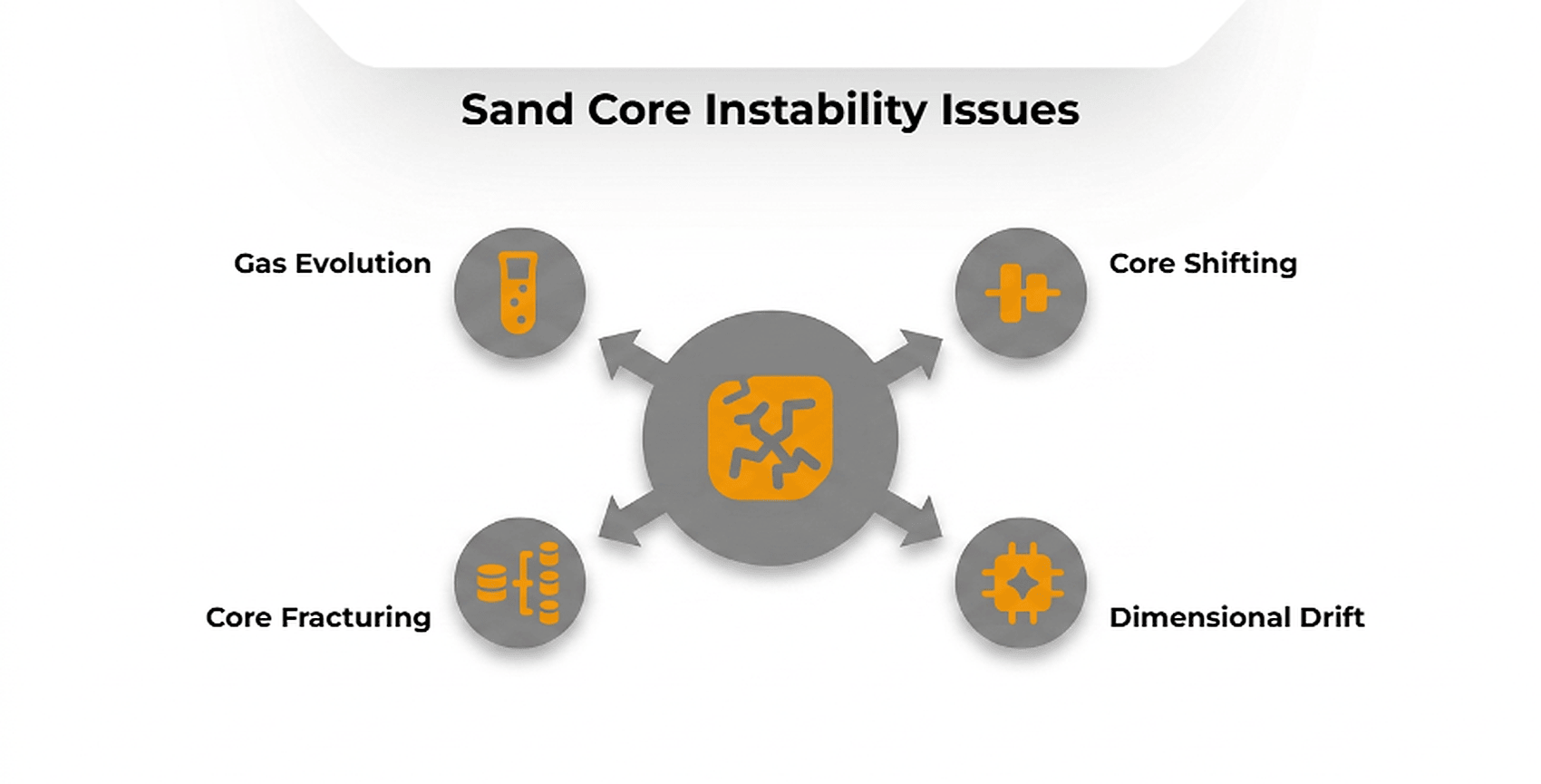
The main challenges and limitations of using sand cores in semi-permanent mold casting center on core stability: the same expendable body that forms the internal geometry can shift, drift dimensionally, fracture, or evolve gas during fill. Each behavior has a distinct physical origin, and each leaves a recognizable signature on the finished casting.
Molten aluminum is considerably denser than the bonded silica core it surrounds, so the core experiences a strong buoyant uplift the instant the cavity fills. When combined with the dynamic pressure of the incoming stream, that force floats or bends the core out of position unless the core’s anchoring at each end is sized to resist it.
The consequence is wall-thickness asymmetry — thick on one side, thin to the point of non-fill on the other. Filling the cavity gently mitigates but never eliminates this uplift, which is one reason many cored parts run on a tilt pour configuration rather than a static pour. For the mechanics of that filling method, see What is tilt pour casting?.
Even a perfectly located core does not guarantee a stable feature: as the aluminum contracts around it, the cored diameter shrinks at a rate governed by wall section, core type, and resin content. Published work on semi-permanent molds records inner-diameter shrink factors from roughly 0.006 to 0.011 in./in.
Cores can also fracture during setting or under metal inrush. Even small dislodged particles become entrained in the casting wall, one of the most common ways a cored part goes to scrap. Finally, the resin and shell binders decompose on contact with the melt, evolving gas that must escape through deliberate venting. Where venting is inadequate, that gas is trapped as porosity or blows.
These are, in effect, the classic disadvantages of sand casting — porosity, dimensional scatter, and inclusion risk — imported into an otherwise tightly controlled permanent mold. They represent the most consequential aluminum casting defects characteristic of the process.
Engineering Impact: Casting Design, Tooling Costs, and Manufacturability
Part geometry is the primary driver of core complexity, which in turn determines both tooling cost and manufacturability. Thin walls and deep undercuts demand slender, high-aspect-ratio cores that are more fragile, require more coreprints to restrain, and necessitate more venting to clear binder gas, each of which adds cost to the core box and risk to the process. Complex internal geometries and thin walls can indeed be produced with semi-permanent mold casting; that is precisely its advantage over a fully permanent tool.
But each incremental feature narrows the process window. A decision made early in CAD to route a passage through a thin section commits the program to a fragile core and its attendant defect risk for the tool’s entire life. This is why aluminum casting defects and solutions belong in the design review rather than the inspection report: the most durable designs are engineered before steel is cut. Solidification modeling predicts where the core will shift and where the last liquid will freeze, so coreprint sizing and venting can be corrected on screen rather than at first article pouring. This is where an integrated supplier changes the economics.
Procast produces its own sand cores, runs in-house engineering and Solidification Analysis, and cuts core boxes and dies within an integrated Tool & Die department. It then validates the result with CMM inspection, CNC machining, and, for pressure-containing parts, air decay and underwater pressure testing to 150 psi under an ISO 9001:2015-certified quality system. For the geometry-specific trade-offs that govern these choices, see Are there specific design limitations or considerations when choosing semi-permanent mold casting for complex aluminum components?.
Strategic Selection: Sand vs. Permanent Mold vs. Die Casting
Engineers choose between sand casting, permanent mold casting, and die casting by weighing three variables: production volume, precision requirements, and tooling cost structure, against one decisive question: does the part actually need cored internal geometry? If it does not, the semi-permanent process offers little advantage over standard permanent mold, and the disadvantages of sand casting it inherits become a pure liability rather than an acceptable cost of complexity.
Permanent and semi-permanent mold routes carry tooling costs roughly an order of magnitude lower than die casting, making them viable at medium volumes where die-cast tool amortization never pays for itself. The deciding factor remains geometry: a component with enclosed passages points toward a sand core, while a component without them rarely justifies one, especially given the porosity, drift, and removal costs the core entails.
For a detailed comparison of how semi-permanent mold casting stacks up against other methods, see How does the quality or durability of aluminum parts from semi-permanent mold casting compare to other methods like sand or die casting?.
Core shift is cheapest to correct on screen and most expensive to correct in the first article. Procast produces its cores in-house and models their behavior under fill before cutting the tool, keeping core print and venting decisions within one team.
Related reading
If you need more information on the components and industries that rely on cored permanent mold castings, see Permanent Mold Casting Applications.
Send your internal geometry for a feasibility review and we will tell you where the cores will fight you before the tool is cut.