Permanent Mold Aluminum Casting
Permanent mold aluminum casting is a pivotal process in the manufacturing sector, known for its precision and efficiency. It utilizes reusable molds, typically crafted from steel or iron, to make it highly suitable for consistent, medium- to high-volume production runs. Permanent mold aluminum casting creates high-quality aluminum components with superior surface finishes and dimensional accuracy, distinguishing itself as an economical alternative to pressure die casting.
As a vertically integrated, single-source solution provider, Procast ensures consistency and quality through every stage of the process, offering professional service, reliable on-time delivery, and competitive pricing. Procast invests continually in cutting-edge technology to provide a seamless, all-in-one solution for custom aluminum castings exceeding customer expectations.
Achieving Quantifiable Precision
The high quality and precision achieved through the permanent mold process are essential for critical components across numerous sectors, guaranteeing superior surface finishes and dimensional accuracy. Standard linear tolerances for permanent mold aluminum castings are significantly tighter than those for methods like sand casting, generally ranging from 0.010″ to 0.025″.
Furthermore, due to the rapid cooling rate achieved with durable metal molds, permanent mold aluminum casting promotes a finer grain structure in the final material, resulting in higher strength and, consequently, improved strength-to-weight ratios. Components are engineered with precise design criteria, including a preferred minimum wall thickness of 0.180″.
Procast utilizes advanced internal processes to ensure this high level of precision and quality control. Critical to this is in-house solidification analysis, an advanced technique that utilizes a virtual reality simulation to optimize the casting process. Here, pouring simulations are pre-run to proactively identify and eliminate common defects such as shrinkage, porosity, and misruns prior to producing tooling.
What is Permanent Mold Casting?
The permanent mold casting process utilizes reusable molds, typically made from steel or iron, to produce high-quality metal castings. Within the world of permanent mold aluminum casting manufacturers, it is defined by its ability to achieve precision and efficiency in high-volume production.
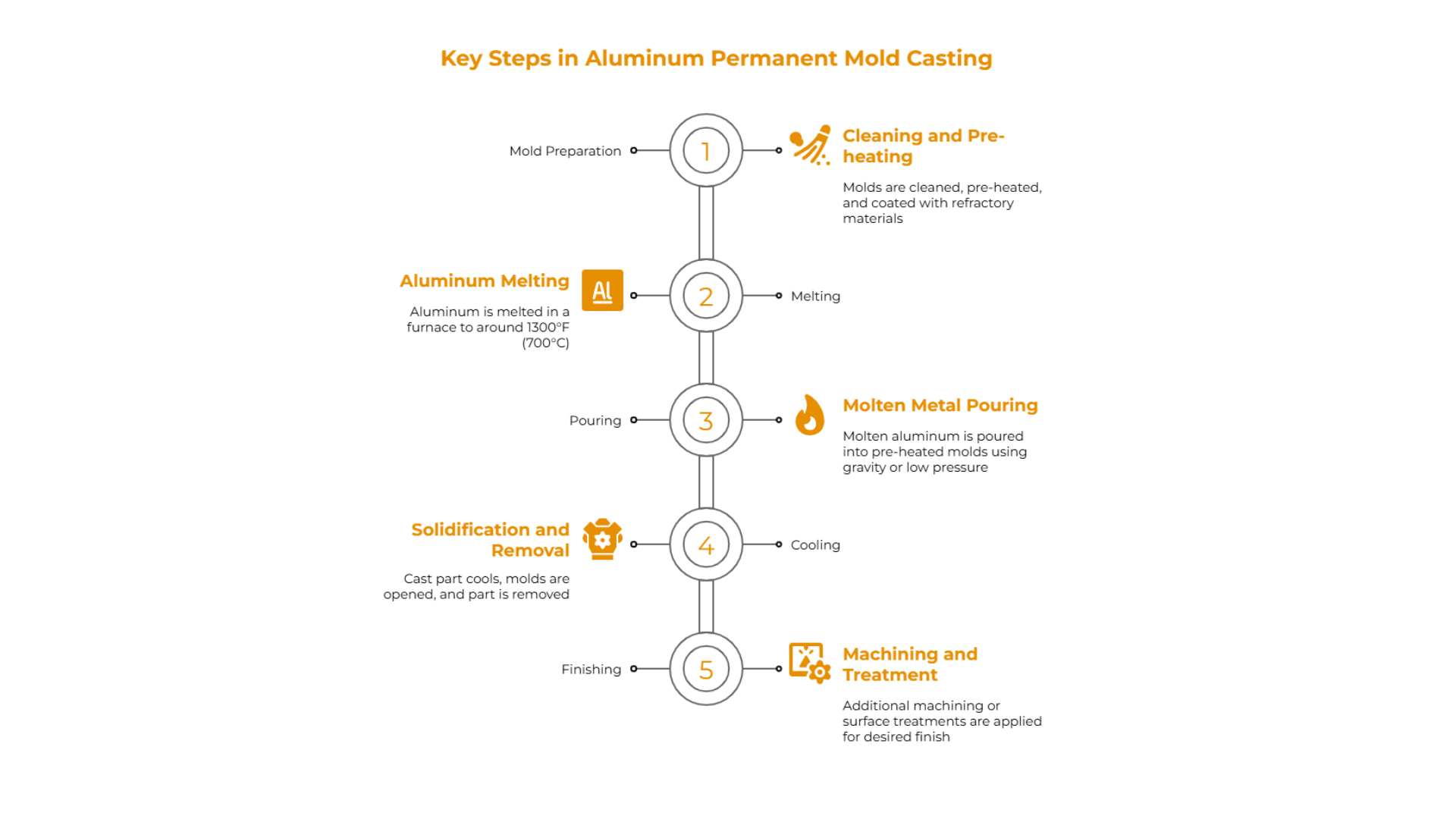
The basic process involves these key steps:
- Mold Preparation: Molds are cleaned and pre-heated, then coated with refractory materials to facilitate part removal and control solidification.
- Melting: Aluminum is melted in a furnace, reaching temperatures around 1300°F (700°C).
- Pouring: The molten aluminum is tilted or static poured into the pre-heated molds, typically utilizing gravity or low pressure, allowing for rapid solidification.
- Cooling: After cooling, the molds are opened, and the cast part is removed.
- Finishing: Additional machining or surface treatments may be applied to achieve desired tolerances and finishes.
This results in components with excellent dimensional accuracy, surface quality, and strength to weight ratios.
Advanced Process Enhancement
Procast significantly enhances these basic steps through in-house solidification analysis. This advanced technique utilizes virtual reality to pre-run pouring simulations. By identifying potential issues prior to the actual pouring, this process helps eliminate common casting defects such as shrinkage, porosity, and misruns. For more detailed insights, refer to our Permanent mold casting process blog.
What is the Difference Between Die Casting and Permanent Mold Casting?
The fundamental distinction between die casting and permanent mold casting lies in the pressure used during the mold-filling stage.
| Feature | Permanent Mold Casting | Pressure Die Casting |
|---|---|---|
| Mold Filling | Relies on gravity (or low pressure). | Uses high-pressure injection. |
| Part Size | Better suited for medium to large components. | Ideal for small, intricate parts. |
| Mechanical Properties | Provides excellent mechanical properties and surface finishes. | Faster production, but potentially lower strength due to gas entrapment. |
| Volume Suitability | Cost-effective for medium- to high-volume runs (500 to 50,000 pieces). | Best for very high-volume, thin-walled components. |
The permanent mold process offers an economical and high-quality alternative to pressure die casting, counting superior dimensional accuracy and strength-to-weight ratios among the main advantages of casting metal. Procast’s integrated operations utilize Management Execution Software to enhance efficiency and maintain precise control over production timelines.
Is Aluminum Hard to Cast?
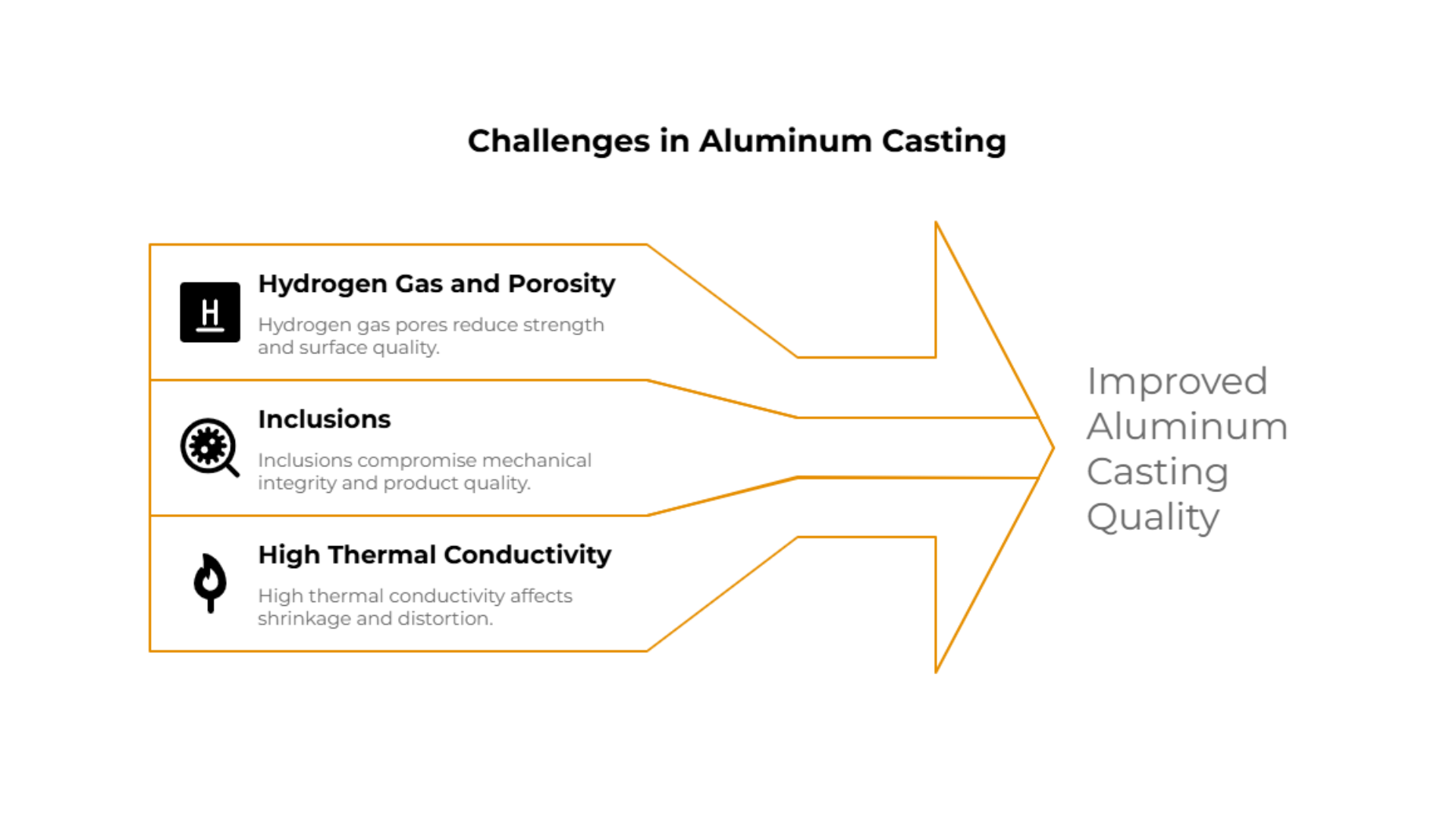
Aluminum casting presents unique challenges primarily due to the properties of the metal itself. Aluminum alloys are subject to the formation of defects and variability in properties if fundamental metallurgical principles are not strictly controlled during the melting and pouring phases.
Key challenges include:
- Hydrogen Gas and Porosity: Aluminum over solid solubility forms hydrogen gas pores during solidification. Excess hydrogen solidifies into solid solution heterogeneously and precipitates to form gas pores during solidification. These gas pores impair the strength, ductility, and cutting surface quality of the cast product.
- Inclusions: Inclusions (such as oxides, borides, and alkali elements) must be removed to assure product quality and mechanical integrity.
- High Thermal Conductivity: Aluminum’s properties require careful control of the thermal process to manage shrinkage and distortion.
To overcome these difficulties, foundries must employ rigorous molten metal processing (or refining) techniques. This includes the use of inert gas dispersion to efficiently remove hydrogen and inclusions via floatation.
Procast addresses these challenges through its vertically integrated approach. The use of advanced solidification analysis, incorporating pre-pouring simulations, is critical for identifying and eliminating potential defects like shrinkage, porosity, and misruns before they occur.
What Are Permanent Molds Made Of?
Mold material is crucial as it determines the heat transfer rate, durability, and eventual cost of the cast part. In permanent mold aluminum casting, molds are typically referred to as aluminum casting molds. The most common materials used by custom aluminum casting mold manufacturers are:
- Cast Iron or Steel: These are preferred due to their high thermal resistance and durability, making them suitable for thousands of casting cycles. They are essential for processes requiring the permanent mold casting process due to their reusability.
- Graphite: Used primarily for specialized applications requiring complex shapes and rapid heat dissipation, or for continuous casting processes.
Molds are lined with refractory coatings. These coatings serve three main functions:
- Protecting the Mold: Extending the life of the metal mold.
- Facilitating Release: Preventing the molten aluminum from sticking to the mold surface.
- Controlling Cooling: Allowing the thermal profile to be managed for optimal solidification.
The choice of mold material and coating directly affects the cooling rate, which influences the microstructure and resulting dimensional accuracy and surface quality of the final component.
Why is Permanent Mold Casting Used?
Permanent mold casting is favored across diverse sectors because it offers a combination of high quality, efficiency, and cost-effectiveness for medium-to-high production volumes.
This manufacturing method has become a cornerstone process in modern manufacturing due to its ability to consistently produce components that meet stringent quality requirements while maintaining economic viability. Unlike sand mold processes, permanent mold casting utilizes reusable metal molds that can withstand thousands of casting cycles, making it particularly attractive for manufacturers seeking to balance initial tooling investments with long-term production efficiency.
The process excels in applications where dimensional precision and mechanical integrity are non-negotiable. Permanent mold aluminum casting manufacturers utilize metal molds—typically constructed from steel or iron—that provide superior heat transfer characteristics compared to sand molds, resulting in faster cooling rates and finer grain structures in the cast components. This translates directly to enhanced mechanical properties, including improved tensile strength and better strength-to-weight ratios, which are critical factors in industries such as automotive, aerospace, medical equipment, and defense.
From an economic perspective, permanent mold casting occupies an optimal position in the manufacturing spectrum. While the initial tooling costs are higher than sand casting, the reusability of the molds and reduced need for secondary machining operations make it highly cost-effective for annual production runs ranging from 500 to 50,000 pieces. The process minimizes material waste and labor costs associated with mold preparation, as the same mold can be used repeatedly with only periodic maintenance and recoating.
Industries choose permanent mold casting when their applications demand consistent quality across multiple production runs, superior surface finishes that reduce finishing operations, and the ability to maintain tight tolerances without extensive post-processing. Understanding the various types of permanent mold casting available—including gravity permanent mold, low-pressure permanent mold, and tilt-pour methods—allows manufacturers to select the most appropriate technique for their specific component requirements. The method is particularly well-suited for components that require pressure-tight integrity, structural reliability under stress, or aesthetic surface quality—requirements that are common in fluid handling systems, transmission components, electrical housings, and structural parts for transportation equipment.
Permanent Mold Casting: Key Advantages and Applications
Permanent mold casting is favored across diverse sectors because it offers a significant combination of quality, efficiency, and cost-effectiveness for medium-to-high production volumes. This method allows for the creation of high-quality aluminum components with superior surface finishes and dimensional accuracy.
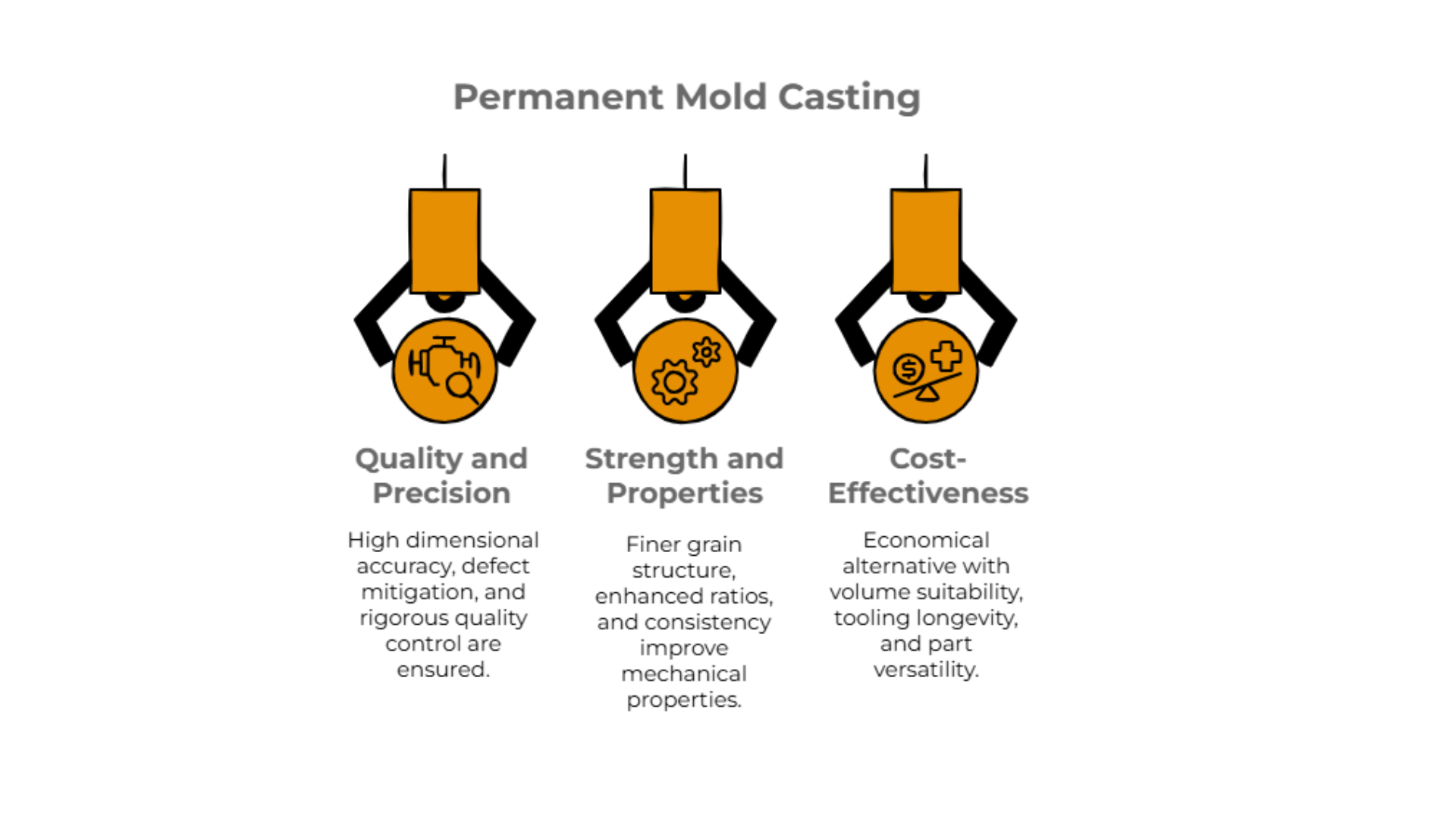
I. Superior Quality and Precision
The permanent mold aluminum casting method provides superior surface finishes and dimensional accuracy compared to other techniques, such as sand casting. This precision is quantifiable through adherence to strict industry standards and advanced quality assurance practices:
- Dimensional Accuracy and Tolerances: Permanent mold aluminum casting is suitable for applications requiring exact specifications and tight tolerances. Industry standards for minimum linear tolerances typically range from 0.010″ to 0.025″. Preferred minimum wall thicknesses are around 0.180″.
- Defect Mitigation: The process is enhanced by utilizing in-house solidification analysis that incorporates virtual reality to pre-run pouring simulations. This advanced technique ensures that casting defects like shrinkage, porosity, and misruns are effectively eliminated before the actual casting process begins.
- Rigorous Quality Control (QC): Quality control measures, including pressure testing, are crucial for industries requiring reliability. Procast offers advanced testing to ensure supplied castings meet intended pressure requirements.
II. Superior Strength and Mechanical Properties
The high strength and mechanical properties achieved by permanent mold casting result directly from the physics of the process:
- Finer Grain Structure: The relatively rapid cooling rate achieved with metal molds promotes a finer grain structure.
- Enhanced Ratios: This finer-grain structure leads to higher strength and strength-to-weight ratios in the final component.
- Consistency: The permanent mold process, whether using tilt-pour or static pour methods, guarantees exceptional quality and consistency in the final aluminum castings.
III. Cost-Effectiveness and Volume Suitability
- Permanent mold aluminum casting offers a high-quality, economical alternative to processes such as sand casting.
- Volume Range: This method is perfectly suited for medium annual volumes ranging from 500 to 50,000 pieces, making it efficient and cost-effective for these production runs.
- Tooling Longevity: Although initial tooling costs are higher than those for aluminum sand castings, the longevity of reusable metal molds makes permanent mold aluminum casting cost-effective for medium- to high-volume production.
- Part Versatility: The process is capable of managing parts ranging in size from ounces to hundreds of pounds.
Diverse Industries Served
Permanent mold aluminum casting serves critical applications across transportation and mobility sectors. The automotive aftermarket relies on this process for engine parts and transmission housings, where reliability and high-quality materials are paramount. Heavy-duty trucks are increasingly utilizing aluminum castings, as the transport sector embraces lightweight solutions to address environmental concerns and fuel efficiency demands.
The railway industry employs permanent mold casting for high-speed trains that require aluminum’s lightweight structural properties, while the marine sector benefits from tailored casting solutions, including components for aluminum-intensive fast ferries. Recreational vehicles and the power sports aftermarket similarly depend on custom aluminum castings that deliver durability and performance.
In industrial and manufacturing environments, permanent mold aluminum casting provides components for equipment that must withstand rigorous operating conditions. This category benefits from the tight tolerances and superior mechanical properties inherent in the process. Materials handling systems, agricultural equipment manufacturers, and power transmission applications all utilize permanent mold solutions when consistent quality and structural integrity are essential. Office furniture manufacturers apply this process to create components that combine functional strength with aesthetic requirements.
Specialized and high-reliability sectors represent another significant application area for permanent mold aluminum casting. Medical equipment components demand exceptional precision and rigorous testing, including pressure testing up to 150 psi, to ensure patient safety and regulatory compliance.
The electrical and lighting industries leverage aluminum’s inherent material properties through permanent mold casting. Electrical transmission and distribution applications value aluminum as an excellent conductor of heat and electricity, where it competes with copper due to its significantly lighter weight.
Lighting manufacturers benefit from aluminum’s extreme resistance to heat when exposed to direct sunlight and other high-temperature environments. This makes permanent mold castings ideal for fixtures and housings that require both thermal management and structural integrity.
The versatility of types of permanent mold casting available, along with permanent mold aluminum casting manufacturers like Procast, ensures that this process remains essential for complex, demanding applications.
What is the Difference Between Sand Cast and Permanent Mold?
The primary difference between sand casting and permanent mold casting is the material used for the mold and its subsequent reusability.
| Feature | Sand Casting | Permanent Mold Casting |
|---|---|---|
| Mold Material | Consumable sand mixtures. | Reusable steel or iron. |
| Accuracy | Lower; requires more machining. | Superior dimensional accuracy. |
| Surface Finish | Rough texture. | Smooth, high-quality finish. |
| Part Geometry | Good for extremely large shapes. | Ideal for high-density components. |
For manufacturers, making the correct choice is pivotal for optimizing quality, cost, and production efficiency. Where high strength and minimal dimensional deviation are critical, metal molds used in permanent mold aluminum casting are the preferred choice.
Is There a Difference Between Aluminum and Cast Aluminum?
- Yes, there is a distinct difference between “aluminum” (the pure element or base alloy stock) and “cast aluminum” (a fabricated component derived from an alloy that has undergone the permanent mold casting process).
- Aluminum (Pure/Wrought Alloys): Refers to commercially pure aluminum (AA 1xxx series) or alloys that are generally formed in their solid state through processes like rolling, forging, or extrusion (wrought alloys).
- Cast Aluminum (Casting Alloys): Refers to alloys specifically formulated with elements like silicon, copper, or magnesium to enhance their fluidity and minimize shrinkage during solidification (e.g., AA 3xx series). These materials are defined by the process they undergo (such as the permanent mold process), and are known for their enhanced strength and density compared to sand-cast materials.
These differences impact their use in manufacturing; cast aluminum is ideal for complex geometries that require excellent mechanical properties in three dimensions, while wrought alloys are selected for applications that prioritize specific deformation characteristics or formability.
What is the Minimum Tolerance for Casting?
Tolerances in casting refer to the permissible variation in the dimensions of a finished part. Maintaining tight tolerances is essential because it minimizes the need for costly secondary machining and ensures component fit and function.
Significantly tighter tolerances can be achieved in permanent mold aluminum casting when compared to sand casting. This is primarily due to the dimensional stability of the reusable metal molds, which are typically made of steel or iron.
Precision and Industry Standards
For Permanent Mold castings, the precision achieved is a key advantage, providing superior surface finishes and dimensional accuracy.
- Industry Standard Linear Tolerances: The standard minimum linear tolerances achieved in permanent mold casting are generally between 0.010″ to 0.025″ .
- Design Criteria: Beyond linear tolerances, design criteria for permanent mold castings include a preferred minimum wall thickness of 0.180″ and preferred minimum draft angles of 3 degrees.
Procast’s Role in Meeting Rigorous Tolerance Requirements
Procast leverages its vertical integration and advanced technology to ensure high quality and consistency, allowing it to meet and exceed rigorous tolerance requirements.
- In-House Tooling Design: Achieving perfect precision begins with custom tooling solutions provided through in-house tooling design and manufacturing.
- Advanced Analysis and Defect Elimination: Procast utilizes advanced solidification analysis to optimize the casting process. This involves pre-running pouring simulations using virtual reality, which is critical for identifying and eliminating potential defects such as shrinkage, porosity, and misruns before they occur. Since these defects cause dimensional variation, their elimination leads to higher precision.
- Post-Processing Accuracy: Tighter tolerances than the minimum standards (0.010″ to 0.025″) can be achieved through CNC machining. Procast provides unparalleled accuracy and quality using state-of-the-art CNC machining services.
4. Quality Control and Testing: To ensure functional integrity related to dimensional accuracy, Procast performs rigorous quality control. Pressure testing techniques, such as air decay and underwater testing, ensure that supplied castings meet the intended pressure requirements of up to 150 psi. Also, CMM Metrology inspections ensure all dimensions are within tolerance.
This rigorous testing is critical for high-reliability components, such as those used in the medical
equipment industry as well as a multitude of others.
Frequently Asked Questions
What are the advantages of using permanent mold aluminum casting at Procast?
At Procast, our permanent mold aluminum casting offers several advantages:
- We provide a seamless all-in-one solution, ensuring efficiency and quality throughout the process.
- Our in-house capabilities, including tooling, heat treating, and CNC machining, guarantee precise results without subcontracting.
- Advanced simulation techniques like Solidification Analysis help eliminate defects before production, ensuring superior quality.
How does Procast ensure quality in permanent mold aluminum casting?
Quality assurance is integral to our permanent mold aluminum casting process:
- We utilize cutting-edge technology, including real-time systems to monitor processes continuously.
- Our inspection ensures every casting meets rigorous specifications.
- In-house engineering teams conduct thorough assessments, ensuring compliance with industry standards, especially in regulated sectors like medical and defense.
Can Procast handle custom designs for permanent mold aluminum castings?
Yes, Procast specializes in custom designs for permanent mold aluminum castings:
- Our in-house engineering team collaborates closely with clients to develop tailored solutions.
- We use advanced simulation technology to refine designs before production.
- This approach allows us to adapt quickly to specific requirements, ensuring optimal performance and efficiency.
What industries does Procast serve with permanent mold aluminum casting?
Procast serves a wide range of industries requiring high precision and regulatory compliance:
- Medical, defense, explosion-proof applications, electrical, process monitoring, power transmission, and compressor manufacturing.
- Our expertise ensures compliance with stringent safety and quality standards.
- This specialization allows us to deliver innovative and reliable solutions.
How long does the permanent mold aluminum casting process take at Procast?
The timeline varies based on project complexity:
- We prioritize efficiency while maintaining quality, often completing initial prototypes quickly.
- In-house engineering, tooling, and machining streamline production.
- For precise timelines, project details should be reviewed with our team.
What is the role of simulation technology in Procast’s aluminum casting process?
Simulation technology plays a critical role in our casting process:
- We use Solidification Analysis to predict and mitigate defects before production.
- This approach reduces waste and rework.
- Advanced technology ensures consistent, high-quality, defect-free products.
Does Procast offer heat treating services for permanent mold aluminum castings?
Yes, Procast offers comprehensive heat treating services:
- In-house heat treating ensures optimal mechanical properties.
- This enhances durability and performance for demanding applications.
- Keeping all processes in-house maintains strict quality control.
How does Procast manage project collaboration with customers during the casting process?
Procast prioritizes collaboration throughout the casting process:
- Engineering teams work closely with clients from initial design onward.
- ERP systems (JobBOSS) provide transparency and real-time production updates.
- AI-based CNC and casting cell monitoring optimizes production flow and responsiveness.
Unlock the full potential of your manufacturing processes with our comprehensive guide on Permanent Mold Aluminum Casting here at Procast! Dive deeper into the benefits, techniques, and innovations in this essential casting method. Click here to explore our in-depth resources and elevate your expertise today!